
My garden has experienced some losses recently. About two weeks ago, as I was awaiting the landing of my Oregon Duck who was to visit for a couple of days before flying further afield and across The Pond to study abroad in the UK, I was strolling in my back garden watching an oddly acting squirrel. He was sitting on a branch, just under the Screech Owl brood house, in a nose-down position. He was quite a handsome fuzzy-tailed rodent and he sat for a long time. I attempted communication, to which he didn’t respond, but suddenly, he crawled up the trunk of the tree and into the brood house. I was gobsmacked. Never would I guess that a healthy squirrel would risk a confrontation with an owl like that. I heard Mamma Owl clicking her beak at him in protest and warning, saw flashes of her feathers through the hole, and then witnessed her fly out of the house and land on the nearby Retama tree.
Poor Mamma Owl.
She was clearly confused and agitated as she sat in the tree, but she didn’t fly back to her brood house. I quickly retrieved our ladder, climbed aboard, and stuck a stick into the hole, thinking that if the squirrel was there he’d chatter at the stick and exit. Neither happened. I don’t know if he ran out of the hole as I was fetching the ladder or was in hunkered down in the house, keeping quiet. I fear it was the second. Unfortunately, I didn’t see Mamma Owl for the rest of the evening.
The next morning, the squirrel was on the ground and I noticed that he couldn’t move properly–his back legs were partially paralyzed when he crawled. Though he didn’t move well or quickly, I followed him hoping to get a better look and to check for any obvious injuries, which I didn’t see. Meanwhile, Mamma and Dad Owl were in the Mountain Laurel, awake and alert. The Mountain Laurel is where Dad rests during the days that Mamma is in the brood house with the eggs. As I was squirrel-watching, Mamma flew to the brood house, stuck her head into the house, tail feathers sticking out unceremoniously; she stay there, tail feathers out, for about five minutes, then she settled into the brood box for the day. I lost track of the squirrel when he crawled under some ground cover–and didn’t see him again.
I thought that all was well since Mamma was in the house every time I looked that day, but, in fact, that day was the last time I saw Mamma in the house, which means that the eggs or hatchlings ceased being cared for. What I now believe is that the squirrel stayed in the house overnight and the owls couldn’t tend to their offspring. After checking the brood the next day, the parents abandoned their brood.
I fretted about it and hoped that I’d see or hear the owls–but didn’t for well over a week. A return call from an Audubon Society owl expert confirmed my suspicion: the owls abandoned their brood. I’d read that Screech couples will sometimes breed again if their brood is lost and the Audubon person suggested that we clean out the brood house. There is a possibility, though not a probability, that the couple could breed again and re-nest before it’s too late in the year. So Husband climbed up, cleaned out, and added fresh sawdust and leaves in the brood house.
These are the four little eggs that we recovered from the abandoned nest. 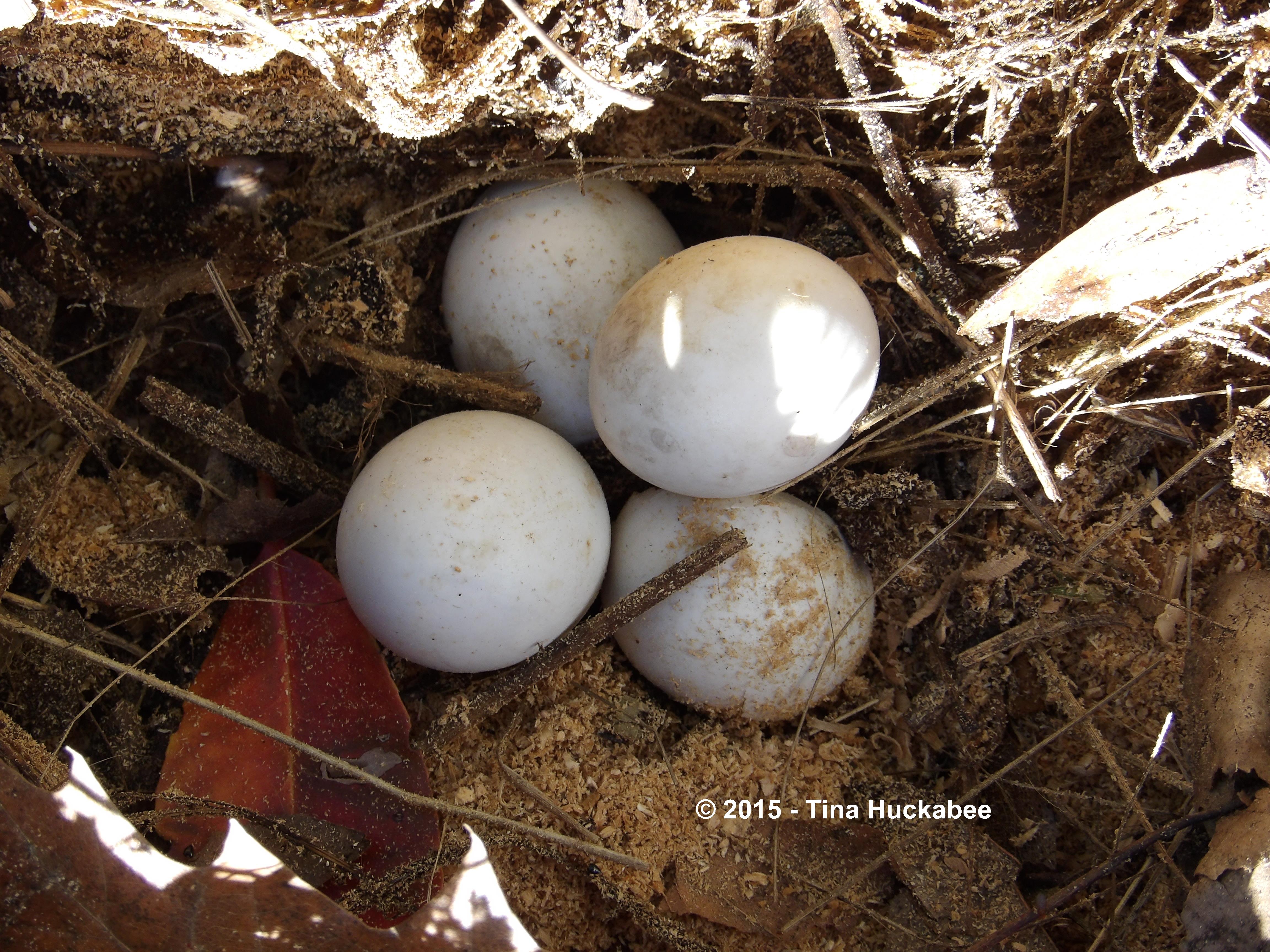
Sob.
More than likely, there will be no little owlets this spring in my garden. I’m sure the toads and other prey are breathing a sigh of relief, but I’m disappointed. I have heard Dad Owl and seen the bereft couple once or twice in a neighbor’s tree, but I’m realistic and believe that their chance to raise a family is finished for this year.
Additionally, in my fervor to keep my bee hives healthy (which they’ve been) and check for swarming signs (which there were), I think I may have rolled both queens in both hives.
This is just not my spring for fostering critters.
I’ve checked the entire set of boxes (three for each hive) regularly these past weeks and with Warre hives, rolling bees between the comb (squishing is another way to describe this), is a thing that can happen and in fact, did happen last year. You think I would learn from prior mistakes. Sheesh! I have an emergency order for two queens and am hopeful that I can introduce them successfully soon, therefore saving the hives. Well, it’s really the new queens who will save the hives with prodigious egg laying and reproduction for the next generation. I’m only the facilitator of the event.
Fingers crossed.
For personal reasons, I’ve pulled my participation in the 2015 NxNA Garden and Artisan Tour this coming Saturday, May 2nd. If you live in Austin, please consider buying a ticket ($10) for this fun community event. All proceeds go to support Walnut Creek Metro Park and McBee Elementary School–good causes both. The $10 allows entry into private and community gardens. What a deal!! The private gardens are practical and doable home gardens designed, planted, and loved by their owners. The gardens on tour and their attendant and enthusiastic gardeners should inspire visitors to create, grow, connect : for wildlife, for water conservation, and for preservation of green space.
Go out, tour the gardens, support community, and have fun!