Tree Following, May 2016: Waiting for Blooms

Thanking Lucy at Loose and Leafy for hosting the fun Tree Following meme, we’re checking in today on our chosen trees. My Retama, Parkinsonia aculeata, leafed-out fully this past month, providing a respite for this Red-winged Blackbird during his visit to my garden.

IMGP7116.new  IMGP7117_cropped_3171x3167..new

No longer just a display of green bones that are trunk and limbs,

IMGP7361.new

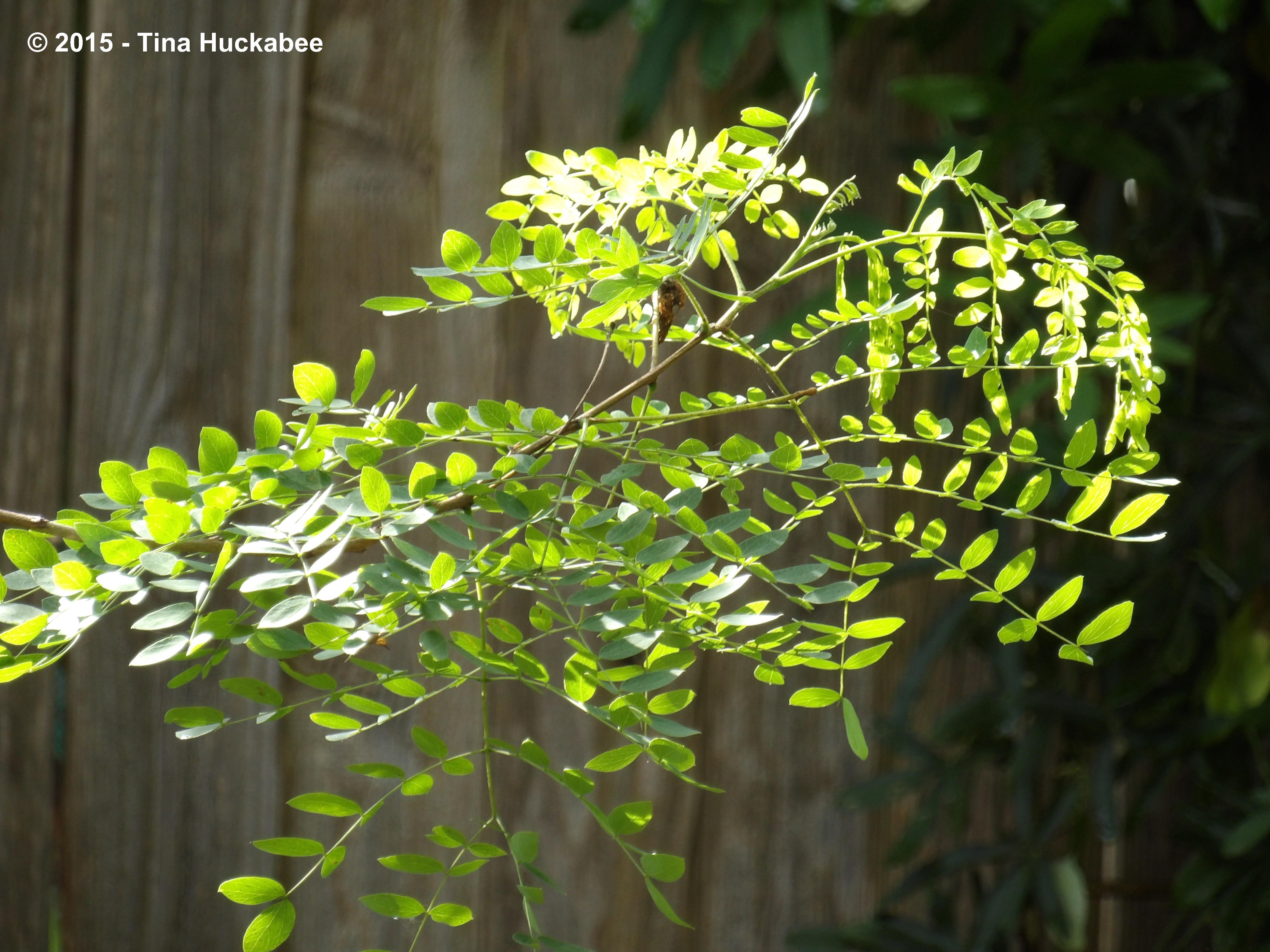
…the tiny, flat leaflets formed along the paired stalks and sport a spring green that is most welcome in my garden.

IMGP7355.new

The fine foliage is lacy against the sky.

IMGP7353.new

IMGP7360.new

The tree fills in a space between the backdrop of neighbors’ trees and my own Shumard Oak,  Quercus shumardii.  Those blasted electric lines traverse the foliage.

IMGP7357.new IMGP7555.new

I guess I shouldn’t complain about the lines though, should I?  After all, I couldn’t very well write about Retama and hit “send”  without them.

IMGP7358.new

The Retama is lovely in any light–I’m so glad I have one in my garden and that I chose it to follow this year.

IMGP7359.new


In the past week, look what’s happened!IMGP7615_cropped_3612x2691..new

Blooms!!IMGP7642.new

Just a few for now and they are clustered together in the topmost foliage, but soon the flowers will appear all over the tree and pollinators of all stripes and wings will visit.   It’s been windy here recently, so good photos are tricky.

As this week is National Wildflower Week in the U.S. I think it’s appropriate to laud the Retama’s beauty and appropriateness in its native range.  Retama is a native small tree/shrub to Texas and a bunch of other places throughout North and South America.   It is an arid climate plant, thriving in dry, hot conditions and a valuable plant in many ways–medicinally, and scientifically, as well as being important for erosion control and soil reclamation.

But the Retama, P. aculeata,  has also proven invasive and a problem plant for many areas where it has been introduced.  Australia has banned it entirely because it’s become such a noxious weed. Retama escapes from controlled cultivation, probably by birds which spread the seeds, and becomes weedy in natural ranges. IMGP7556.new

I think this is a good reminder that where a plant is native, there are controls and conditions to keep the plant “in check.”  The Retama in my garden belongs here, in my garden.   It is a native plant to the region in which I live and garden, and a fine addition for its beauty, its water-wise characteristics, and  its ability to thrive in the hot summers. Additionally, it’s also a great wildlife plant.   But in places where it is introduced and has invaded, problems arise.  Retama spreads and grows rapidly, forming thickets and native plants cannot complete, thus the Retama is responsible for declining flora diversity. It causes problems with livestock (because of its thorns) and spreads profusely when there is plenty of soil moisture.

Because we love of plants, gardeners should be cognizant of how our plant choices impact our home region.  When we can do, we should choose native plants and wildflowers to help beautify our world and assist wildlife, but we should also encourage and lobby nursery businesses to supply native plants so that we have choices.  When we totally fall in love with a non-native plant and must have it–and that’s happened to all of us–we should learn about the plant and take care that it isn’t invasive and won’t harm our local environment.

IMGP7122.new

Thanking Lucy again for Tree Following–pop over and learn about trees from all over the world.  Enjoy!

Wildlife Wednesday, May 2015

Bees, beetles, butterflies, birds, blooms–all are the big Bs of wildlife gardening and my garden was chock full of them this past month.  Welcome to Wildlife Wednesday, celebrated on the first Wednesday of each month by and for gardeners who cherish wildlife in their gardens.

It was the good, the bad and they ugly in my gardens this past month.  A crew of icky aphids set up an all-you-can-eat diner on the foliage of some of my Frostweed, Verbesina virginica.  I’ve never seen the Frostweed host these damaging insects before–until this spring.

IMGP7322_cropped_3230x3277..new

I hit the foliage with a stream of water three different times within the span of a few days to knock off the aphids and by then, the good guys, Lady Bird Beetles like this Seven-spotted Ladybird BeetleCoccinella septempunctata, and their larvae moved in for the kill.IMGP7318.new Or, rather, the meal.

The adults eat, but their larvae, typical of all kids, eat more. These little alligator-looking Ladybird Beetle larvae contentedly munched away at their favored food, the squishy, juicy aphids.

IMGP7321_cropped_3577x3277..new

The aphids are gone now, thank goodness, and the Frostweed is on its way to  its autumnal glory.

Lady Bird beetles have made themselves at home on other plants too–presumably because what they eat (like aphids) have been abundant this spring.  They hunted on the wildflower, Lyreleaf Sage, Salvia lyrata, 

IMGP6853_cropped_4143x2737..new

…where you can see the aphids amidst the eating beetle.   I’ve also seen plenty on fennel which I plant primarily for the Black Swallowtail, Papilio polyxenes, butterfly larvae, like this well-fed beauty.

IMGP7325.new

Once the Ladybird Beetle larvae eat-n-grow and complete their four larval molts, they pupate, like this one,

IMGP7327_cropped_3032x3175..new …to become adults, like these two.

IMGP7314.new

IMGP7184.new


Last month, I identified this excellent garden companion, the Horsefly-like Carpenter BeeXylocopa tabaniformis.

IMGP6895_cropped_3485x3111..new IMGP7007.new

I’m charmed by these bees–they possess a je ne sais quoi, which is unexpected in a bee.

IMGP7140.new

These native bees are common in my gardens, working blooms from sunrise to sunset.

IMGP7043.new

I love watching them in my garden, though I’ve had trouble photographing them because they’re so active–zooming up, down, and all around.  I’ve finally captured a couple of good shots and would you take a look at those baby-blue eyes,

IMGP7144.new

…and that cute face,

IMGP7003.new

…especially when playing hide-n-seek with me.IMGP7147.new

I think Paul Newman would be jealous of their beautiful peepers.

Bees are the bomb in any garden. This native Sweat Bee, maybe a Augochloropsis metallica(?), was only willing to show her abdomen while she pollinated a native wildflower, a SpiderwortTradescantia, ssp.IMGP7016.new


But the Metallic Green bee, Agapostemon texanus, on the open WinecupCallirhoe involucrata, worked intently and not shyly while gathering pollen for her offspring and nest.  She  performed admirably for me and my camera.

 IMGP7544.new

IMGP7547_cropped_3364x3341..new

IMGP7548_cropped_3313x3322..new

I particularly like this shot.  Head stuck deep in the pollen center of the flower, with only the abdomen and splayed back legs visible.  There’s also a tiny companion ant on the flower.IMGP7553.new

I gave up on an identification of this pollen-covered bee, though I suspect it’s some kind of carpenter bee.  The medium to large size, dark/black coloring and relatively hairless body are good general descriptors of carpenter bees.

IMGP7079.new

IMGP7067_cropped_3443x2622..new IMGP7075_cropped_3047x3267..new

IMGP7070_cropped_3327x2728..new

I watched her crawl around the blooms of a Globe MallowSphaeralcea ambigua, one Sunday afternoon and was impressed at the amount of pollen she gathered on her body.  How does she fly and see with all that stuff on her body and in her eyes?IMGP7076_cropped_3331x3327..new

IMGP7084_cropped_4161x2575..new

IMGP7085_cropped_4036x2608..new

If you know what this bee is, give a holler; I’m stumped, but glad she’s visited!

I think the wildlife plant-of-the-month award goes to the Engelmann or Cutleaf Daisy, Engelmannia peristenia.  It’s currently serving as Syrphid Fly central,

IMGP7493_cropped_3770x3396..new

IMGP7504.new

…providing nectar for the adults,  also known as Flower or Hover flies, and aphids for the larvae, which are little green to creamy-yellow worms.IMGP7501_cropped_3839x3323..new

These are beneficial insects, so you want them visiting your gardens.IMGP7495.new

Besides, look how pretty they are–both the flowers and the insects.

This guy,

IMGP7499_cropped_3236x3391..new

…a “true bug” or Hemiptera and in the Family Coreidae or Leaf-footed bug, is a Spot-sided Coreid, Hypselonotus punctiventris, and also liked my Engelmann Daisy.  I don’t think he’s someone I really want on my plants, though it looks to me like he’s in a nectar-sipping mode, rather than a sucking-the-life-out-of-the-plant mode.

IMGP7500.new He’s dashing in his brown tuxedo.

The Engelmann Daisy in my garden has attracted Ladybird Beetles and their offspring and at least five types of bees, as well as visits from butterflies.  It’s a good wildflower and wildlife plant.  Since it’s National Wildflower Week, I think Englemann Daisy deserves a huzzah! for its usefulness and beauty in the home garden.

IMGP7621.new

Of course butterflies are happenin’ pollinators this month, as well.  This pretty Gray Hairstreak, Strymon melinus, appears to enjoy the nectar benefits of the native wildflower, Zexmenia, Wedelia hispida.  The host plant for the Grey Hairstreak includes mallow and pea family plants, but the adults will nectar on a variety of blooms.

IMGP7329.new IMGP7331.new

IMGP7333_cropped_4221x2746..new

This attractive butterfly, a Mournful DuskywingErynnis tristis, doesn’t look particularly mournful to me.

IMGP7346_cropped_2631x2954..new

In fact, this little fella looks as if he’s challenging me because I’m wanting him to pose prettily.

IMGP7347_cropped_3506x2866..new

Or maybe I disturbed his smooth-moves with a lady-friend.

IMGP7348_cropped_3723x3064..new

The host plant for his kind includes a variety of oaks and they breed in Texas three times per year.  I’ll leave you to it, M. Duskywing–I like seeing you and your bunch around my gardens during the summer.

I observed a bird that I’d never seen before, flitting between my Shumard Oak tree, just above where my honeybee hives are located, and a neighbor’s tree.  Because he was shy, this was the best photo I could get.  Look at that color!!IMGP7523_cropped_3410x2824..new

This gorgeous thing is a juvenile male Summer TanagerPiranga rubra, and is North America’s only truly red bird. They breed in Texas, though I’ve never seen one before; it may have been passing through or perhaps he lives in a nearby area. I wondered aloud why he kept returning to the oak tree and The Husband offhandedly suggested that maybe the Tanager eats bees.   I whipped out my phone and checked the Cornell Ornithology Merlin app and read about this eye-poppingly beautiful bird.  Indeed, they hunt bees and wasps! They catch the bee as they fly (both bee and bird), hit the bee on a branch (ouch!!) to kill it, remove the stinger and chow down on bee/wasp.  My poor honeybees–that’s why the bird was hanging around! But that’s the natural world–not necessarily pretty, tidy and well turned out, but always interesting.

I hope your gardens benefitted from wildlife visitors this month and that you will join in posting for May Wildlife Wednesday. Share the rare or mundane, funny or fascinating, beneficial or harmful critters you encounter. When you comment on my post, please remember to leave a link to your Wildlife Wednesday post so readers can enjoy a variety of garden wildlife observations.

Happy wildlife gardening!


If You Plant Them, They Will Come

I’m always amused when someone says to me, Oh, your gardens are so pretty.  It must take a lot of time….  The reality is that while those same people are mowing, watering and edging their pointless lawns, or hiring some company or individual to do so, I’m sipping my coffee, or whatever, and enjoying the native plants in my gardens–as are the wildlife who are attracted to those plants.

IMGP7528.new

Wildflower and native plants gardens are beautiful and require less work than traditional “yards” of turf.  Additionally, wildlife of all sorts will visit and set up house–because they evolved with natives and generally prefer native plants above others.  Gardeners who plant with natives and wildflowers, instead of introduced plants or turf, help heal the Earth.  A well-designed native and wildflower garden is a balm to the gardener, to people who visit the garden and to wildlife which is threatened by habitat destruction.

IMGP7607.new

Celebrate National Wildflower Week and plant some wildflowers in your garden. Heck, just make your whole plot of land native plants and wildflowers.

IMGP7606.new

Wildflowers work:  they’re beautiful, easy, and support wildlife.

IMGP7519_cropped_3014x3263..new