Waiting

It’s been a week or so since I last saw a hummingbird in my garden. Perhaps I haven’t been out at the right time or maybe Ms. Hummer isn’t around at the moment.  She’s probably a nesting female, busily tending her little ones somewhere nearby.

When I last observed, there were two hummers: two females, pursuing one another from Turk’s cap blossoms to Mexican orchid tree blooms, with a quick turn about the sunflowers.  Continuing the chase, they zoomed off, heading away from my garden.  Now, I’m waiting to see either one, or both, again.

Not long ago, I bumbled out the door while Ms Hummer was slurping at the salmon blooms of the Red yucca, Hesperaloe parviflora.  She darted up and settled onto the Desert willow, Chilopsis linearis, whose foliage is lacy over the front garden.

She rested, alert but relaxed, waiting for me to exit the area.   I snapped some shots while she posed prettily.  She eventually grew tired of my presence and sped to another place, presumably where no one was taking her photo.

This begins the time of year when the hummingbirds are most active in my garden.   No doubt, I’ll see the females again, but I’ll also begin seeing the males, especially in August and September, as they prepare for their journey south.

To garden with wildlife is all about waiting:  waiting for the right moment to feed, to forage, to observe, to photograph.

I’m pleased to join again with Anna and her Wednesday Vignette.   Check out her blog, Flutter and Hum, for musings of various sorts.


Peanut Party: Wildlife Wednesday, July 2019

In my garden, I’ve never hung loads of feeders.  I’ve limited the feeder frenzy to one, occasionally two, black-oiled sunflower seed feeders at any point in time, augmented during the cool season with one feeder for commercial suet cakes.  Recently I began offering peanuts at my backyard bird buffet.  Peanuts are power food for birds.  Packed with fat and protein, as well as plenty of other avian-appropriate nutrients, peanuts pack a punch for bird nutrition, and often, for the bird-lover’s pocketbook.

Last summer I began filling a ceramic pot I’d made with unshelled peanuts.  The pot was originally crafted for a succulent (I even placed a hole in the bottom for water drainage), but I decided that, given my poor history of watering container plants and especially where I placed the pot, that it might make a more successful  bird feeder.

The Blue Jays, Cyanocitta cristata, squawked, flapped their feathers, and applauded–and then they ate!  Now, each morning, bleary-eyed and before coffee, I pop a couple of handfuls of peanuts in the little square pot and the jays have at it. There’s usually at least one Jay in the tree under which the pot sits, waiting patiently for me to deliver the goods, and then vamoose.  There have been times that the jays line up on the fence where the pot is affixed, politely taking turns swooping to the pot, each grabbing a breakfast bit and swooping off to enjoy in some neighboring tree.

I’ve seen photos of Titmice and other birds enjoying unshelled peanuts, but in my garden, it’s only the Blue Jays who partake.  Squirrels never eat the peanuts either, though I know that may bird lovers complain vociferously about the peanut-stealing squirrels.  I guess I should count my peanut blessings that it’s only the Blue Jays after the peanuts; they certainly consume enough of them.

A few months back, I purchased a feeder for shelled peanuts because I wanted to provide this yummy, healthy food to a greater variety of birds. (No dis on you jays, but I like some bird diversity munching my offerings.)

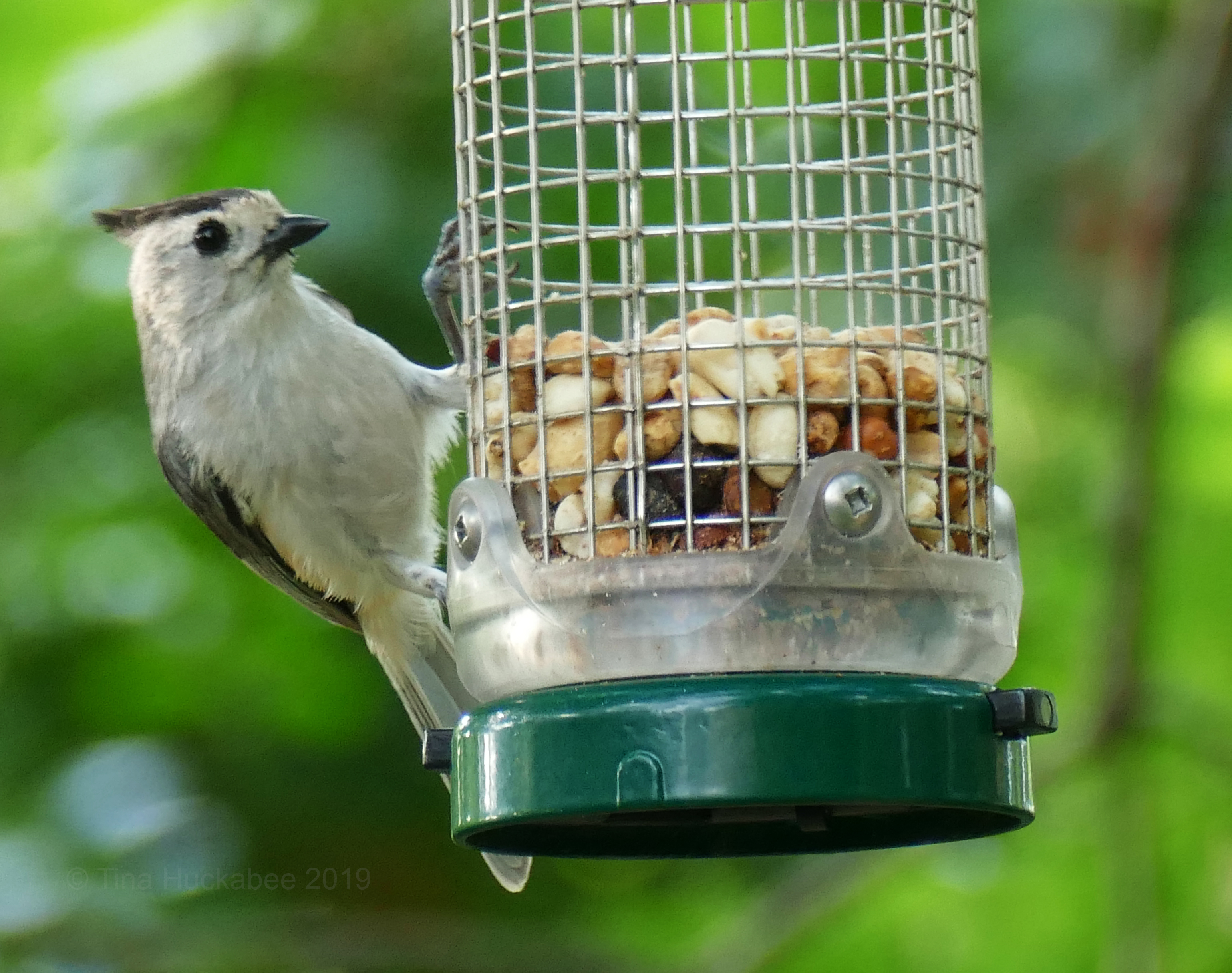
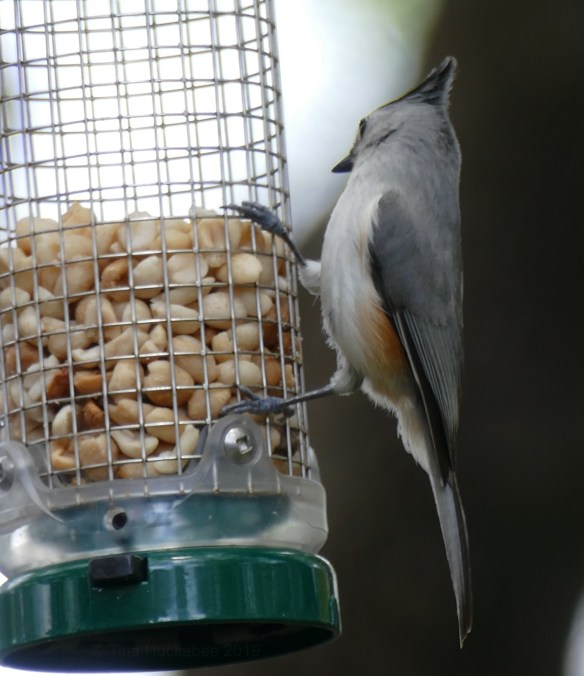
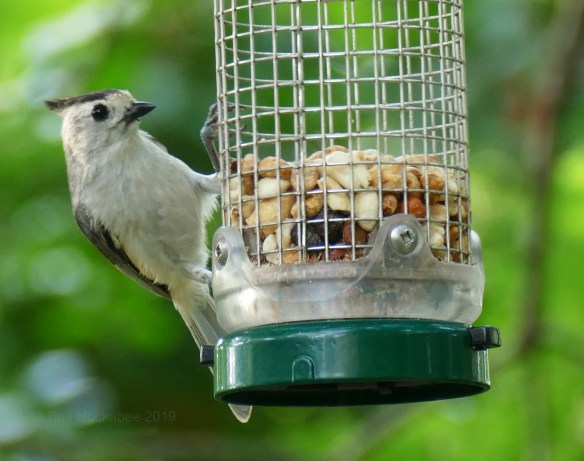
And munched they have!  The peanut feeder is the place to eat now, so much so, that I’ve had to limit the supply of peanuts.   The male Black-crested TitmouseBaeolophus atricristatus, pays no attention to me snapping his photo, as he’s focused on his snack.

He works the wire with claw dexterity.
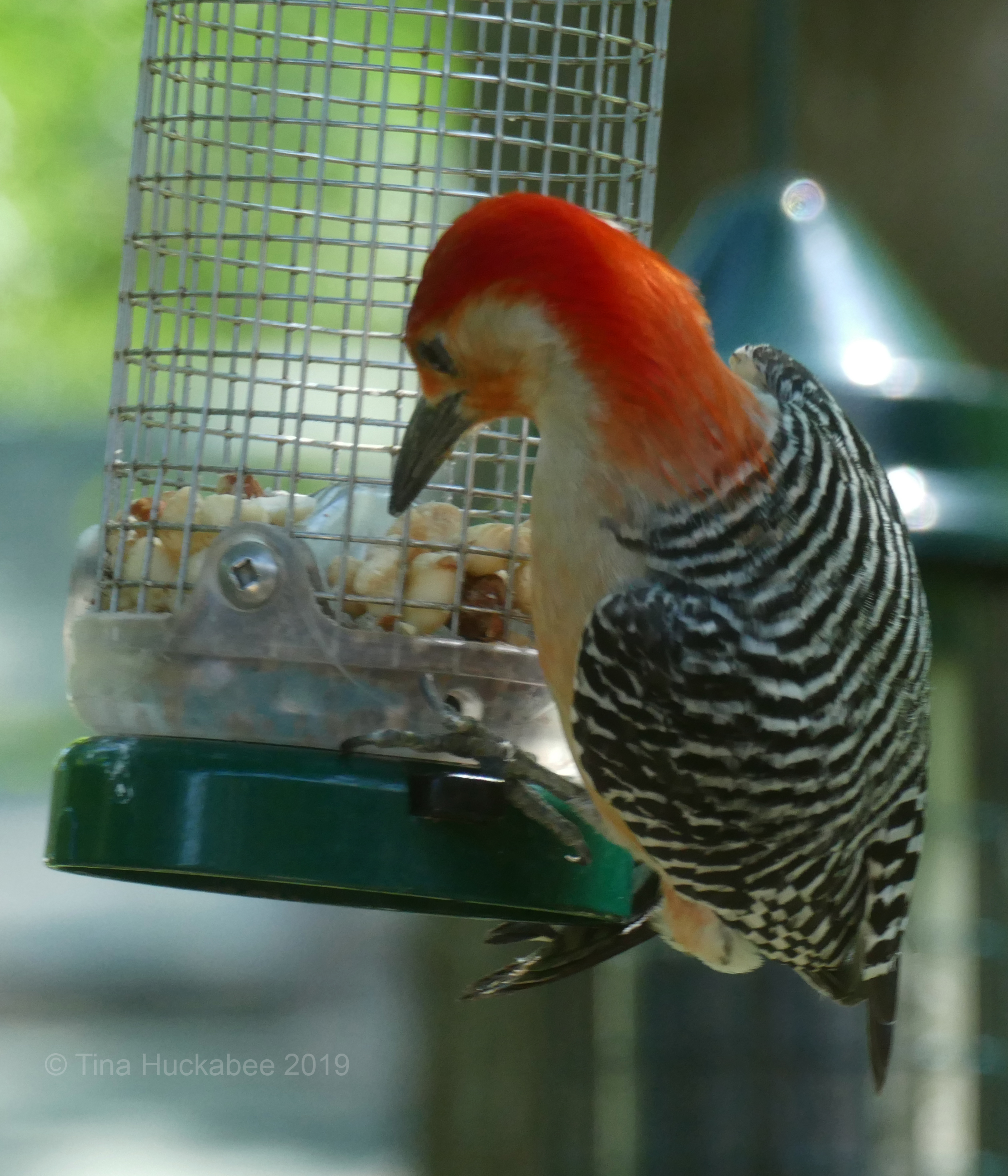
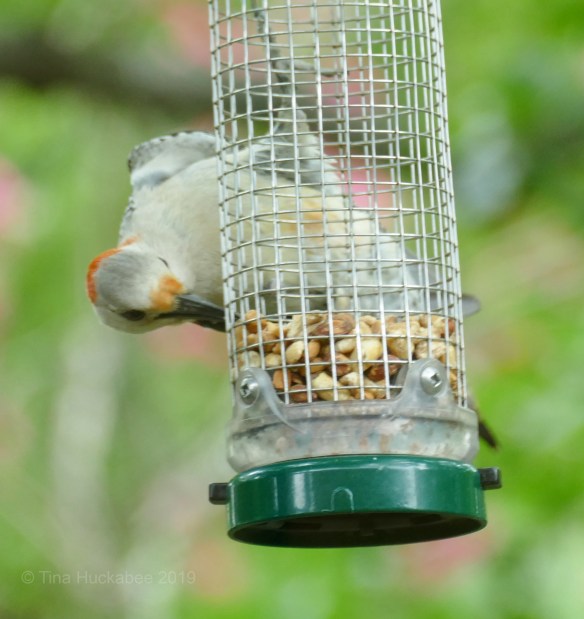
The neighborhood Red-bellied WoodpeckerMelanerpes carolinus, is a shy-guy (as is his mate), but when he lands on the feeder, he is the master of the peanuts and defends his meal.

While his head is red, it’s the blush on his belly which gives him the moniker red-bellied.  And he likes his peanuts!

The female partner also visits and snatches her share of the legume.   Not as flush with blush, she still rocks that red hat and snazzy plumage pattern.
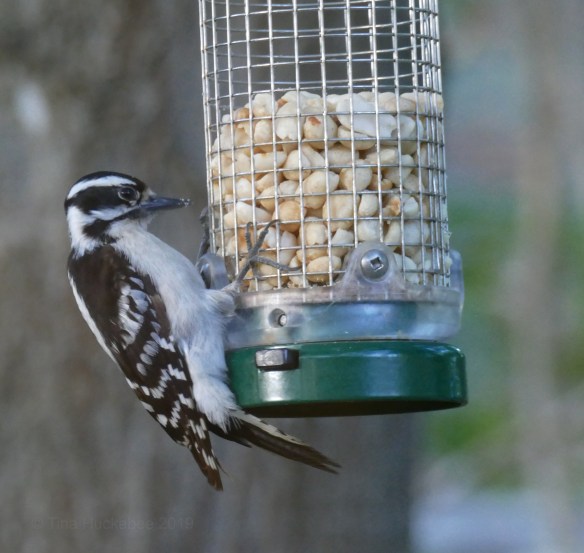
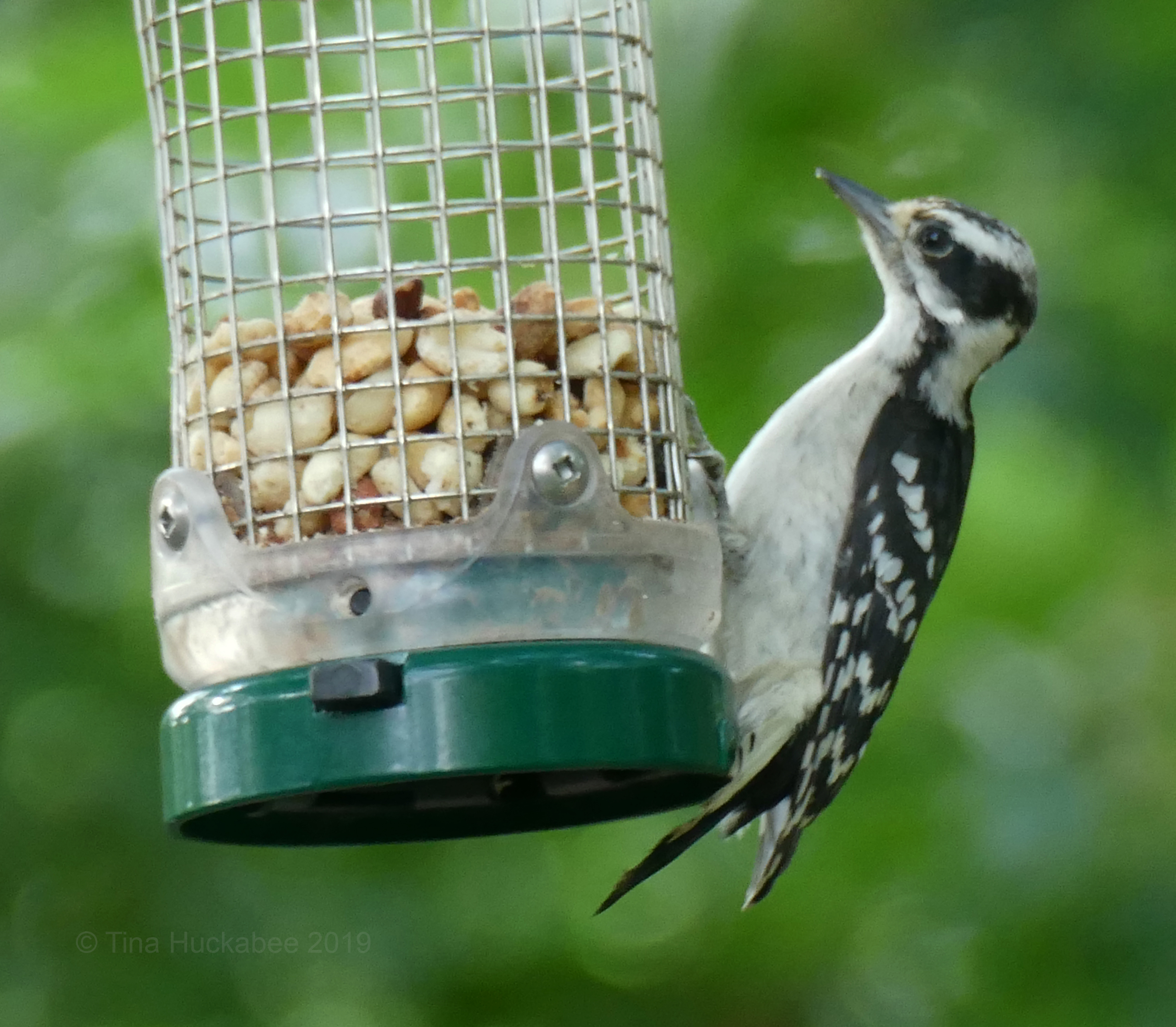
The biggest boon to providing the shelled peanuts is that I now observe a family of Downy Woodpeckers, Dryobates pubescens, regularly in my garden.   Daddy Downy dons the jaunty red beret.
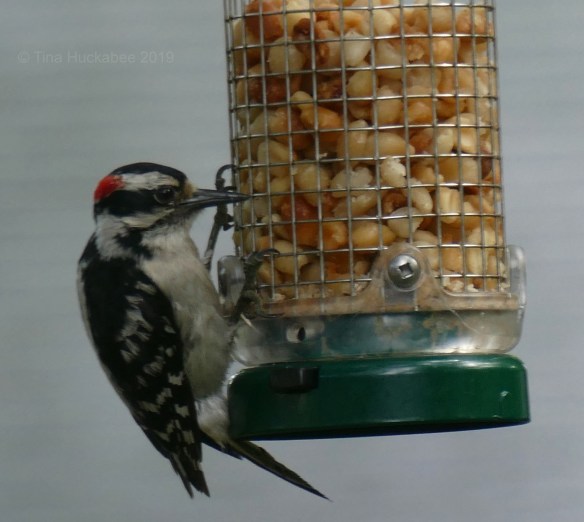
Hang on there, buddy!

Mama gets her share of protein, too.
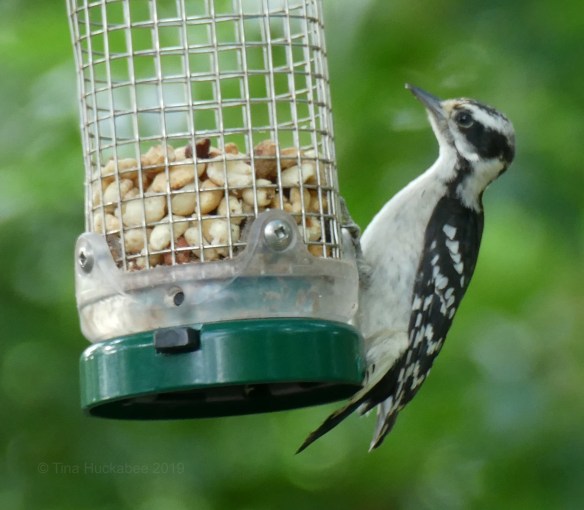
The pair of Downies had one chick (that I’m aware of)  this spring.  I watched Daddy Downy feed his fledgling and show her the ropes on maneuvering around the feeder. Baby looks like Mama, but with shorter tail feathers.
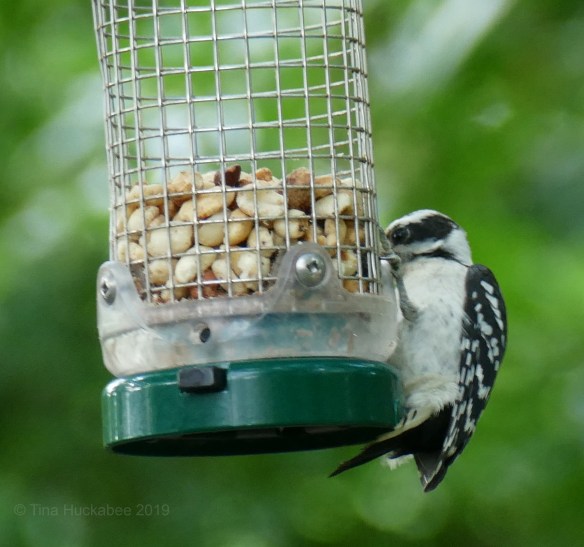
The number of Downy visits have lessened in the past few weeks, but I still spy furtive visits, especially in the evening.  It’s good dinner-time entertainment.

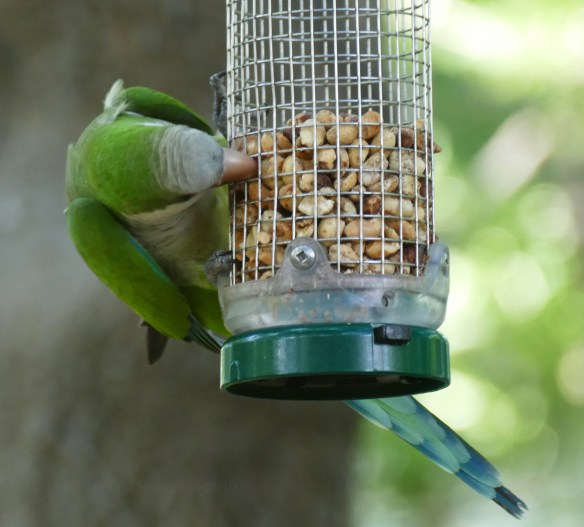
Green goblins!  Austin hosts several colonies of Monk Parakeets, Myiopsitta monachus.  Not native to this area, these gregarious greens fly over my house often, squawking their squeak, but rarely stop in my garden.  One afternoon, I spotted two in the oak tree where the peanut feeder hangs.  One popped down for a nosh.

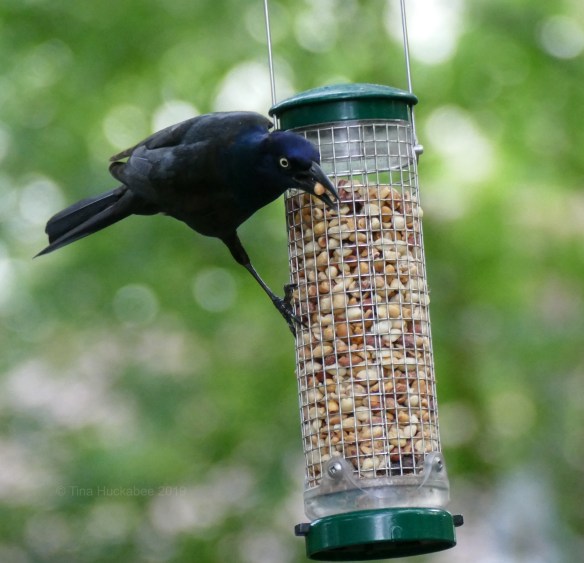
This ninja bird is otherwise known as a Great-tailed Grackle, Quiscalus mexicanus,  the Gracks have become nuisances at the peanut bar.  Like the so many others, these brassy birds share a love of the nut, but also scatter the smaller birds like titmice, chickadees, and Downy woodpeckers when  they zoom in for the feed.
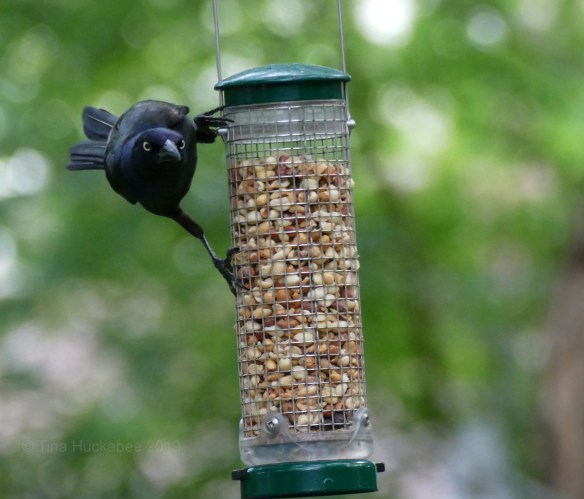
Peanut in beak, ready to eat!
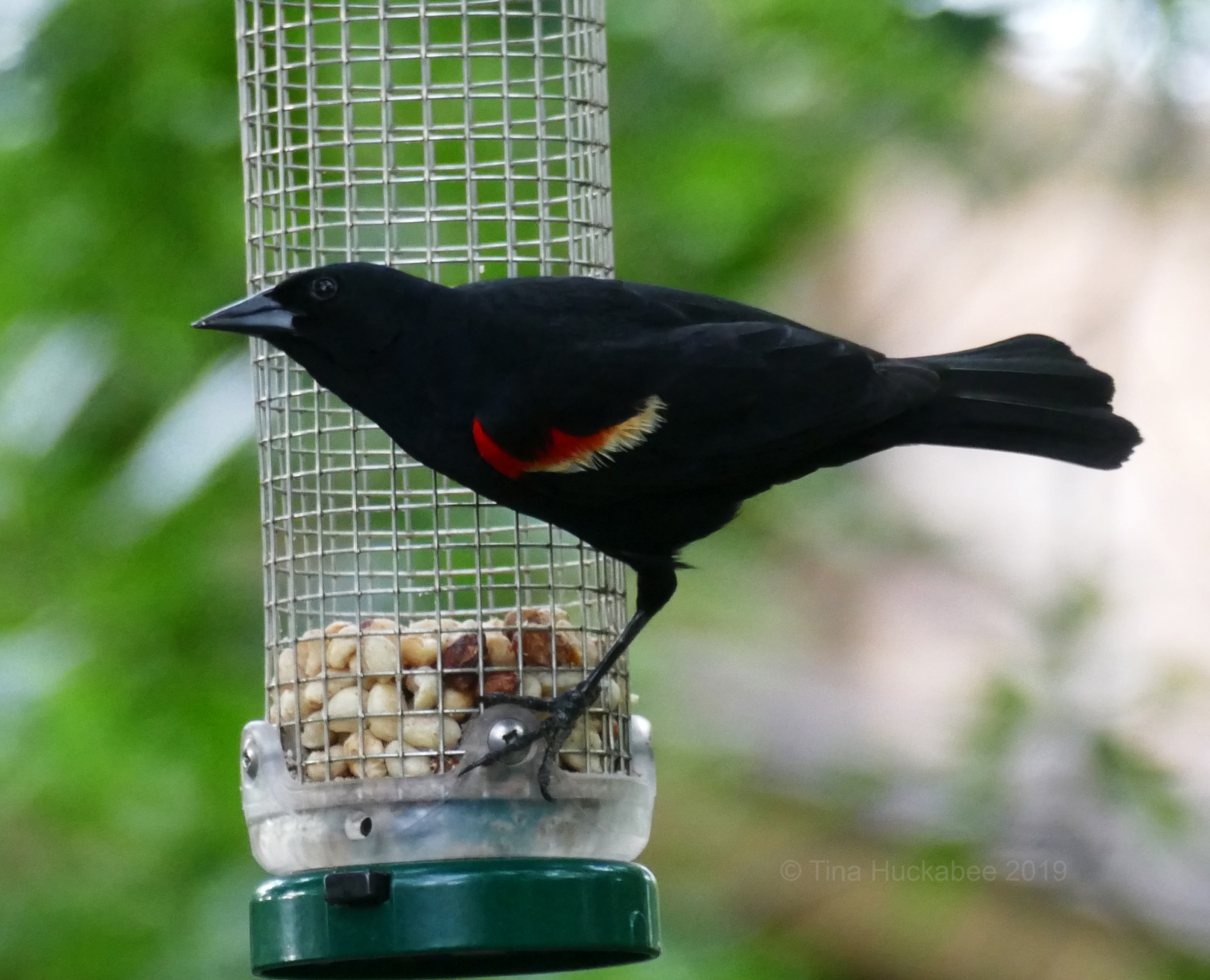
I usually see Red-winged Blackbirds, Agelaius phoeniceus, in spring, but this handsome dude has hung around all June because of the available peanuts.  Red-wings breed in this region, though none have ever spent time during summer in my back garden.  I’m glad there’s something to attract him.

I hear him before I see him because of  his melodic, high-pitched call as he perches in the tree where the feeder hangs.  He’s cautious about flying to the feeder, but once arrived, he’s is all in.

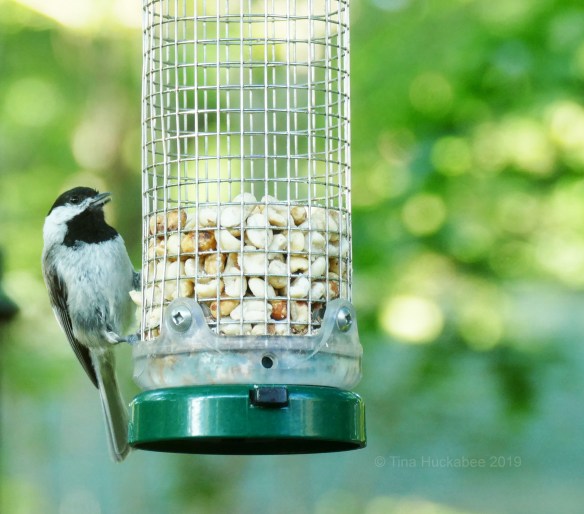
The tiniest is the the quickest!  Carolina Chickadees, Poecile carolinensis, are nut lovers too, but so quick at their snacking that it took some time for me to get an unblurred photo.  This little one picked bits of peanut from those behind the mesh.  Do you see that peanut mush at his beak?
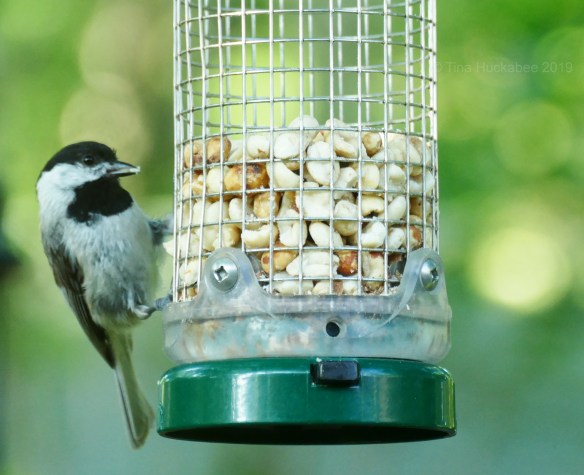
Scoping out choices: which peanut should I grab?
An unwelcomed visitor is this fella, a European Starling, Sturnus vulgaris.  It’s rare to see only one at a time and this summer there’s a whole clan swooping in daily to gobble up the peanuts.  I  admire Starlings’ beautiful plumage, but they are bullies and I don’t like them muscling in on the peanut action.  When I first offered peanut pickings, I filled the feeder in the morning and it was empty by late afternoon.  Per advice from Wild Birds Unlimited and since the native songbirds mostly nosh mornings and evenings, I’ve mitigated the Starlings’ peanut gluttony by offering only a small amount of peanuts in early in the day and another small amount in evening, leaving the feeder empty for the afternoons.  The schedule change has allowed a slight decline in Starling visits and I’m not emptying my bank account keeping them in peanuts.

The poor, hapless White-winged Doves, Zenaida asiatica, have no game at the feeder.  They land on top, bumble around trying to figure out how to work the mesh. Inevitably, fluttering to the ground because they can’t hang on to the cylindrical feeder, they feed on fallen peanuts.. Doves are ground feeders and competently snatch up leftover peanut bits–as long as they’re terra firma.

The feeder hangs close to this ceramic pot holding graceful Basket grass, Nolina texana.  The doves (and some other birds) root around the plant, pecking and picking peanut droppings.  There’s no peanut mess for me to clean up, but birds poop on the foliage.  It’s always something.

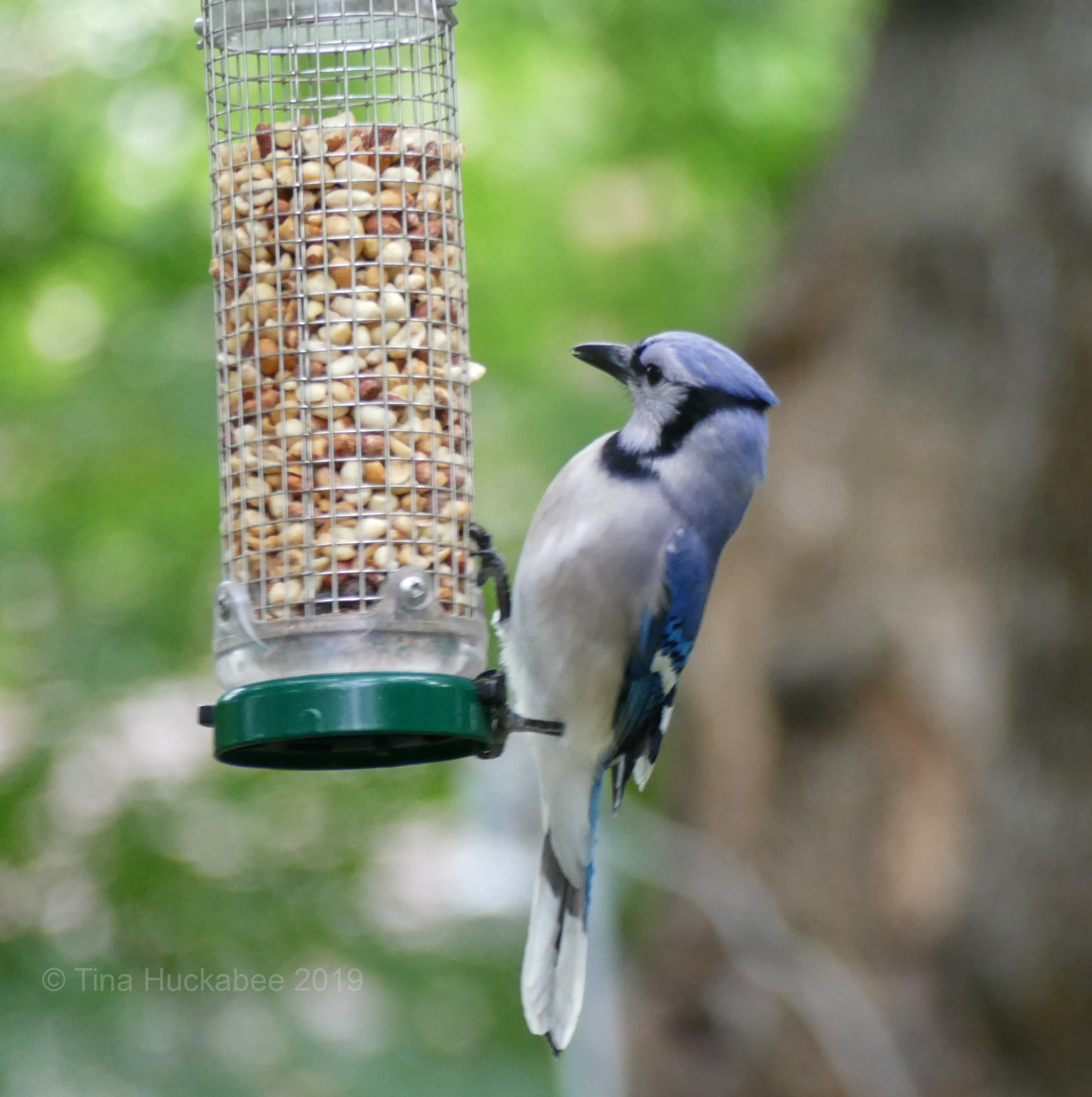
I started this peanut gallery with Blue Jays and will end with them.  Jays like peanuts:  shelled, unshelled–they love’m all!

How is your wildlife?  Are they foraging in your foliage or feasting at your feeders?  Please share your wildlife garden stories and remember to leave a link when you comment here–happy wildlife gardening!
A Roof with a View

With apologies to E.M. Forster, it’s always interesting to see someone or something through different eyes.  But first, some background: we’ve had a raccoon visiting our back garden.  We haven’t actually seen him or her, but twice it has knocked over one of my bird baths.  This is a blue ceramic that we all like:  the gardener, the birds, the bees.

This photo is several years old and the bird bath sat in a different area of my garden at that time.

It’s an old bird bath and has been knocked over before, but this time the fall was fatal–the fall busted the basin to the point of no return.   I purchased a commercially made, large, heavy, container pot drainage plate and glued it using E6000 to the original and undamaged bird bath pedestal.

Voilà!

Two nights later, the marauding monster knocked the entire bird bath over again. Scoundrel!  The plate, now bird bath basin, wasn’t dislodged from the pedestal and no damage occurred, except to my back as I Iifted and set the bird bath upright once more.  That the now heavier bird bath can be upturned and its basin remain attached and intact is a testament to 1) the strength, and perhaps size, of the raccoon, and 2) the adhesive power of E6000.  I learned about the magical powers of E6000 when I was studying art, specifically ceramics, in recent years.  The stuff works!

I can also tell that the masked miscreant has been mucking around in my pond.  The fish are skittish, the pond lilies askew, and the water murky.

Additionally, once or twice recently and well after dark, we’ve heard a sort of thump on our roof or patio cover (it’s hard to tell exactly where).  Is this a visiting raccoon or is he/she  perhaps squatting somewhere on our property, possibly on the roof?  Raccoons have moved in under our solar panels in the past, but they were juveniles, small and oh so cute, and their homesteading occurred in late summer/early fall after their mamas booted their fuzzy butts from parental care.  We’ve installed a metal protective barrier between the roof and the solar panels to prevent such critter habitation, but raccoons are strong–remember the bird bath.  Could one have busted the barrier?

So out comes the ladder and up goes The Hub to check out any evidence or damage indicating raccoon invasion or vandalism.   From the ground, the only thing I could see under the solar panel was a suspicious lump.  Might that be a raccoon, snoozing in the morning? The Hub verified by spraying water from the pitch of the roof downward and under the panels.  The lump didn’t move, didn’t shift. Turns out, it was a bundle of leaves, but when you’re on the hunt for a rascally raccoon, it’s good to check out all suspects. Thankfully, there was no obvious raccoon renter on or near the roof.  Whew!  That’s good news, though I’m sure our mischievous mammal is still around, most recently squashing some plants at the base of a tree.  Varmint!!

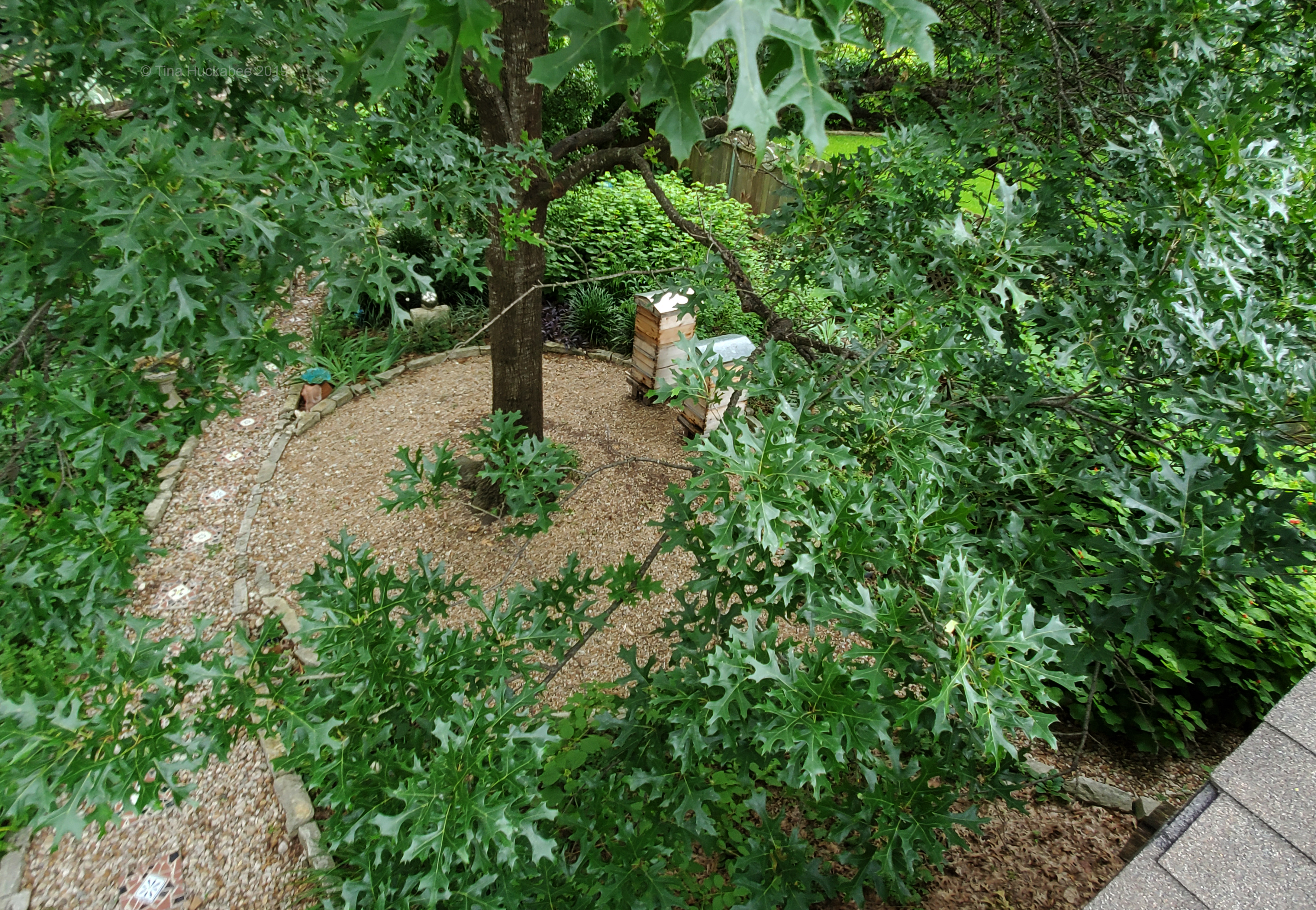
While on the roof, The Hub took pictures of the garden with his phone.  We live in a one-story home and I’m not one to hang out on rooftops, so it’s a view I don’t often enjoy. The photos demonstrate a different and delightful view of the garden I know so well.

The back garden is pie-shaped and the far corner is completely obscured by the tree.  The rest of this part of the garden is also mostly hidden by the lush canopy of the Red Oak tree, but two of our three bee hives sit in an open area.


Moving leftward, the main garden with the pond, comes into view.  My back garden is shady (pop-up sunflower, notwithstanding) and growing showy flowers is challenging, but I’m pleased that foliage variety is apparent from above and lends interest to this large garden.


The central and narrower part of my back garden hosts the pond, seating areas (some of which are out of camera view) and two other perennial gardens, left of the photo.


The northern, left-most part of the garden is where the raccooned-targeted bird bath sits.  The new basin is shallower than the original, but I think the birds will like it, though so far, they’ve been shy about taking a plunge.  The bees however, approve; they were ready for sipping before I added water.

At the left of the photo and hidden by the overhang of the roof is a fence with a gate which leads to the compost bin and a work/storage area.  If you look at the bottom right of this photo, you can see the remains of the broken bird bath basin.  Darn raccoon!

I’ve allowed some late summer and autumn wildflowers to seed out in this area, where I also house yard waste bins, extra mulch, and other garden paraphernalia.  This area becomes messy, but sometimes, I tidy it up.  Sometimes.

The front of the house hosts a raised bed in conjunction to the driveway.  You can see an edge of the solar panels and the darkened spot is where Hub ran the water underneath the panels to flush out, the “raccoon” that wasn’t.   This part of the garden enjoys significantly more sun than the back garden, though it just barely qualifies as “full” sun.  Still, I can grow many bloomers which please the pollinators. Yay!

The last major part of my garden lies in front of the garage, to the right of the above photo.  Shaded by a declining Arizona Ash tree, it’s a nice place to sit and pet the cat (if he’s out), finish the crossword puzzle, or chat with neighbors–all of which we do.  The mulched walkway leads to a narrow side garden.

I take photos of my gardens at least once during each season because it’s a good way for me to see things that, somehow, I don’t directly observe with my eyes.   The view from the roof is revealing and instructive, seeing my garden like the birds see it–looking down upon diverse and mixed foliage, and viewing the flow of pathways and islands of gardens.  I now recognize that there are things and areas that I might change, but I’m glad my space is all garden, full and lush, and a welcome home for critters.

I wouldn’t mind, however, if the raccoon critter would move along to another place.

I’m pleased to join with Anna and her Wednesday Vignette.   Check out her blog, Flutter and Hum, for musings of various sorts.