Hoot-n-Annie

I’ve long thought that naming wildlife an unwise practice.  When I first installed a water fountain at my back patio, we purchased three “feeder” goldfish which the kids and I named.  The fish didn’t last long, as one of our dogs decided that sushi was something he enjoyed.  Once our pond was built and we had even more fish we could name–at first, koi, and later, goldfish and gobs of gambusia (mosquito fish), I’ve steadfastly refused to name even one of the swimmers.  Herons, plain bad luck, as well as old age, all end the fish and I don’t want to lament their loss by name.

The same is true for my regular bird visitors.  I’m fond of the pairs of Carolina Chickadees and Wrens, and Black-crested Titmice, and many others, who I see in my garden.  I’m charmed when they bring their babies to visit and feed in late spring and summer, enjoying the this is how you survive lessons imparted by the excellent parents to their eager and darling offspring.  But I dare not name any one of them.  Ditto for the wintering warblers who daily flit in the garden from November through May.  I already miss them when they leave to wing northward for summer;  how much more would I regret their flying the garden nest if I called them Joe or Rufus or Abigail?

So why name the Eastern Screech-Owl couple who, it appears, are (perhaps?) in the process of choosing to raise a family in my garden?

In a word: weakness.  And, maybe a second word: affirmation.

Meet Hoot and Annie.  Hoot-n-Annie.

The male, Hoot, guarding the nest box.  He wasn’t interested in showing me his pretty face, but I can share his beautiful wing plumage pattern with you.

Annie, trying the nest box on for size. She was tolerant at my photo taking, but I didn’t bother her much–just enough to get this shot.

Here’s a look from our owl cam. What you’re looking at are her tail feathers–her head is looking out the nest box hole.

There are several problems with the conferring of these names, notwithstanding the stupidity of  perceived control.   Firstly, Eastern Screech owls don’t hoot, they trill (in varying forms), and they also make bill claps and low chuckling sounds.  Check out this link to Cornell Lab’s Eastern Screech-Owl sounds to understand what we’ve been hearing for a few weeks now and why “Hoot” is a goofy–and erroneous–name.  Secondly, the life of Screech-Owls is fraught with danger.  Of course that’s true of all wildlife, thus the wisdom of not naming the wild critters in my garden.  We can provide the right habitat,  day and night, but we have little influence over their destiny.  Cars, bigger owls (there’s a Great Horned Owl pair in our neighborhood), and maybe rat poison, are all hazards to Screech-Owls.  Also, Screech-Owls are risks to the smaller birds, toads, and insects in and near my garden.

And so it goes with the wildlife food web.

But I have hope and a sense of reassurance with this particular canoodling pair of owls.  It’s been a few years since we’ve enjoyed the privilege of intimately observing the shy, elusive night birds–more about that at another time. The previous owl pairs were always Mama Owl and Daddy Owl, and except for the last clutch of Screech-Owl fledglings, I never named the babies.  But the dearth of owl watching and owl learning in the last two years renders me sentimental and hopeful about their recent presence in the garden. The strong bond between adults, their focused and shared care of chicks, and their important contribution to diversity of the wild community (of which my garden is a small part) is heartwarming and affirming.  Appreciation of the natural order continues, as (selfishly) does my own education and enjoyment.

If the Screechies move in and raise their family, a kind of avian hootenanny in celebration of life’s dance of diversity and songs of progress will be in place, at least for a specific time and type.

I’m glad to join in today with Anna’s Flutter and Hum and her wonderful Wednesday Vignette.  Please pop over for garden, nature, and other musings.

Addendum:  It appeared as if Hoot and Annie were settled in and comfortable in the owl house.  But one evening in early March, I strolled the garden;  Annie was in the box and looking out. She saw me and immediately took flight.  From that point forward, the owls didn’t inhabit the house, though on a couple of occasions, I saw an owl before dawn perched just outside the box and from time-to-time we’ve continued to hear at least one of the owls trilling.

It’s now three years since an Eastern Screech couple has successfully raised a brood of babies.


The Landing

Outside on a comfortable–warm, in fact–February afternoon, chasing the earliest emerged native bees in my garden and with some success, I spied this charming scene:

I like that the seed balances on the slender arm of a Globe mallowSphaeralcea ambigua, and appears steady and content, perky and upright.

I wonder, though, is it satisfied with the landing?  Afterall, this particular seed is from an American SycamorePlatanus occidentalis, and the goal of the wind-driven reproductive morsel is terra firma–which it missed by about 18 inches.  The achene, with attached propelled pappus, was driven from a nearby mature sycamore by puffs or bluffs of wind.  Who knows when the seed landed on the mallow, probably recently, but is it eager to be whooshed by air or washed by rain to the ground for continuation of the adult sycamore’s legacy?

The Globe mallow ignores the seed–it has its own blooming and reproduction to consider.

How many of us land like the seed, or ignore those who land around us?  How does that impact the course of life?

Joining in today with Anna’s  Flutter and Hum and her wonderful Wednesday Vignette.  Please pop over for garden, nature, and other musings.


Rub-A-Dub-Dub

If you follow Bee Mama Missives, you might remember this contraption from the end of 2018.

Along with the new extractor is a frame knife for breaking the comb and freeing the honey during spinning and a mesh for catching the honey prior to bottling.

Its looks are fuselage-like, but is a sweet thing:  it’s our new two-frame honey extractor and in the not-too-distant future it will be recruited into action.  At the top, you see the nearly, but not completely, flat cover; just below and to the right, is the handle which turns the cage holding the frames of honey.  The spout at the bottom–with the poetic name honey gate–is typically closed, except after the frames full of honey have been whirled and twirled.  When the handle is rotated (more about that later), the freed honey will fling to the sides and bottom of the extractor, ready to flow out in glorious, golden goo.  We’ll capture the honey in a bowl, first straining it through the mesh, then bottle it for friends, neighbors and ourselves.  Yippee!

As soon as our weather cooperates–this coming weekend, I hope–we’ll open our two Langstroth hives, Buzz and Woody, to see how the ladies and their queens have fared since our last meeting in mid-October.  In that last 2018 hive check, both hives had plenty of honey:  each had one 10-frame brood box loaded for bear (no actual bears here, just frames packed with honey), plus a smaller box on top, full of the sweet stuff.

Lots of honey, which the bees probably slurped a fair amount of during these past chilly, wet months.  But until we peek in, we don’t know how much honey, if any, is left.  Plus, the honeybees could be (probably are) gearing up for action with the queen laying eggs and honey production ramping up.  So it’s time to prepare our extractor for the removal of whatever honey is left, which will also allow the bees more room in the comb for the next generation.

This is a small, two-frame extractor.  We’re hobbyist bee keepers and don’t need anything particularly big or extravagant.  It’s a manual extractor, but there are plenty of Internet videos instructing how to attach a drill to the handle, thus converting to a less manual, more automatic honey-getter.

Hope it works.  No doubt there will a Bee Mama Missive post in the future if it doesn’t.

Ahem.

Like any food equipment, it’s a good idea to wash before use, so wash we did!

Flat cover removed, let’s peer into the extractor bowels and look at its innards.  The flat bar across the top holds firm the mechanism for the handle which spins the basket.  As well, in the center of the flat bar is affixed a spindle which spins the basket-with-frames when the handle is turned.  The basket runs much of the length of the extractor body.

Insides dismantled and removed, the lid and handle are washed and left to air dry on the counter.


Bee Daddy (flashing a double thumbs-up) displays the ready-for-washing frame basket.  This is where the frames are placed in the extractor to remove the honey by centrifugal force, either by arm or drill force; we’ll figure that out when the time comes.


The chasm of the extractor’s body is deep.  It looks pretty and shiny, but I don’t want any honey spilling and filling into it without a nice, soapy scrub and a good, hot water rinse.

You’ve probably noticed that we’re not in the kitchen where normal food-related equipment is washed.  The extractor is too big, too tall, too weird for the kitchen.  So the bathroom it is and the rub-a-dub-dub commences.

Inside.

Outside.

Once washed, we let basket and drum dry on a clean towel before reassembling the extractor.    It now waits, clean and at the ready, for the bees, or more accurately, their honey.


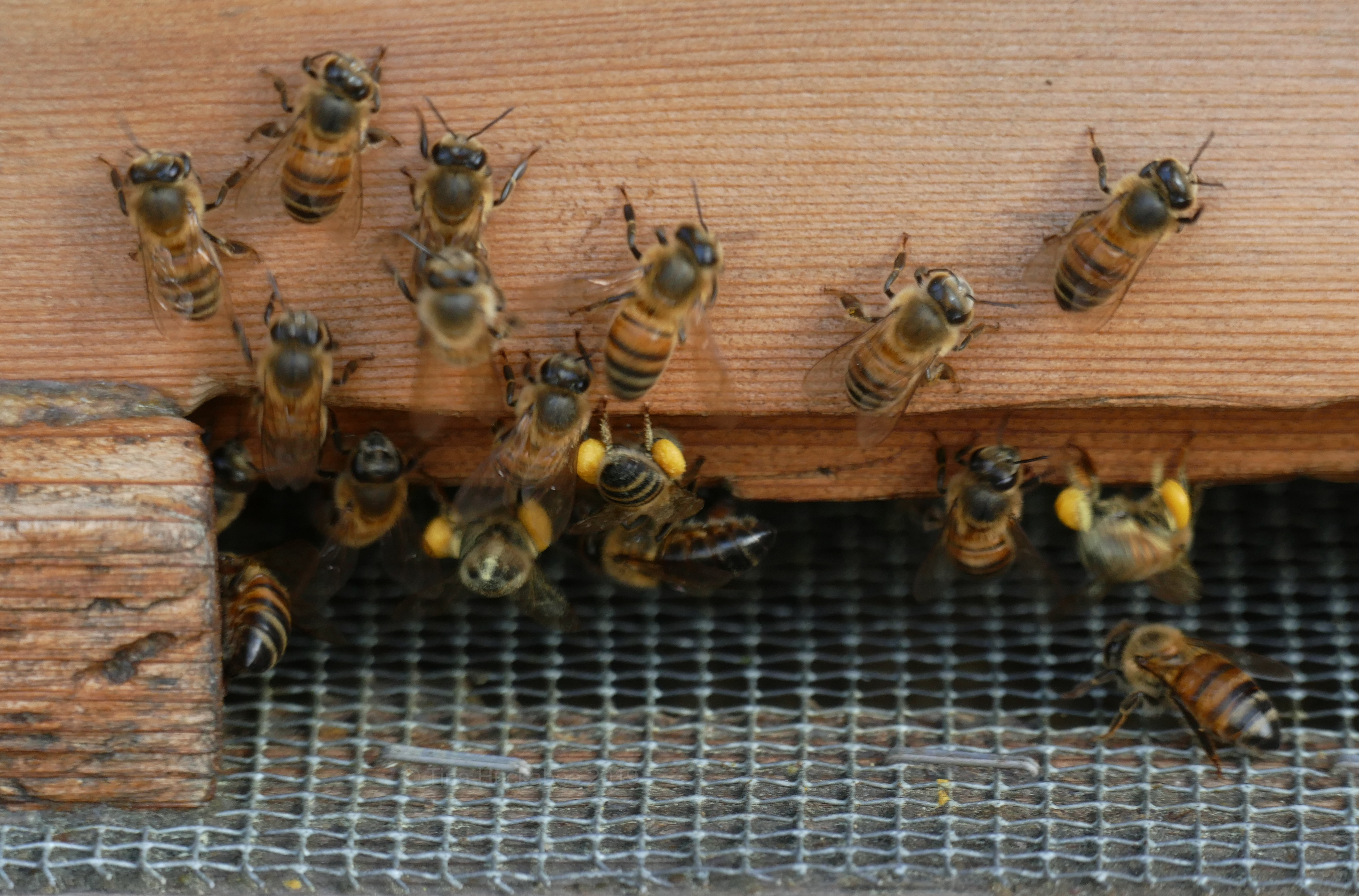
As for the honey makers, each day’s march toward spring sees increased activity as they gather pollen and nectar.  It’s early days in the season, but it has begun.

And the flowers?  They’re opening up for business, too.

Giant spiderwort, Tradescantia gigantea