This Cat Has Nine Lives

Maybe not nine, but this cat,

IMGP2763.new

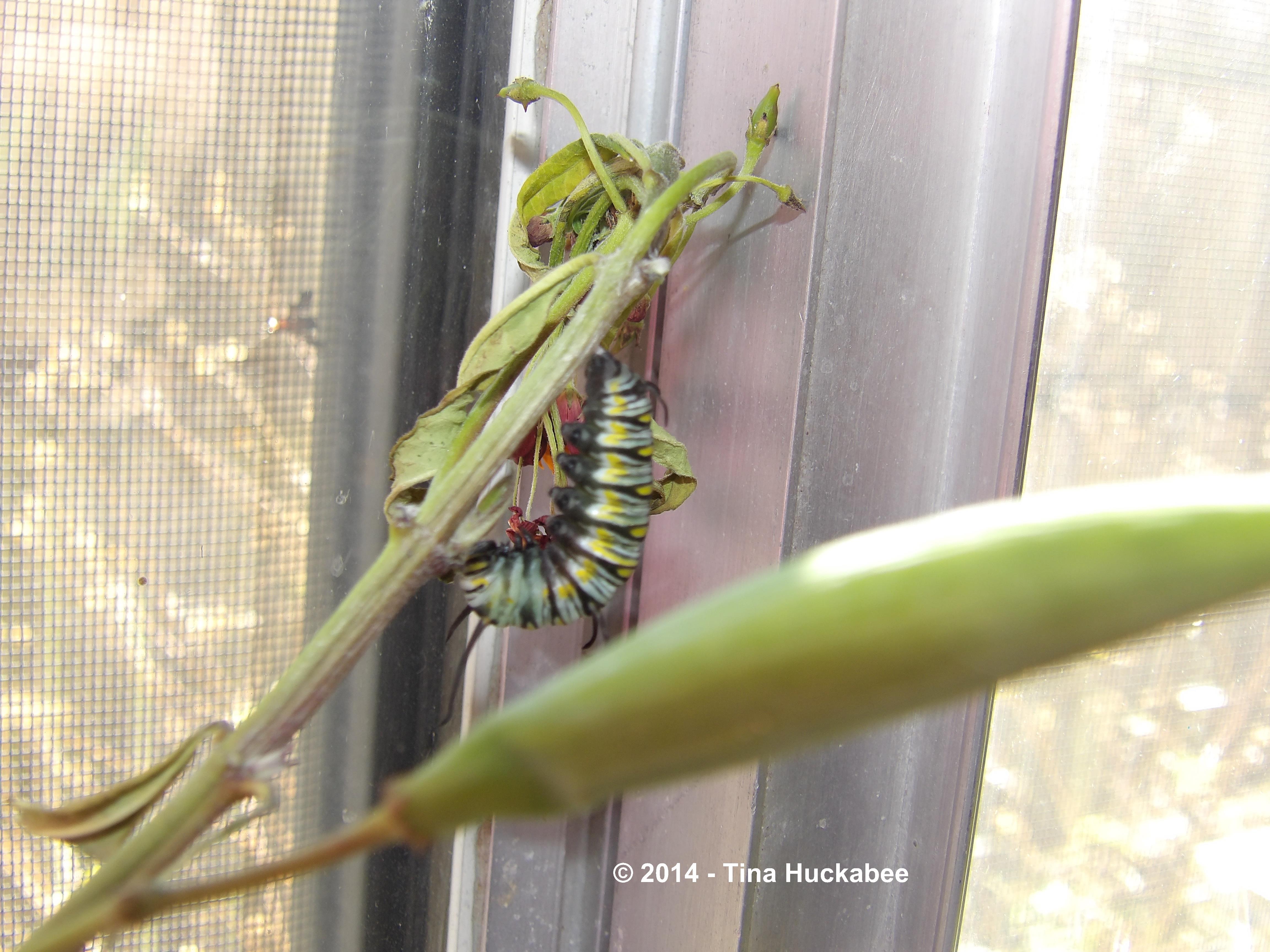
…has at least two or three.  This poor guy. He’s munching along, minding his own business, eating because that’s what he does and plop, he somehow ends up on the floor. I found him, dazed and confused, when I came home. No photo of that as I was scrambling to gently, very gently, pick him up and settle him back on the milkweed buffet.

IMGP2749.new

IMGP2769.new

I set about my own projects and responsibilities and later checked again and…EEK!!! He’s fallen into the water where the milkweed stems rest. Again, no photo of him floating, but I quickly dumped the water out, set him on a paper towel and gently, oh so gently, began prodding him and blowing air on him to dry him out. I have no idea if this is what you do to a drowning caterpillar, but it feels right.  At least, it’s something I can do because  I know I can’t perform mouth-to-mouth resuscitation. Gross.

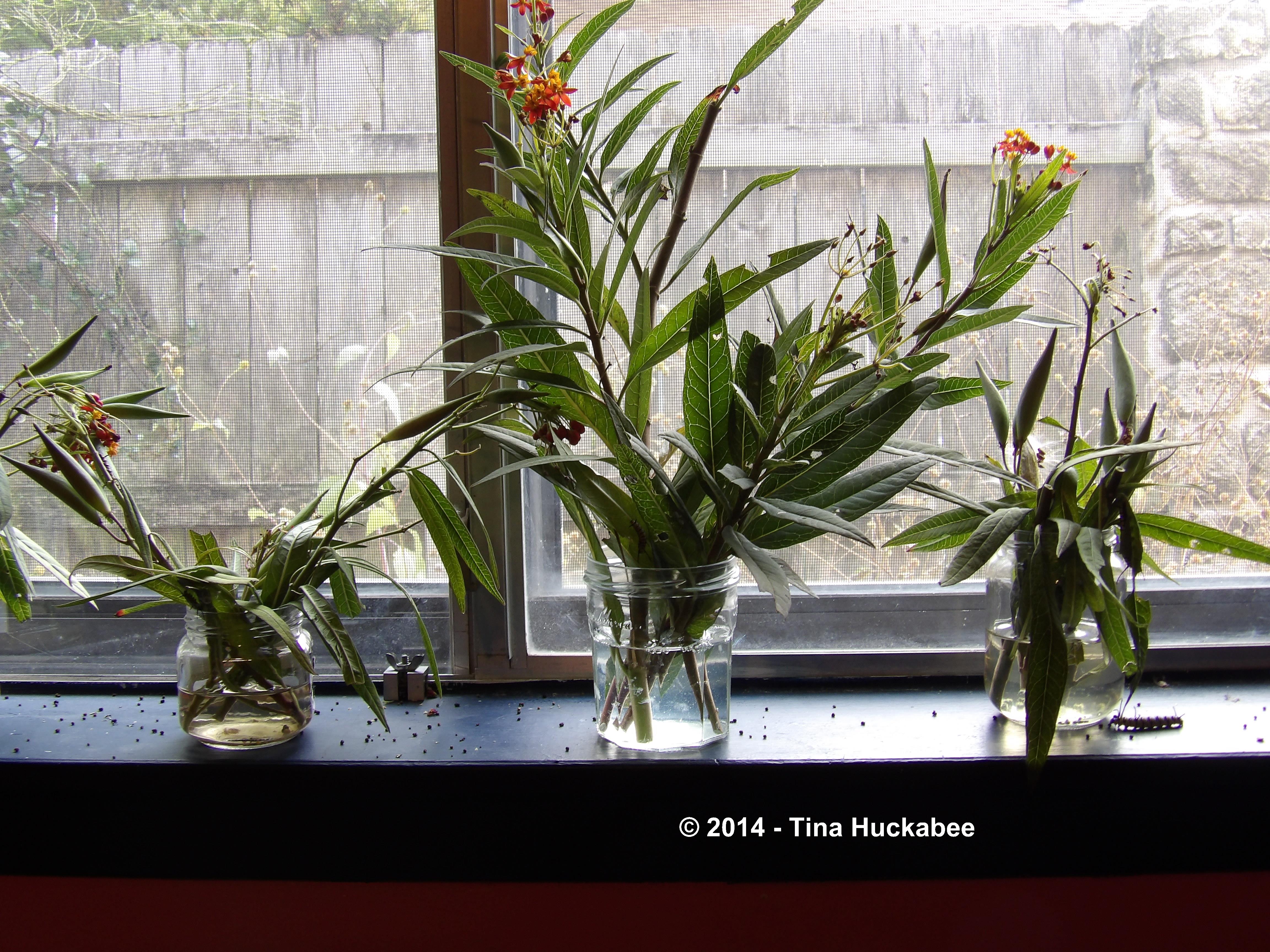
To prevent any more accidental dips in the reservoir, I added a paper towel protective layer to the top of the jar, poked the stems of milkweed through and resettled the last three caterpillars, including Mr. Nine Lives Cat.

IMGP2776.new

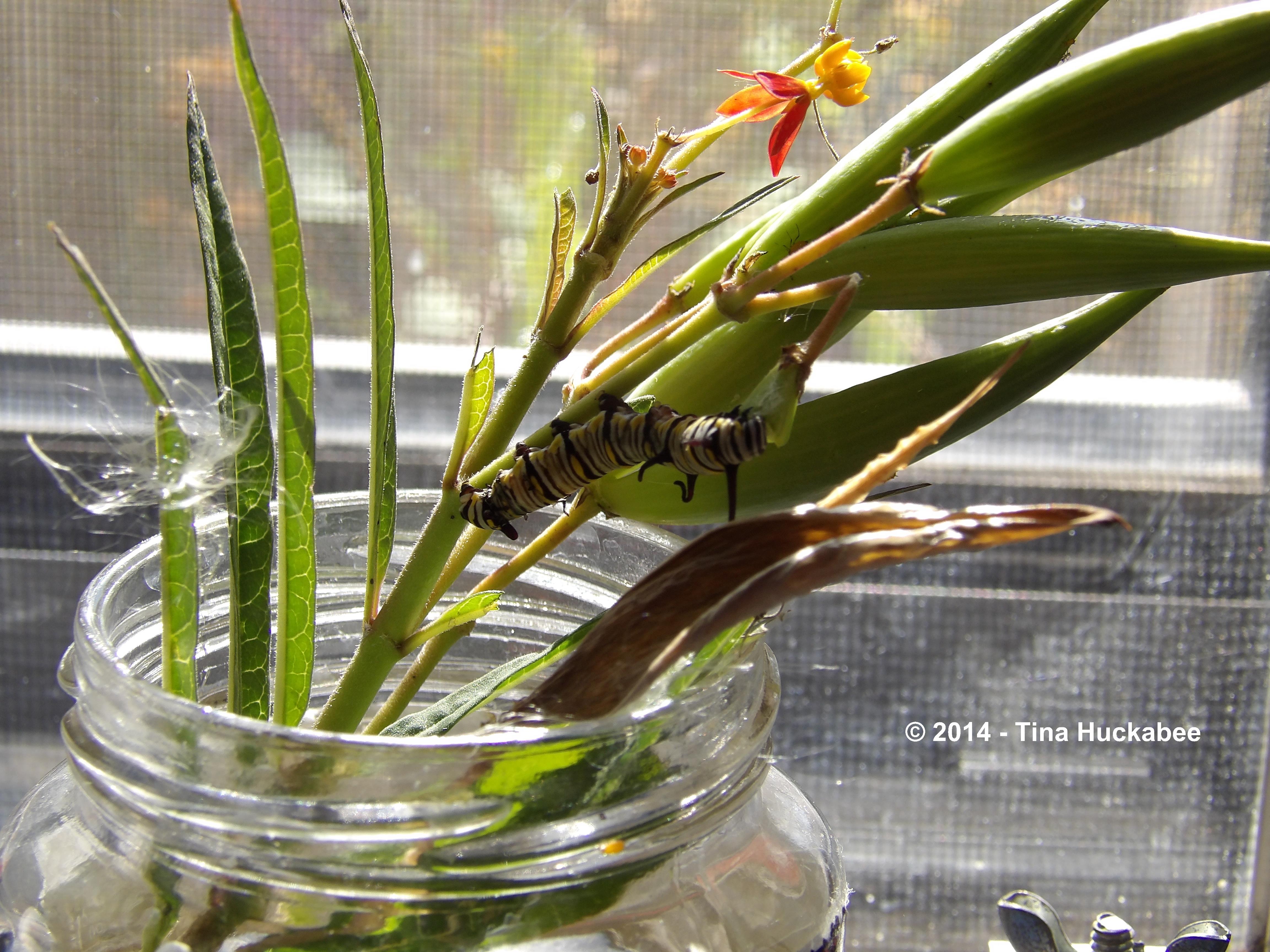
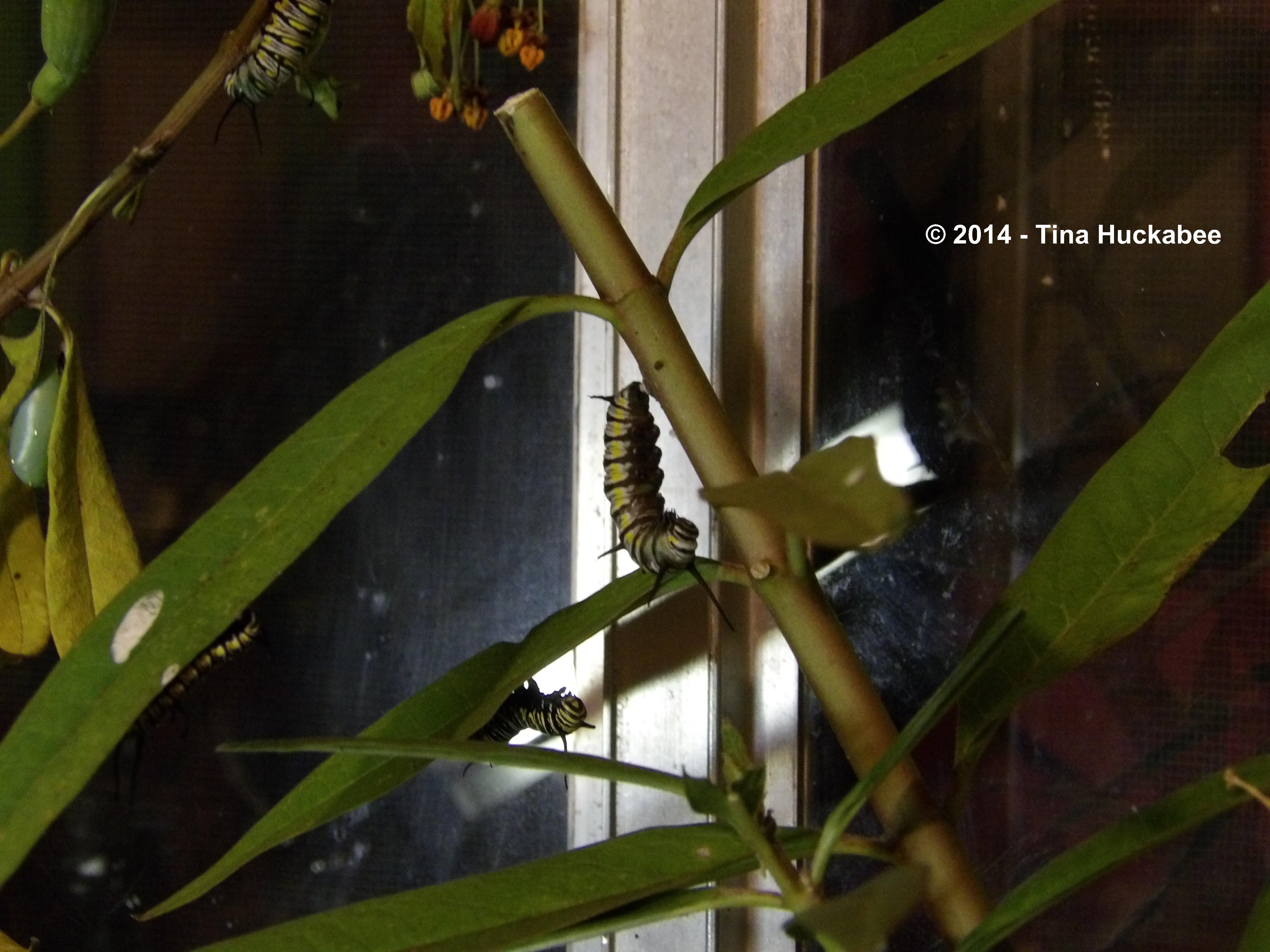
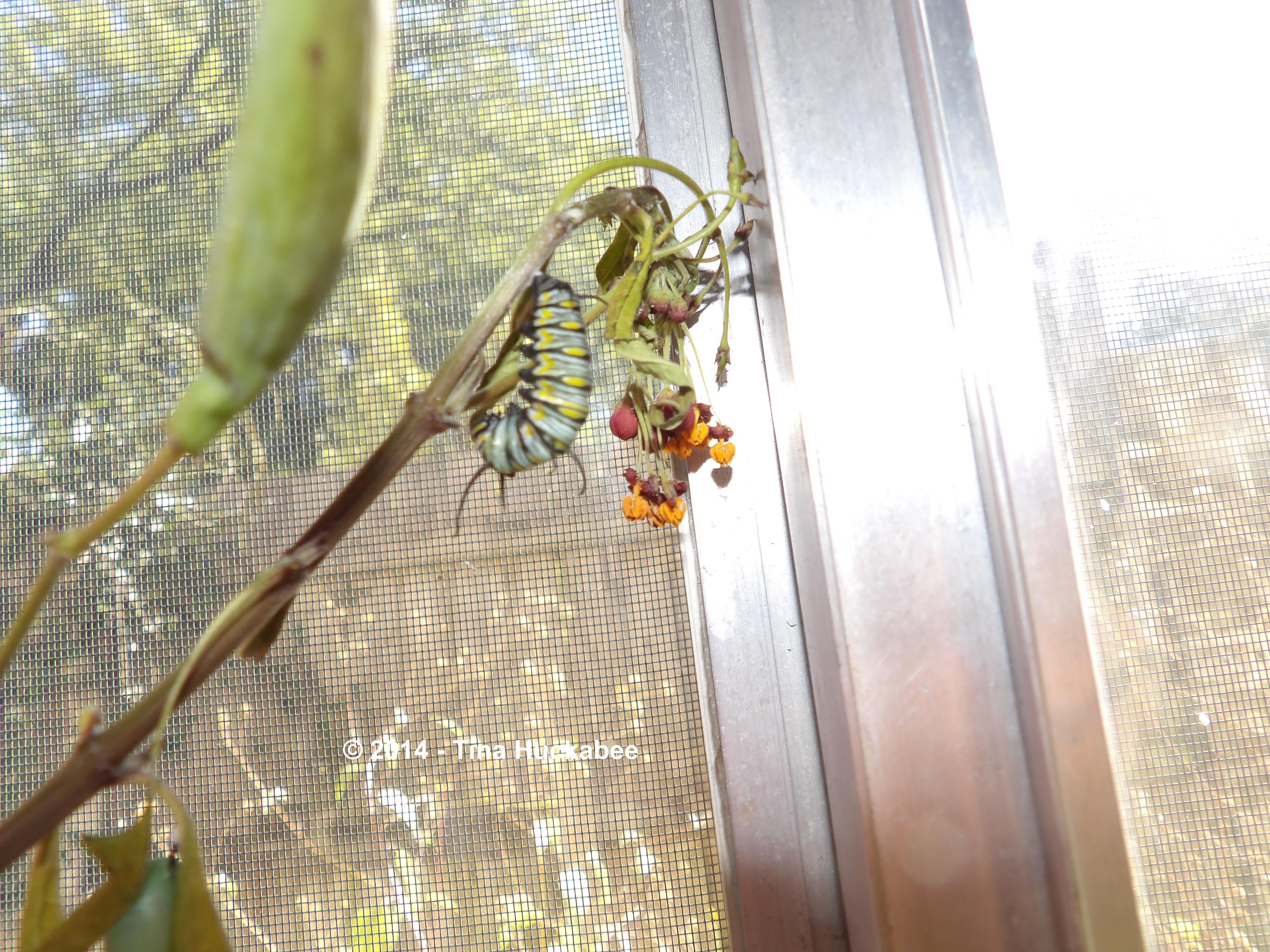
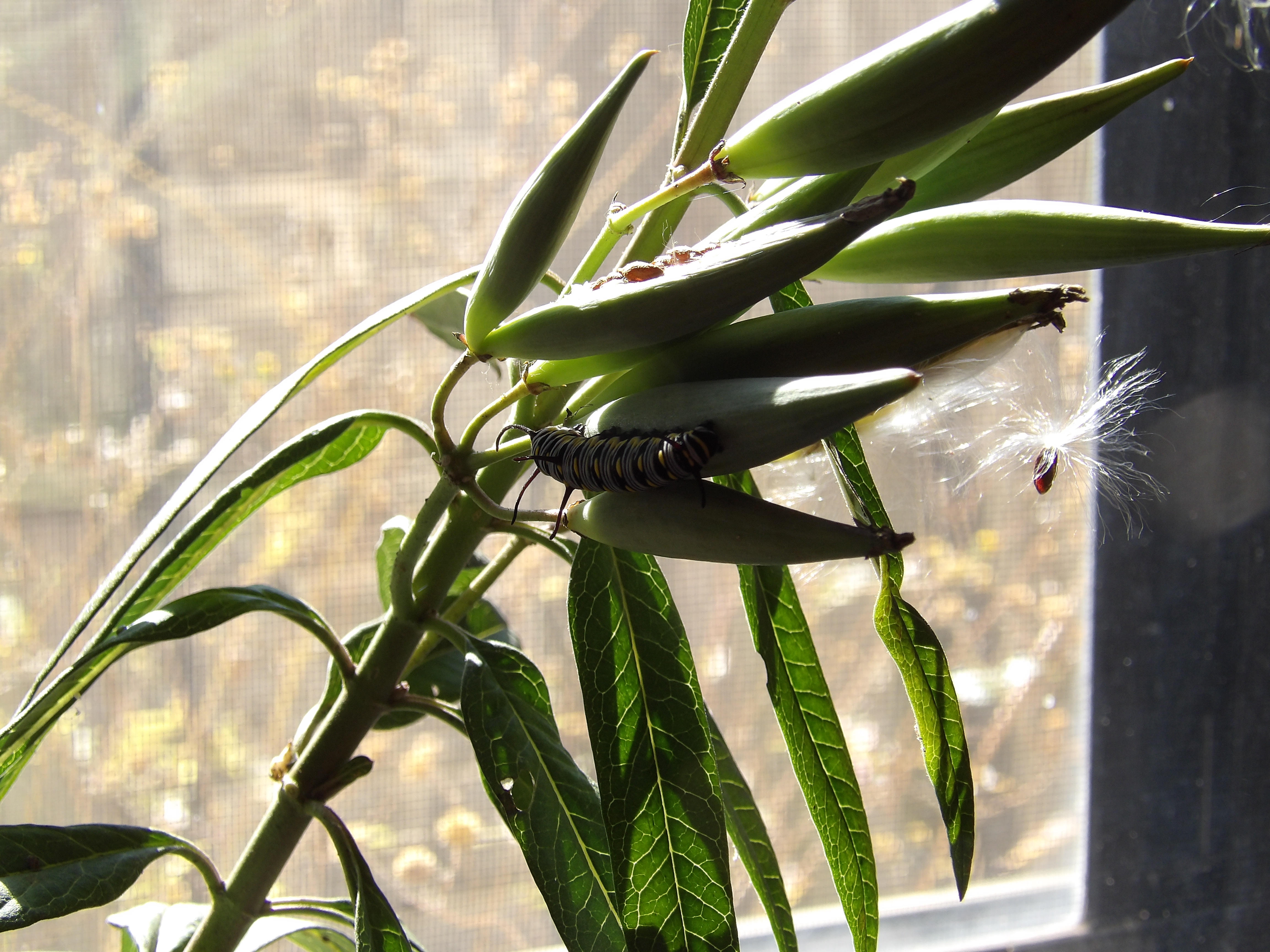
He was a little pokey to recover, but recover he did, gobbling up milkweed a short time later.  Here he is (the darker one) sharing stems with the other, who is also close to pupating.

IMGP2778.new I wonder if the darker coloring is a response to his near-drowning experience?  Probably not and I think his color was a little different before he decided to go for a swim, but there’s definitely a color differential between these two. Also, Mr. Nine Lives Cat also only has two, rather than the normal three, sets of antennae.  I don’t know about this guy–marching to a different drummer?.  Is that acceptable in the Lepidoptera larval world?

For the first part of the weekend, I watched him crawl around the top of the window,IMGP2789.new
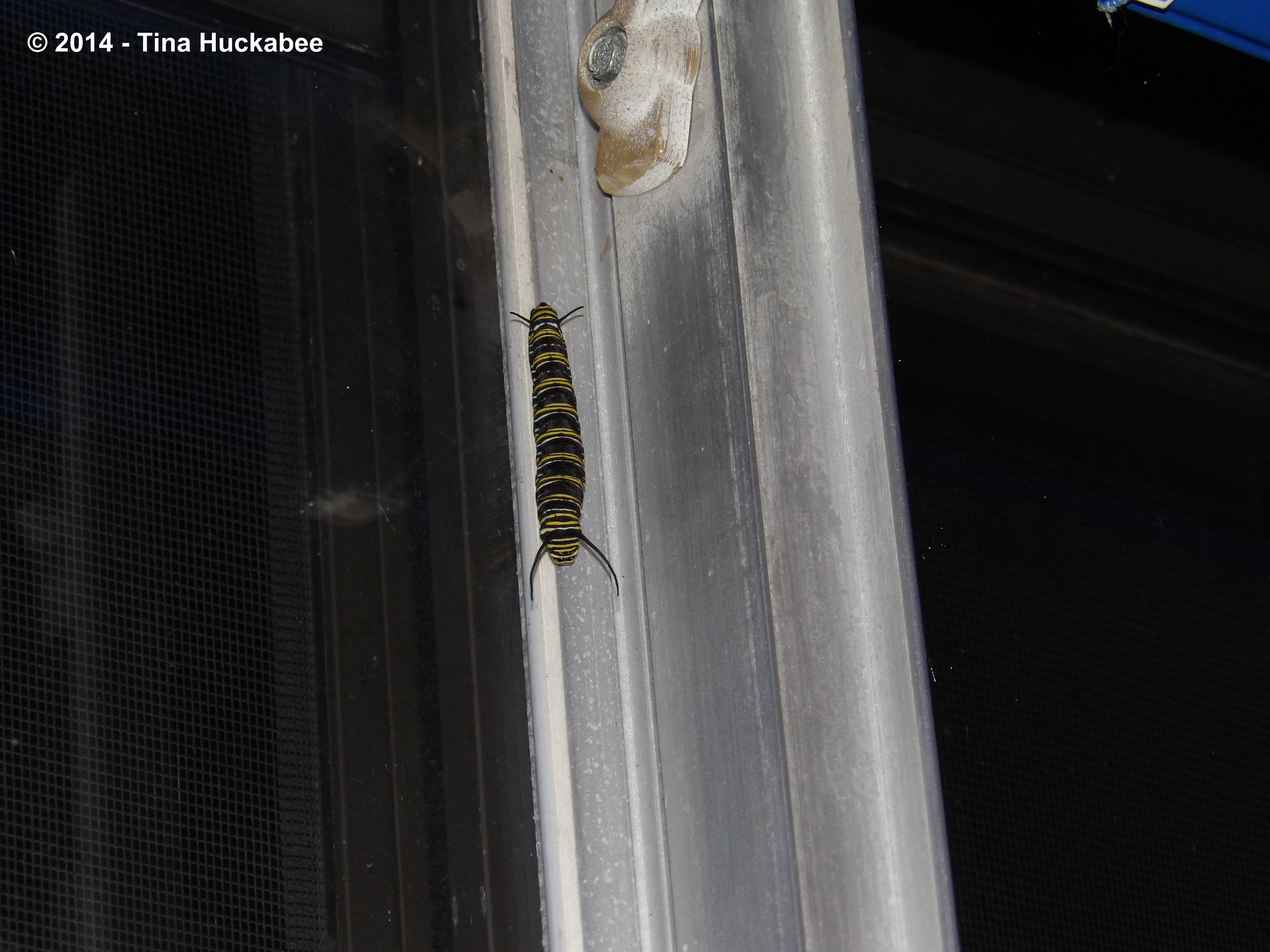
…finally realizing that indeed, he’s not ready to change his caterpillar wardrobe for those of his winged self.  Honestly, he just seemed befuddled–like he’d lost his milkweed way. Saturday night I scooped him up and placed him back on the milkweed where he set about his eating routine.

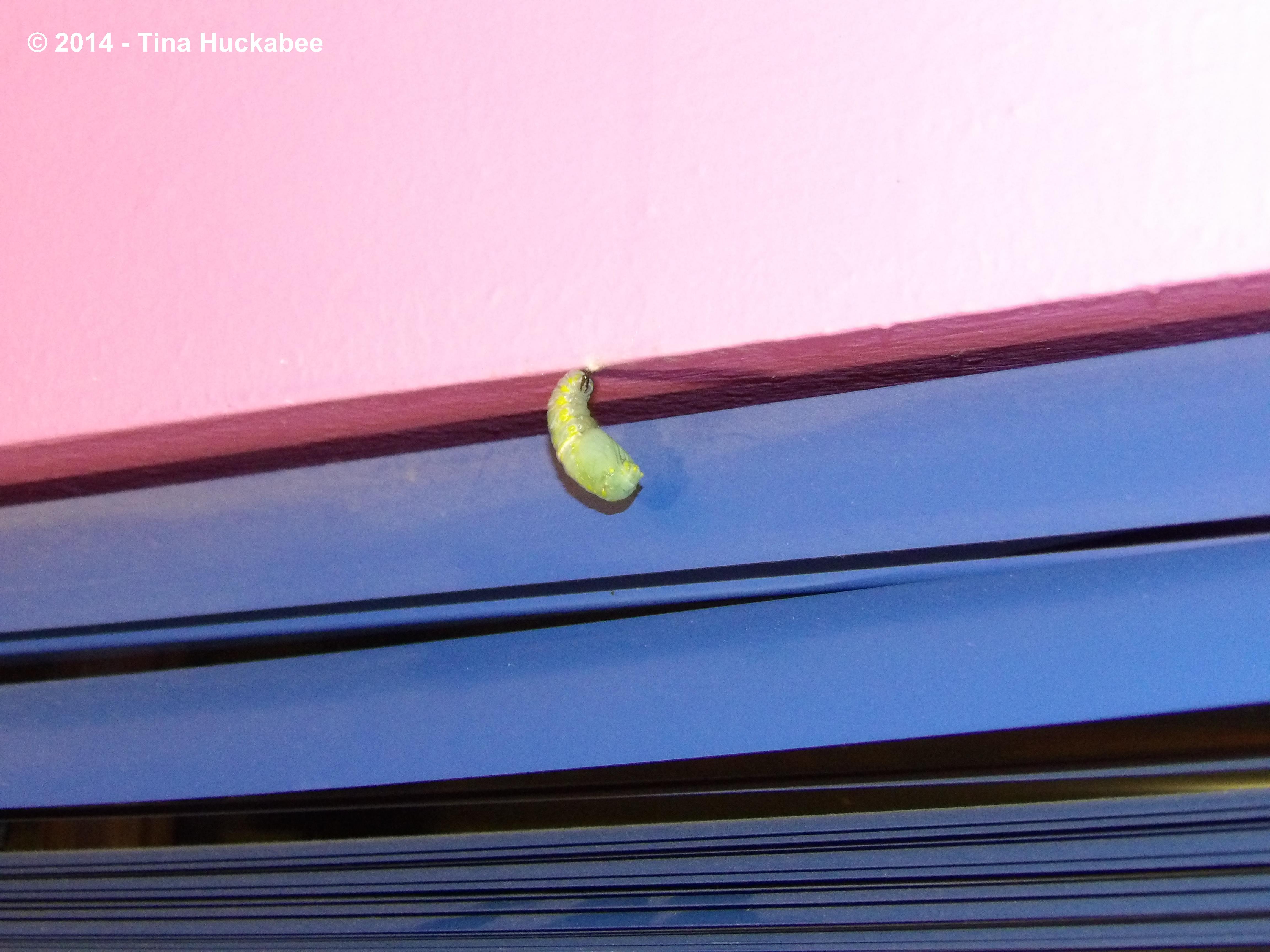
Meanwhile Saturday night into Sunday, the other caterpillar began its morph, forming into the ‘J’.

IMGP2791.new

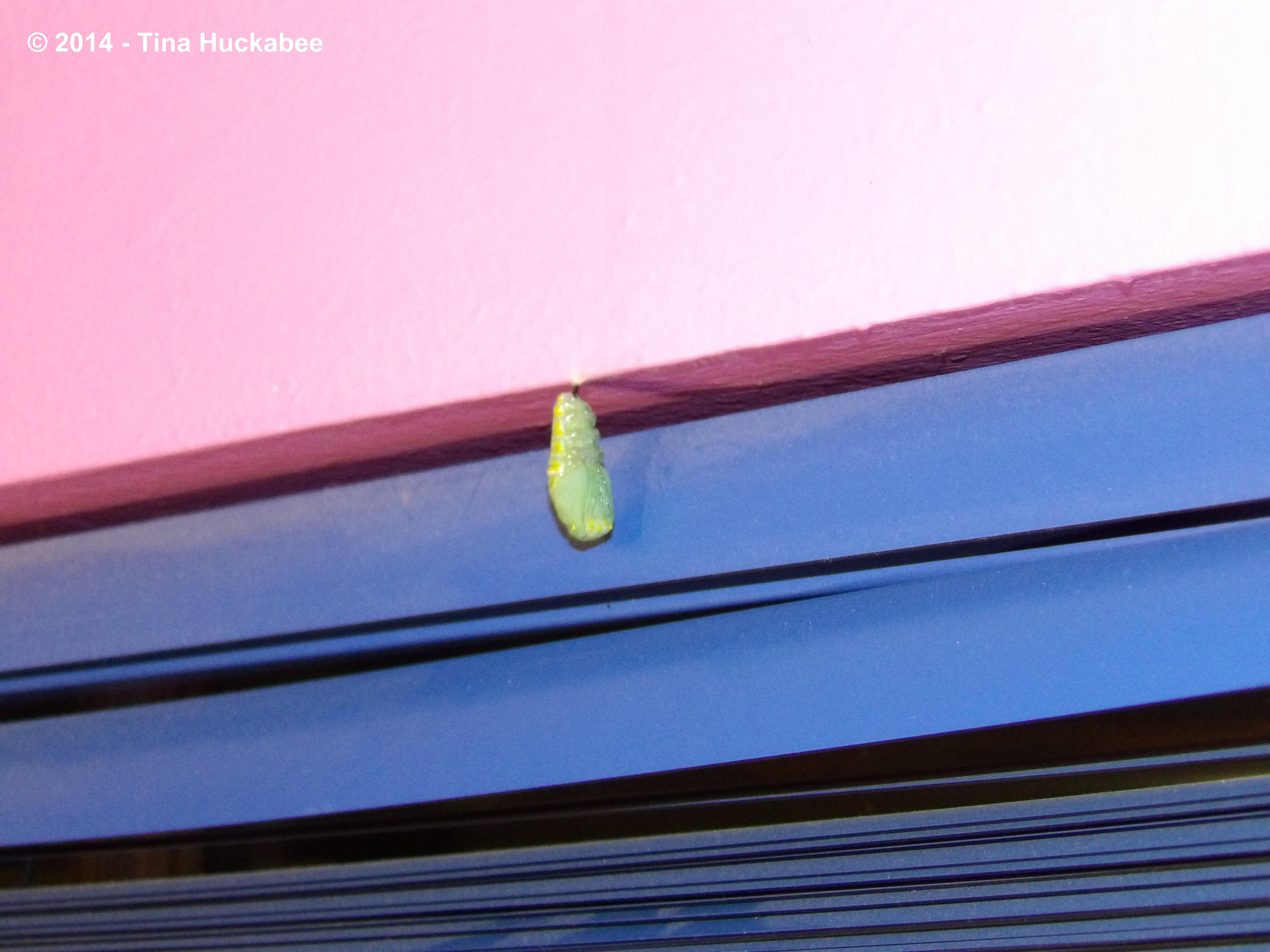
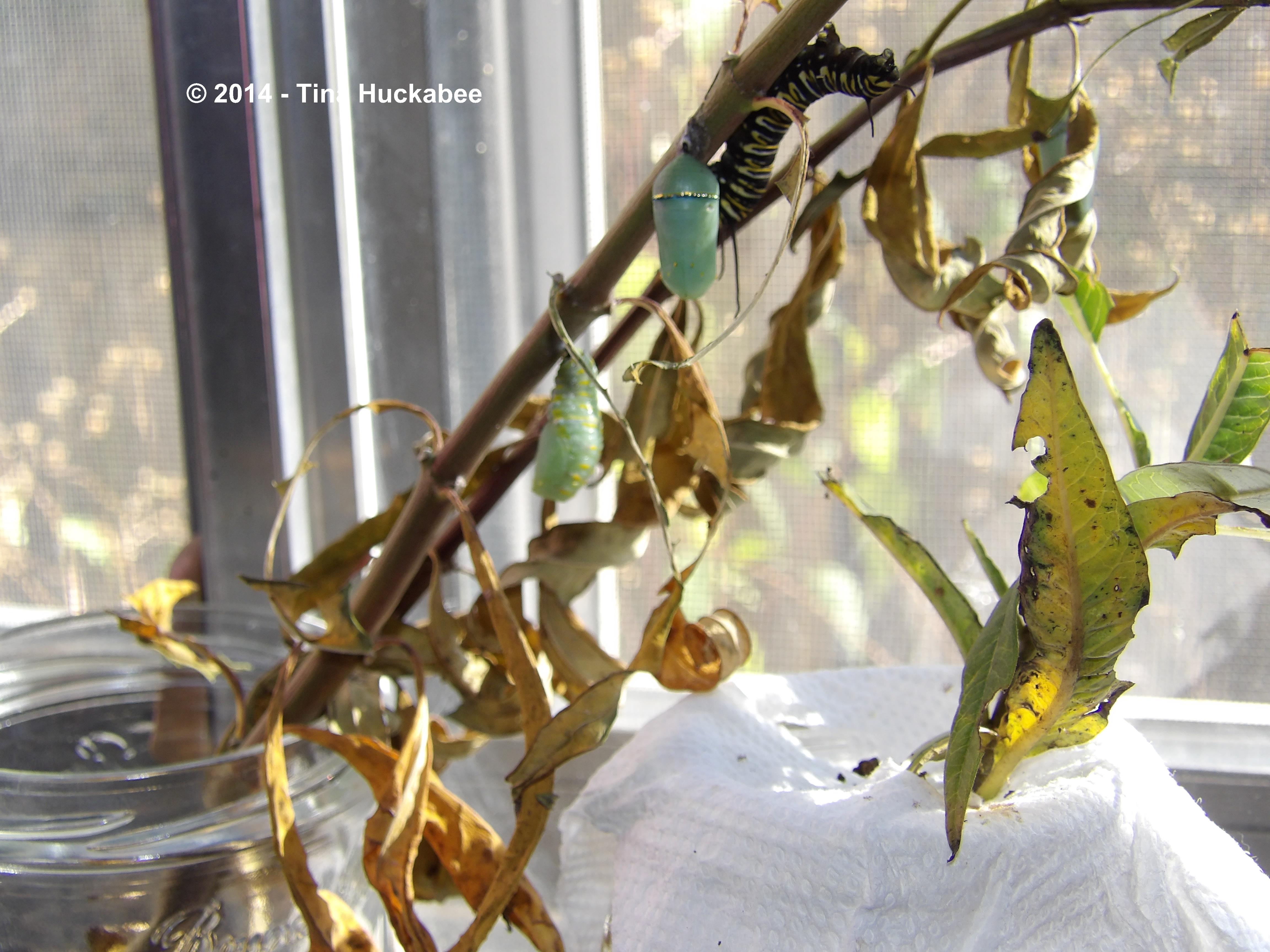
Fortuitously, during a brief Sunday afternoon Monarch check, I  came upon a chrysalis-in-the-making.
IMGP2800.new

IMGP2801.new

IMGP2802.new

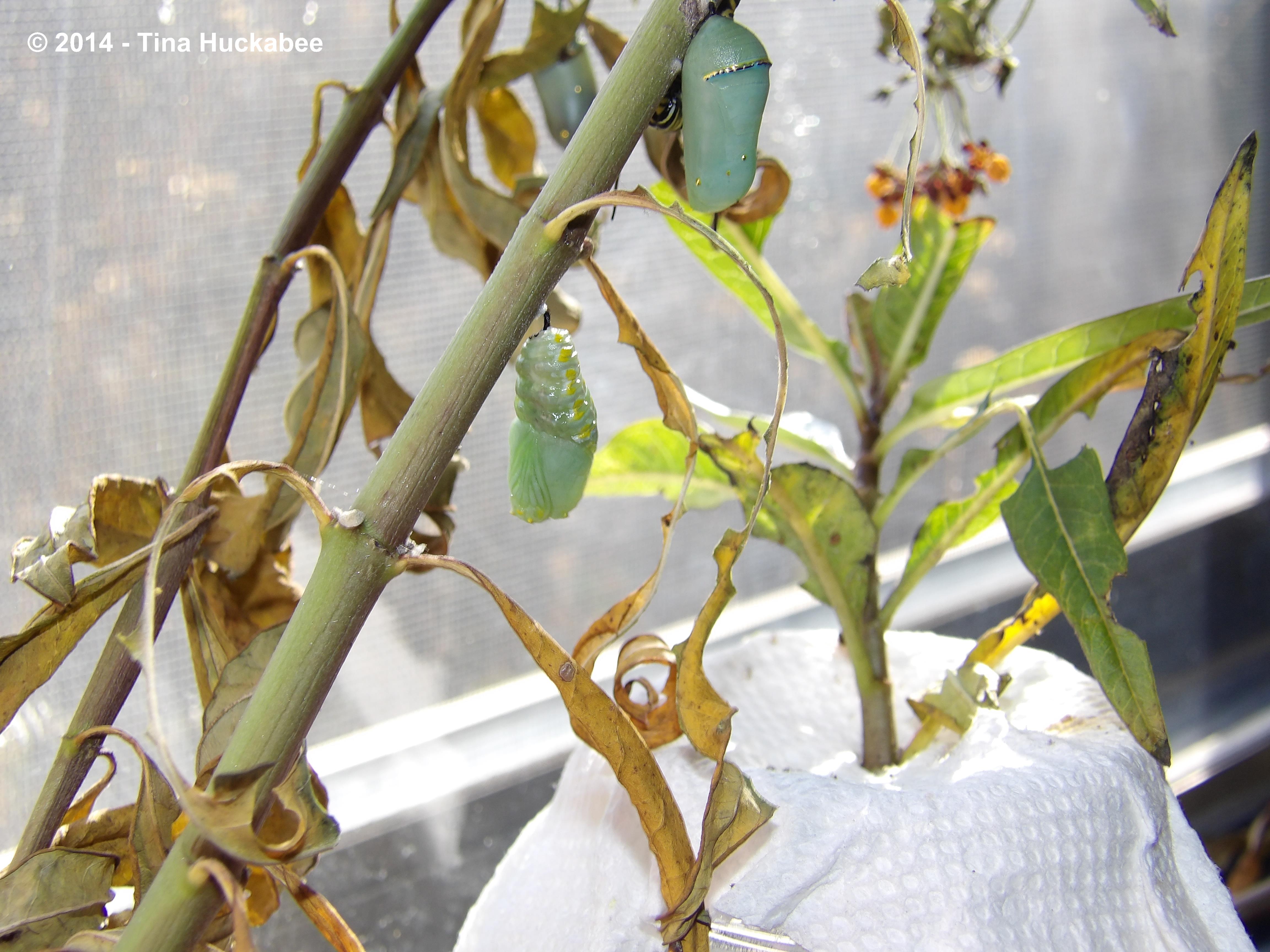
IMGP2804.newI stood there, stupidly transfixed, before I collected myself enough to grab the camera for some shots, because the last morph doesn’t last long.  And it didn’t.
IMGP2806.new

IMGP2809.new

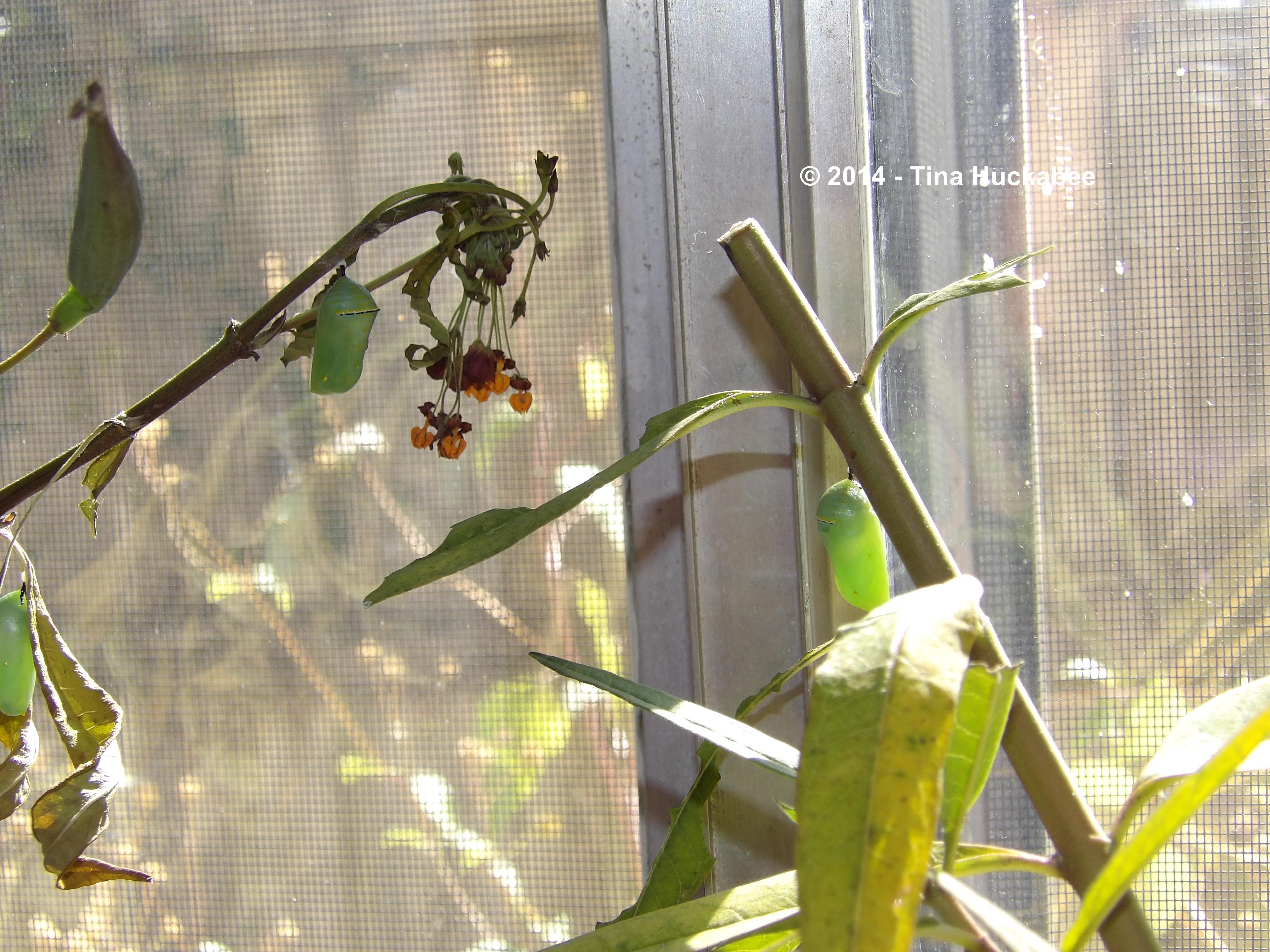
Within a minute or so, the action was over.  You can see the difference between a newly formed pupa and one that is older.IMGP2806.new
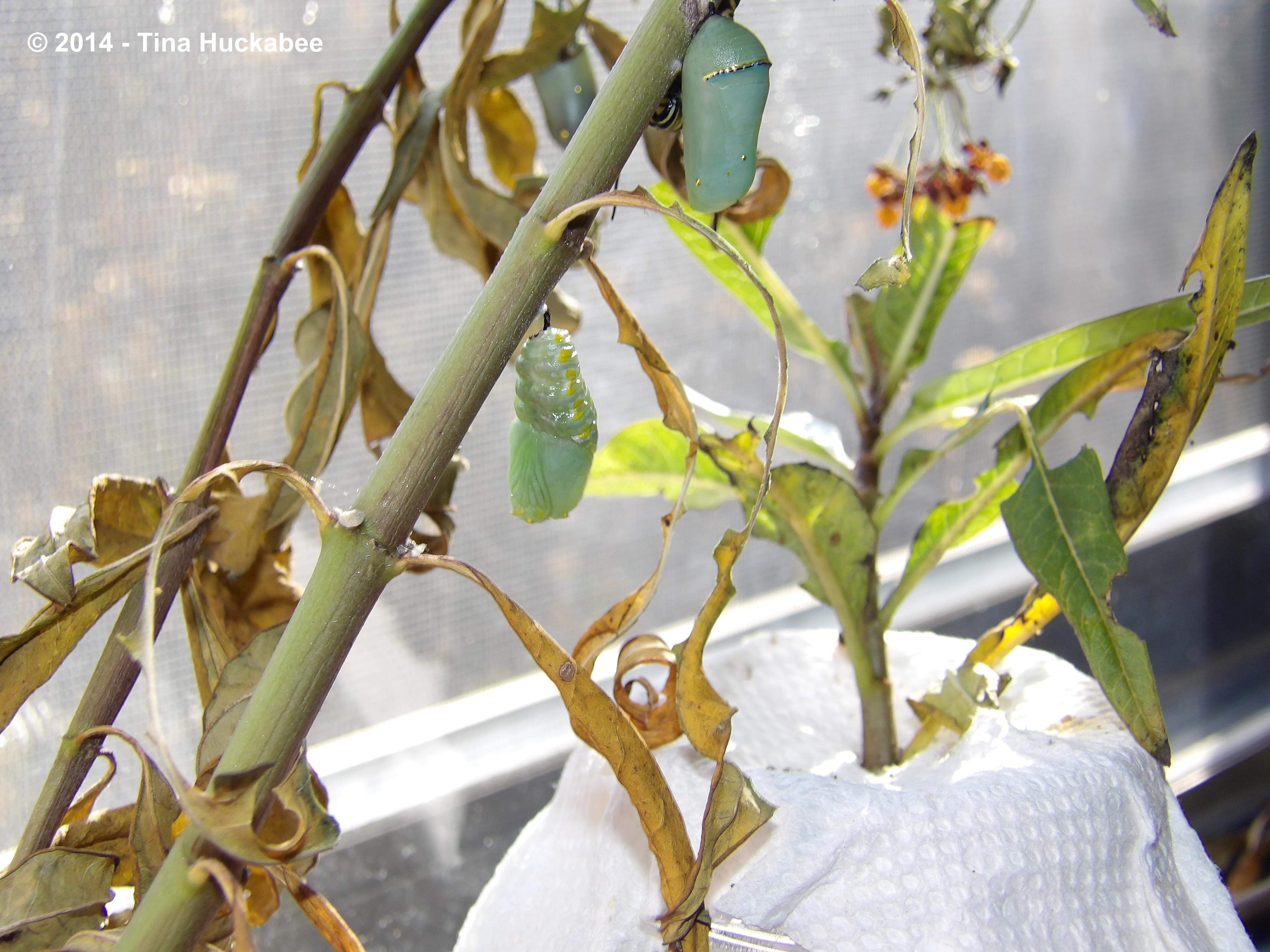
.

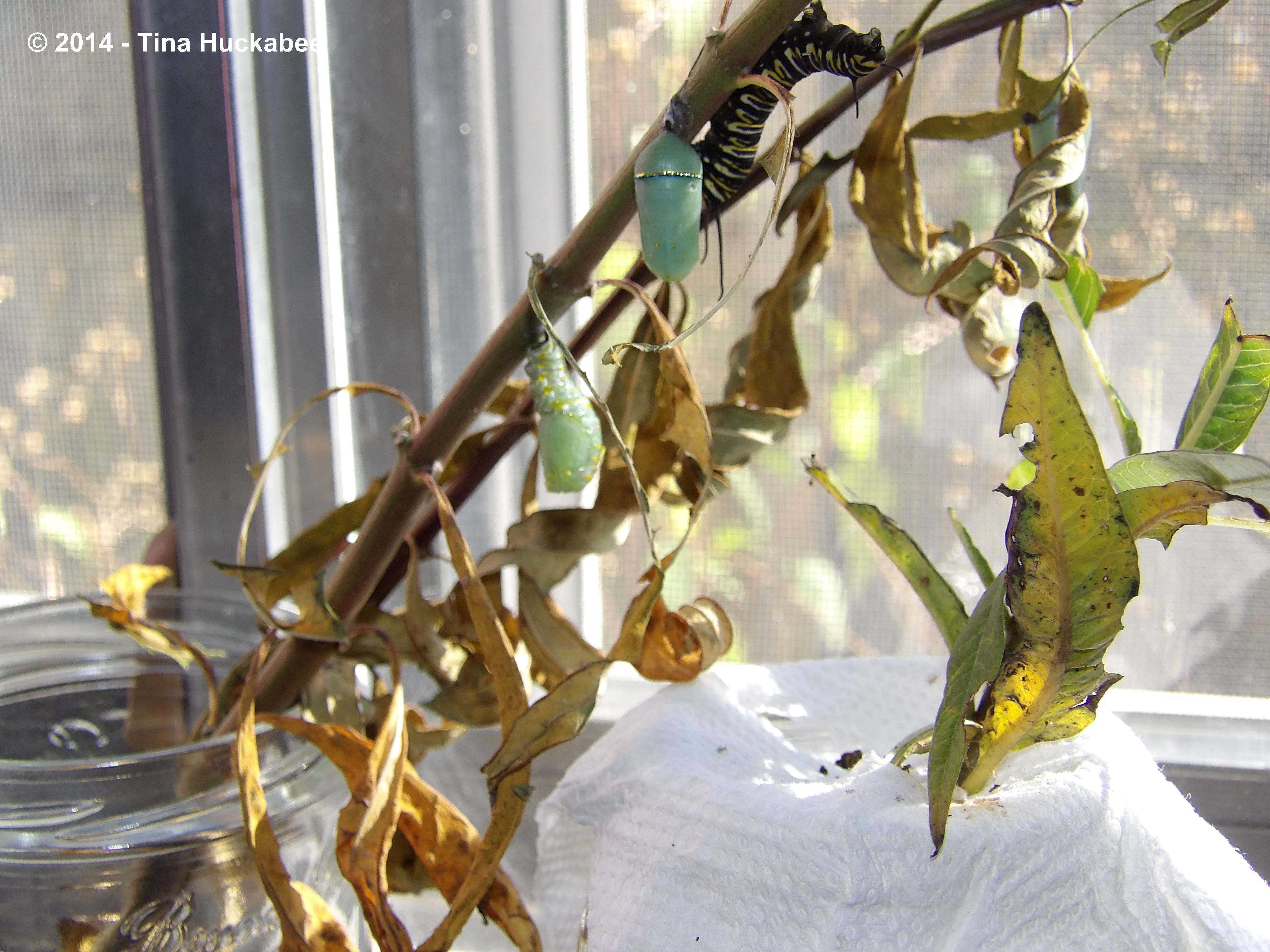
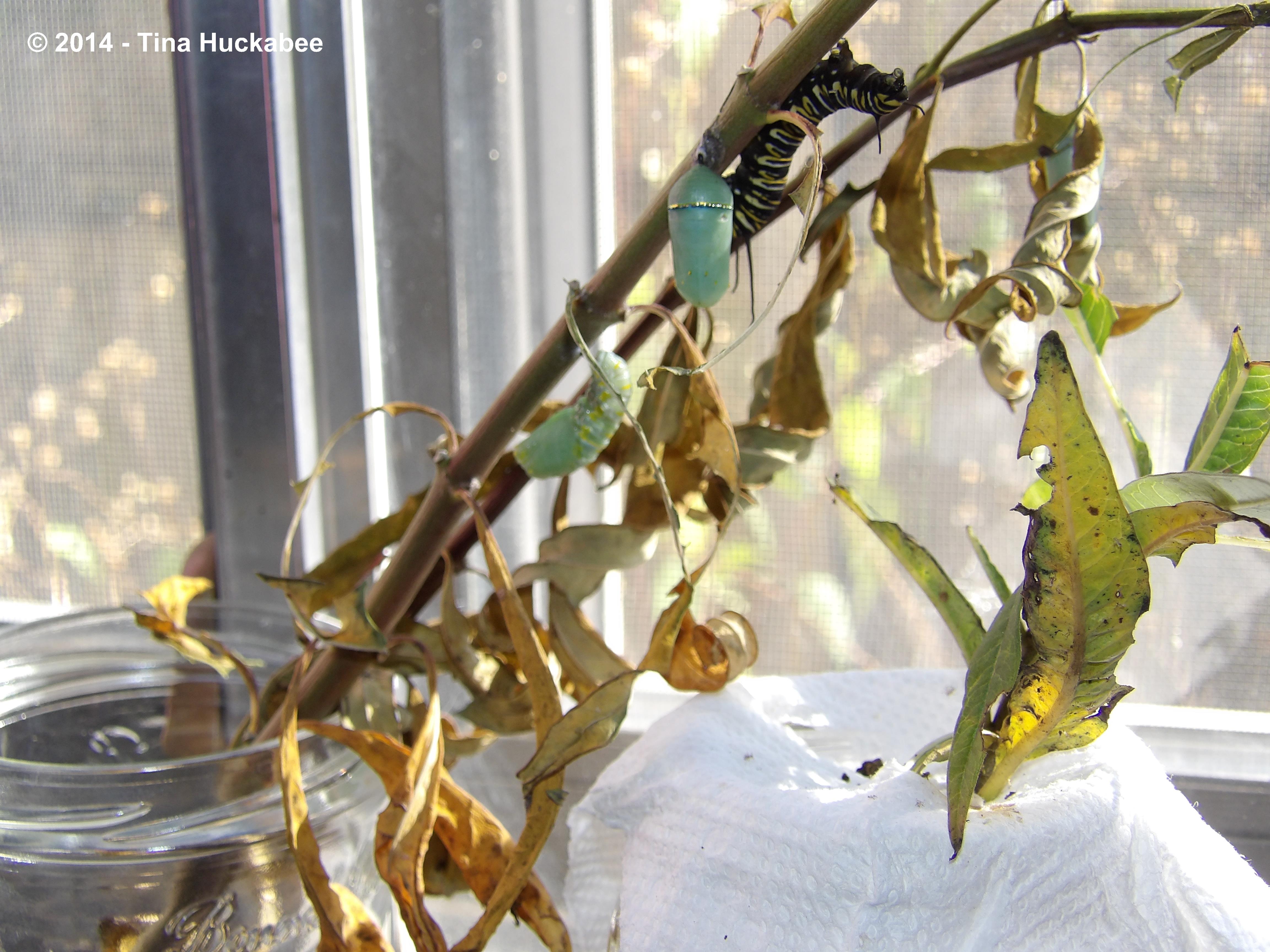
I’ve no idea what Mr. Nine Lives Cat is doing.  Still hanging around and not yet pupating.
IMGP2819.new


This little caterpillar died. Over the last few days, he stopped eating and succumb…to whatever caterpillars succumb to.  He’s the second of the nine larvae to die.
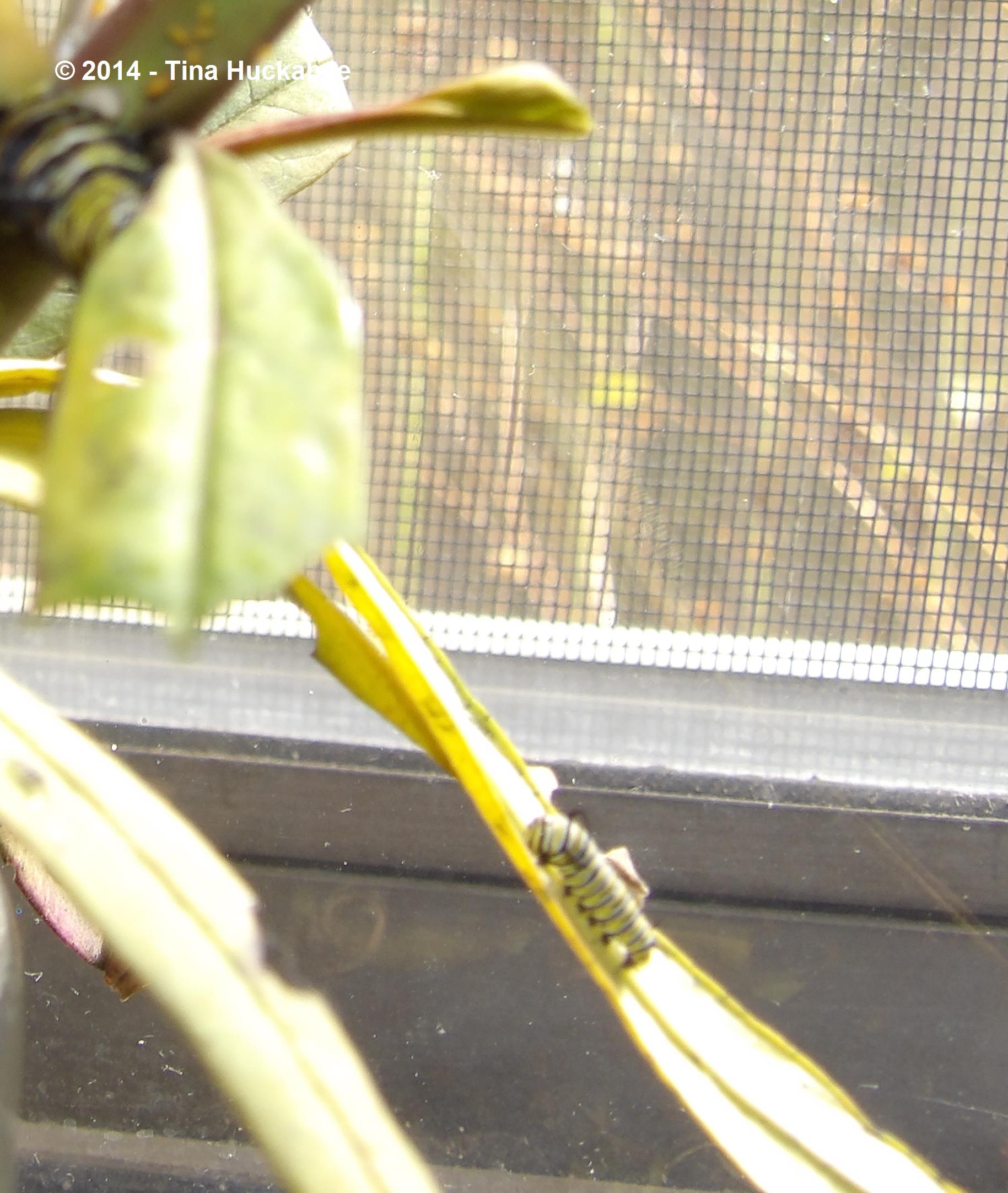
IMGP2752_cropped_1829x2165..new


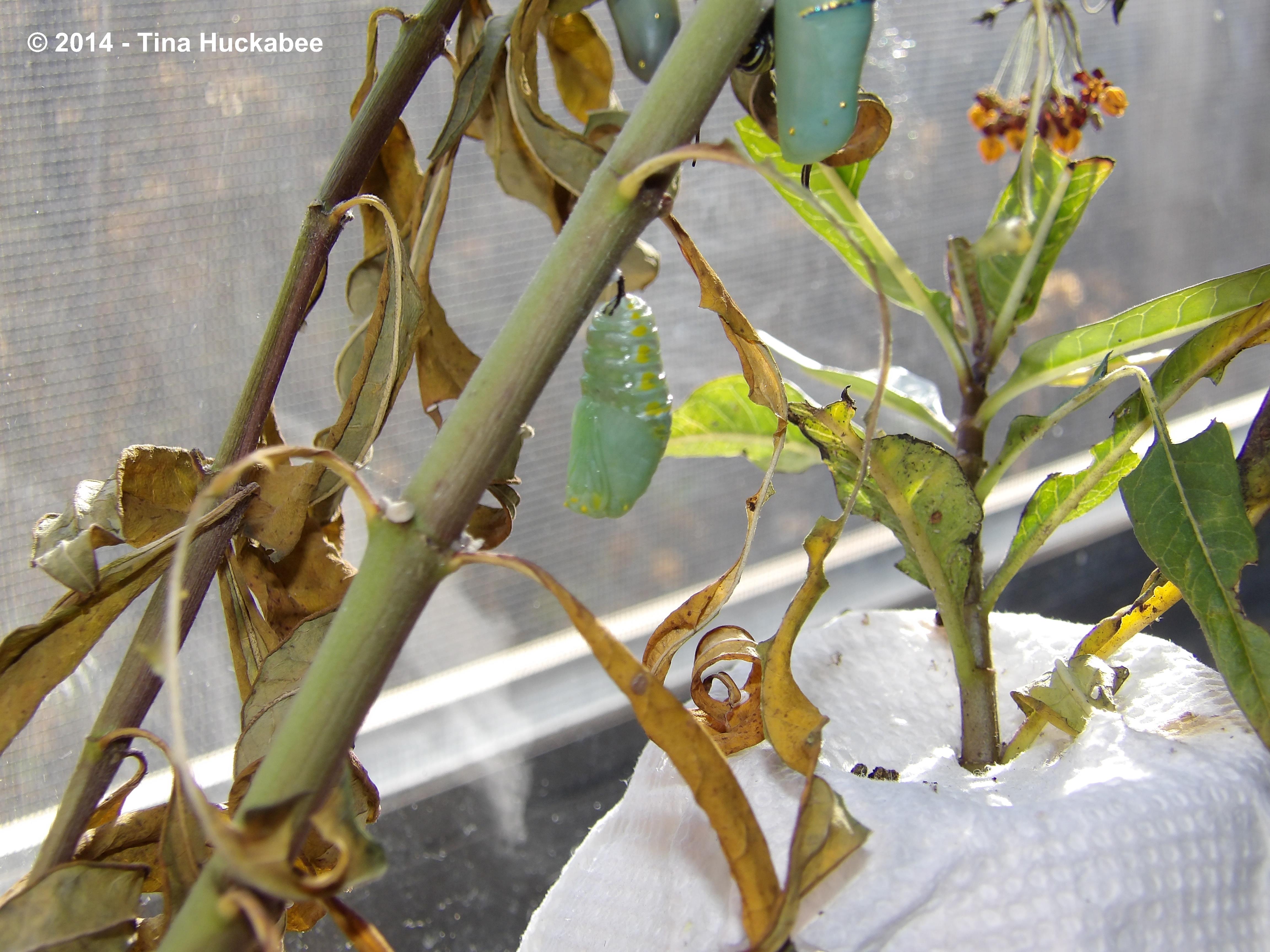
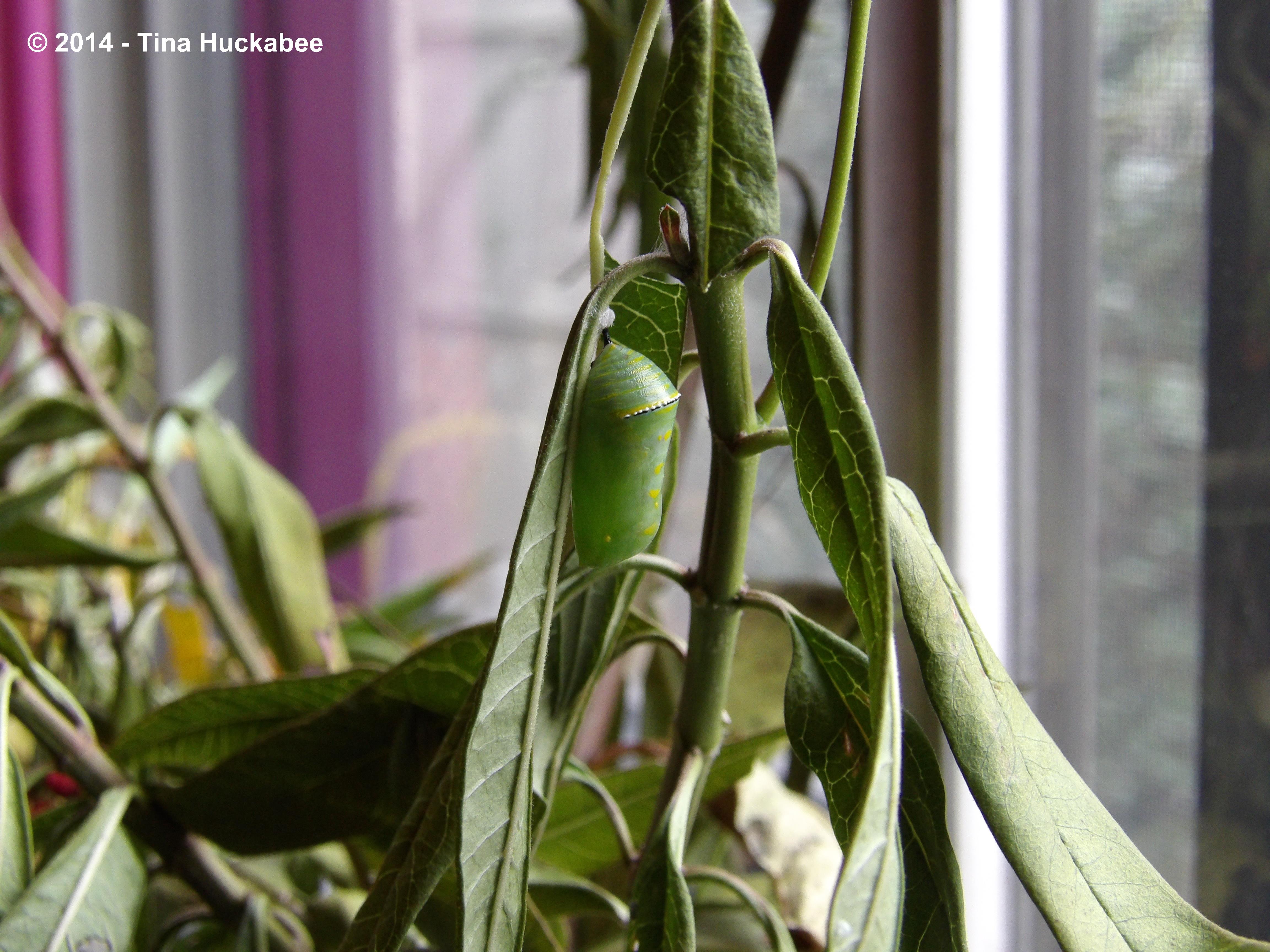
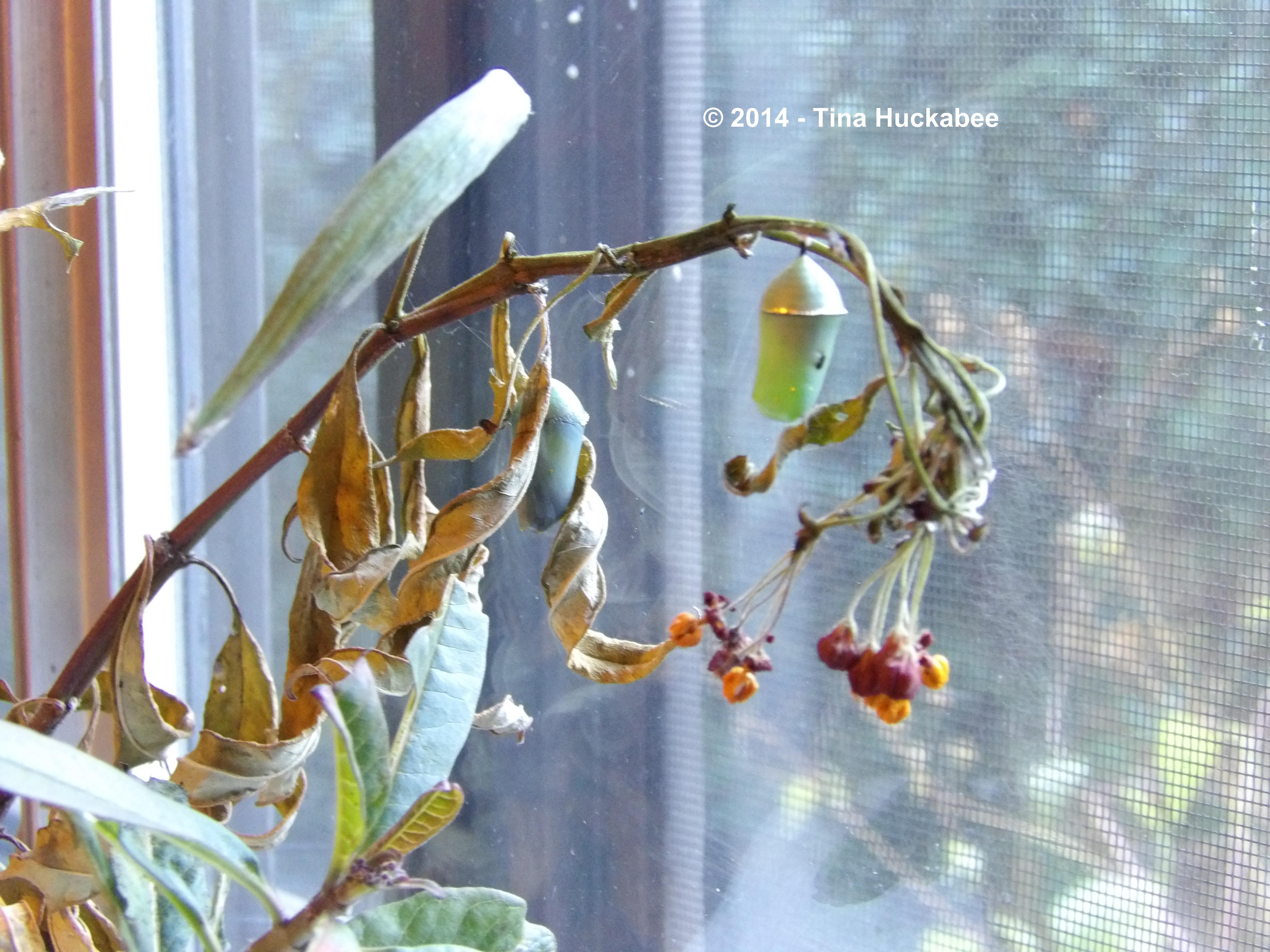
This chrysalis has some kind of glitch.  Do you see the black spot?
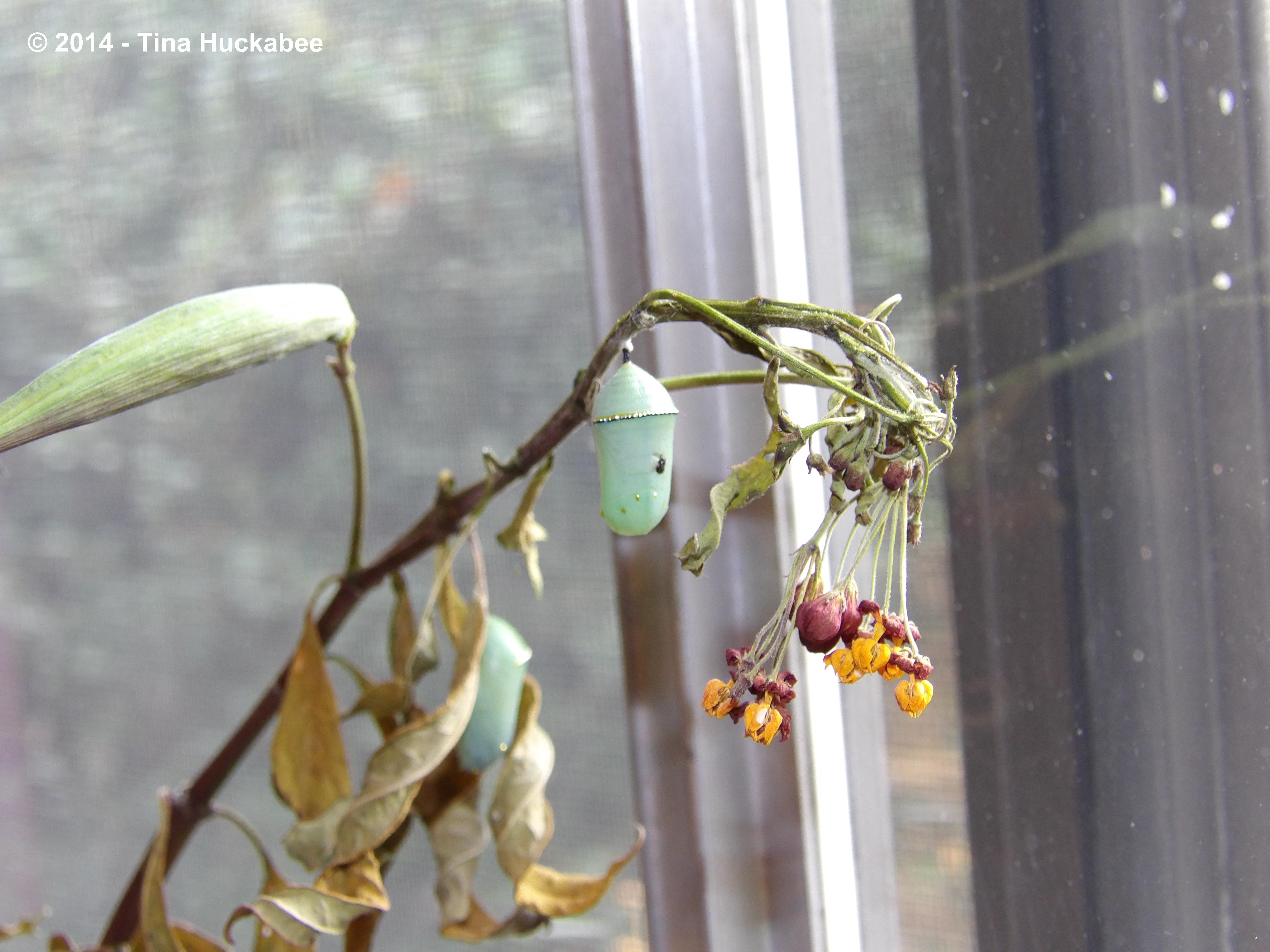
IMGP2767.new

It also appears to have sustained a little tear as well.  I don’t know whether I bumped it or if something else occurred, but it’ll be interesting to observe any anomalies in its butterfly evolution.

This chrysalis (to the left) was the first to pupate and is darkening, which means that the butterfly is in its last developmental stages and it’s a matter of day(s) before emergence.
IMGP2797.new

At least I hope that’s what the darkening means.

Our weather forecast is conducive to butterfly release over the next week or so.  Next stop?  Butterflies!
Monarch Moments

Taking a leaf from a sweet post of Rebecca’s Texas Garden, I am currently nannying Monarch caterpillars in my house.  Monarch-sitting has its brief, dramatic moments, but most days pass without much but eating.

RICOH IMAGING

And eating.

IMGP2484.new

And eating.

IMGP2487.new

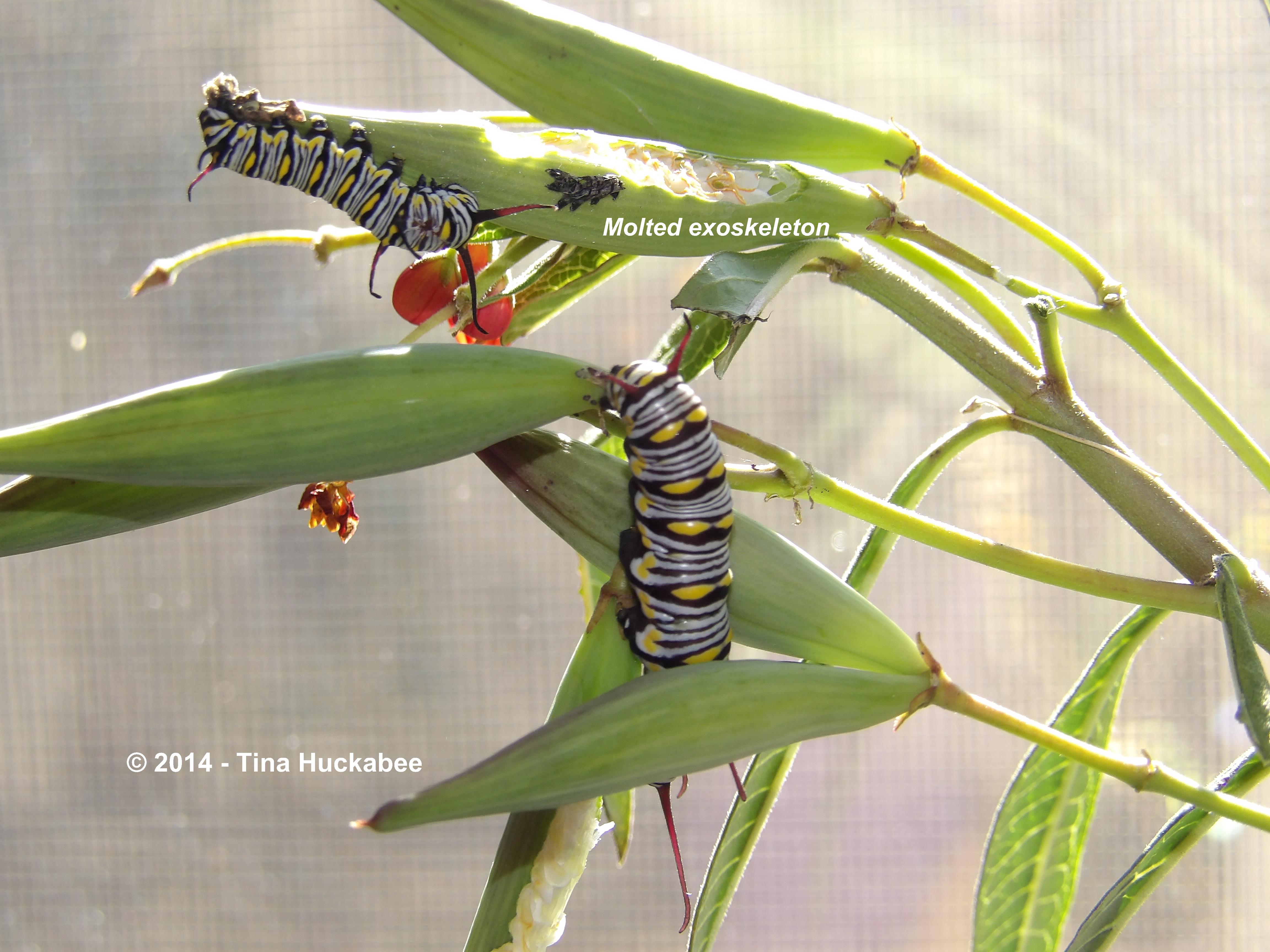
That’s how we grow, right? A  Monarch will gain about 2000 times its birth weight before it begins the process of transforming into its adult self.  And all that eating produces caterpillar poop, which polite people call frass.

IMGP2572.new

I am keeping the frass tidied up.  Sort of.

Continuing with this Lepidoptera saga of moving some milkweed with accompanying Monarch larvae into my son’s recently vacated room,

IMGP2573.new

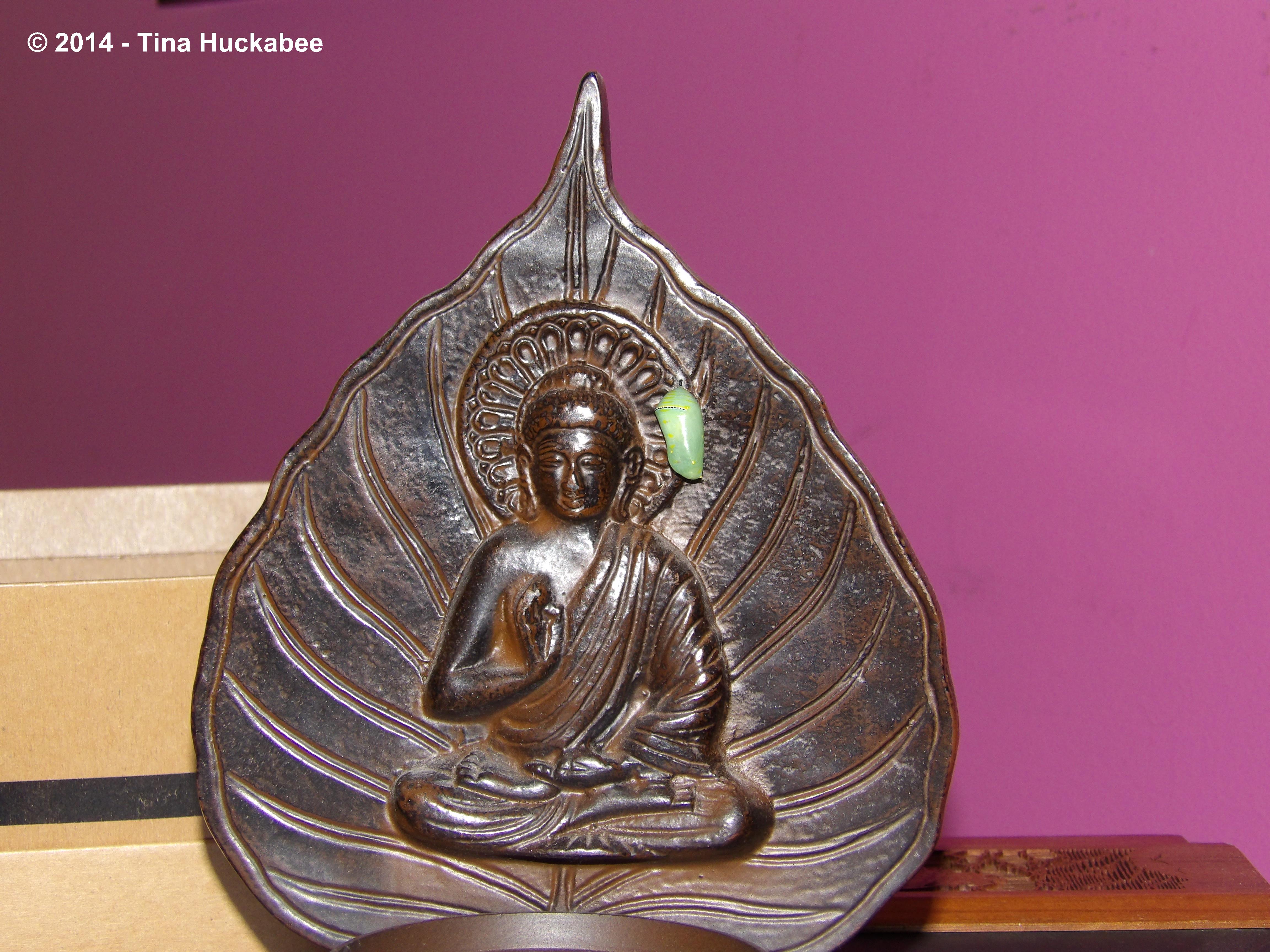
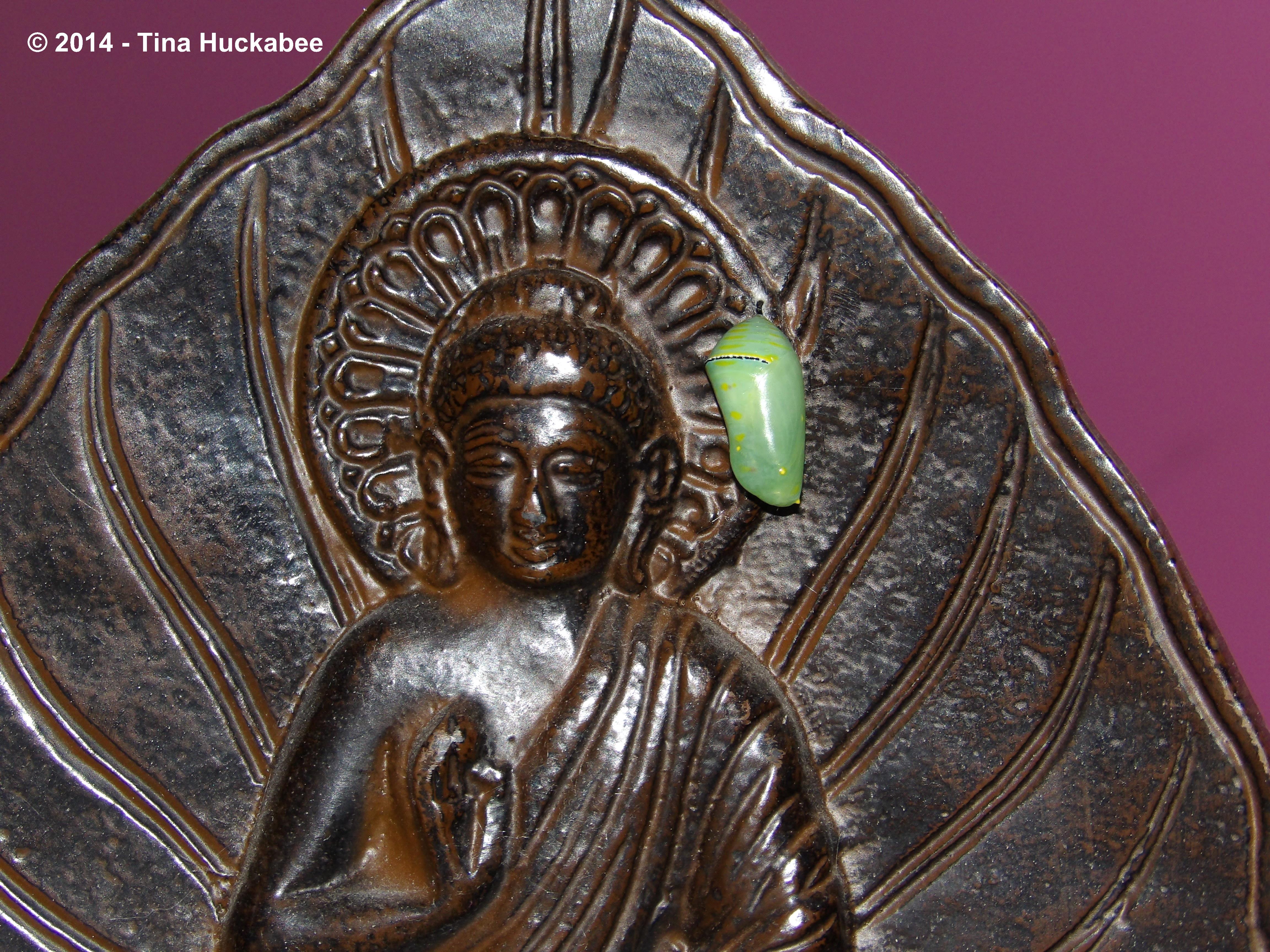
…there is action to report–Monarch goings on, if you will.  A couple of the caterpillars were quite large, nearing pupation stage when I settled them from the garden. Within two days, the first monarch completed its 4th instar (molt of the exoskeleton) and he’d vacated the bunches of milkweed to find a place for the final transformation, the chrysalis.  I realized there was one caterpillar missing and that he’d probably crawled away to pupate and  I launched a search mission.  I looked, knowing he hadn’t gone far, but I couldn’t find him. I counted and recounted caterpillars and was sure he wasn’t amongst the leaf chompers. He’d pupated, but where??

There he is!

Buddha-fly!IMGP2633.new

IMGP2635.new

When I was downloading photos for this post, I noticed in the photo below this first caterpillar crawling along the desk. He found the right spot on the statue of Buddha.

IMGP2585.new


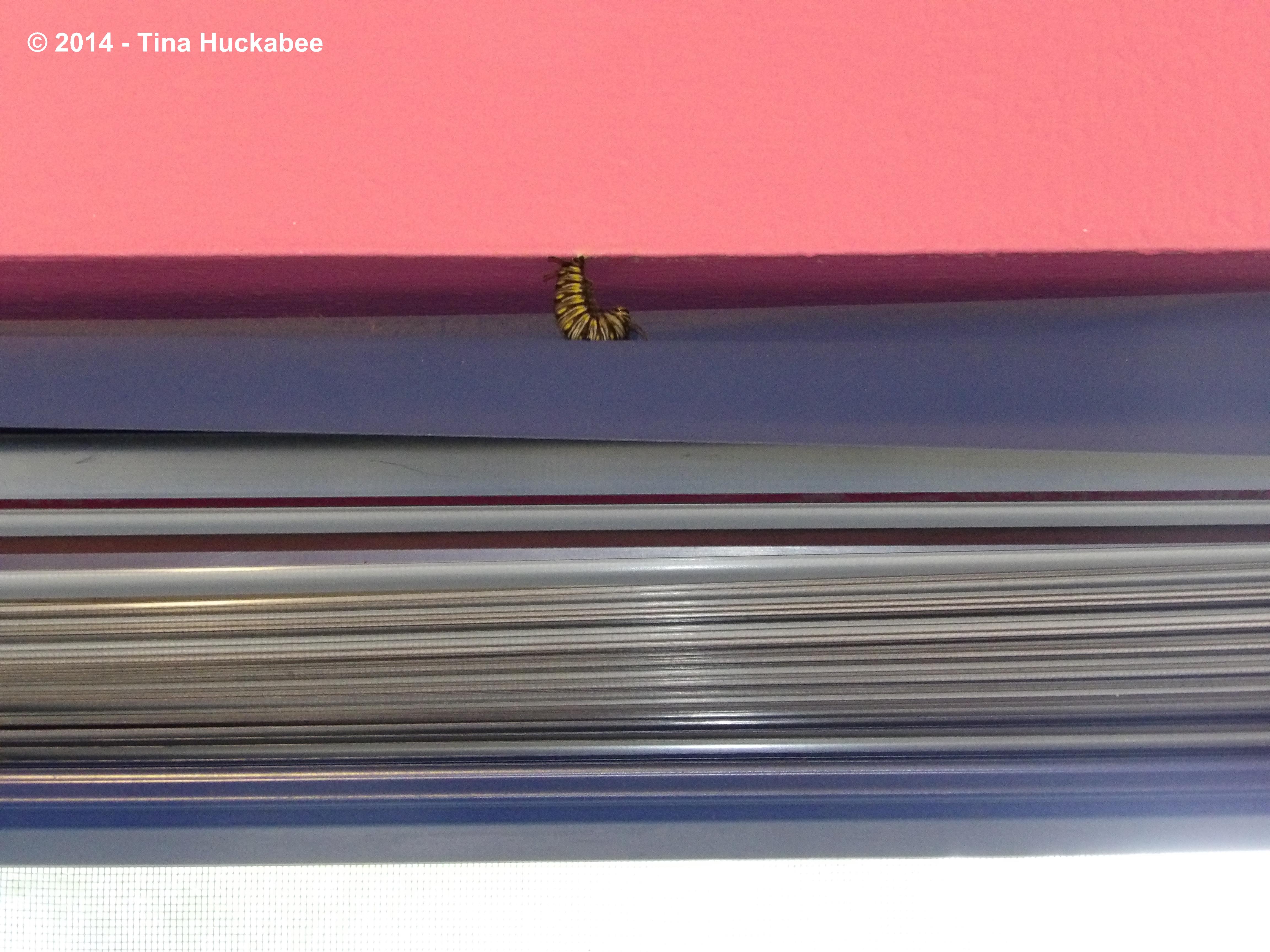
This guy was not far behind in the pupation process.

IMGP2575.new

I observed his disembarkation from the milkweed buffet and for a few minutes, followed his wanderings as he was (I assumed) looking for the perfect place to pupate.  He ended up here.

IMGP2653.new

Approaching his last instar this Monarch larva formed into the signature “J” shape for at least twelve hours.  I knew the “J” would become a bright green chrysalis sometime in the evening and I knew that the chrysalis transformation would happen in a short amount of time–minutes probably.   I came home from an evening out, flipped the light on and observed this wet, glistening chrysalis in major Monarch writhing.

IMGP2665.new

IMGP2666.new

IMGP2667.new

Moving like a green belly dancer, all sparkles and gyrations, the chrysalis was formed within a few minutes.   Afterward, the chrysalis calmed,  dried, and hardened. During the J process, he attached himself firmly to the corner of the window with a silk thread and there, will pupate until emergence.

IMGP2672.new

I think the caterpillars that have pupated  are all males. Looking at this excellent photo from monarchwatch.org, you can see the difference in a pupa between a female and male.  In real-time with my chrysalides, neither my eyes, nor my photographic abilities match that photo, but since I can’t see the line that is indicative of a female, I’m guessing boys so far.  I’ll know for sure once they are adults, because that’s much easier to discern.

The remains of his last larval molt, dropped to the window sill.IMGP2632.new

Another example of molted exoskeleton.IMGP2486.new

The instar process has repeated for this one,

IMGP2679.new


…and for this one.

IMGP2631.new

IMGP2680.new

I was keeping a keen eye on this guy, on and off, knowing the thing was going to happen. You can see the chrysalis green on the curve of the “J.

IMGP2721.new


Notice the drops of liquid.

IMGP2728_cropped_2396x2921..new


IMGP2717.new

Late Tuesday afternoon, I checked him, left to tend to something else, came back within 20 minutes and found the fully enveloped chrysalis, (left).IMGP2747.new

Drat! I missed it!

There are a couple of other caterpillars, still eating and growing.  I expect the first adult to emerge late this coming weekend or early in the week.

There are those who would question the wisdom of my efforts.  I question whether bringing them in was a wise move.  Should the larvae have remained on the milkweed to either overwinter or die naturally?  Should I even grow Tropical Milkweed in my gardens as it’s not native here in Austin?  There is preliminary evidence that the overuse of Tropical Milkweed (which seems to be the most successful large-scale milkweed grown for the nursery trade) in well-meaning, but misguided efforts to help Monarchs, may be interfering with their migratory patterns and possibly causing some disease problems. All of this is valid and I was aware these issues when I clipped the milkweed with the attached caterpillars and brought them indoors.   I now hold these late season larvae captive and they are growing to adulthood.  The next decision I make will be whether to release them and hope they can live to a ripe old age, nectaring on what’s available.  They probably can’t make it to Mexico, but I’m sure they’ll try.  Or, to keep them captive, safe and well-fed until they die of old age after the 5 or 6 weeks of their lives.

I guess the takeaway here is: don’t mess with Mother Nature, there are always unintended consequences.