Foliage Follow-up, September 2014

As with our blooms, the Central Texas foliage perks up with September rains, shorter days, and the suggestion of cooler temperature ahead.  I join with Pam at Digging to celebrate the end of summer, new beginnings for autumn, and all things leafy.

The pond garden is a riot of fascinating foliage.  Just take a look! P1070046.new

Lots of foliage action in this shot!  Clockwise from the bottom, the actual water plants include the lily pads of the two lilies I grow (Colorado and Claude Ikins), the Ruby Red Runner, and the showy leaves of the Pickerel RushPontederia cordata.   All three pond plants contribute to the biological filtration of my pond, though I also have a mechanical filter.

Continuing with the tour d’ foliage, the plants adjacent to the pond include tropical Yellow Bells, Tecoma stans, Soft-leaf Yucca, Yucca recurvifolia, Firecracker Plant, Russelia equisetiformis, Martha Gonzales Roses, Iris, Autumn Sage, Salvia greggii, and Mexican Feathergrass, Nassella tenuissima.  All of these perennials sport differing widths, textures, and colors of leaves.

P1070034.new

Ruby Red Runner dies back in the winter, but by late summer into fall it’s full-on lovely and spreading.

P1070042.new


P1070035.new

It’s seeded out in several places around the pond. This plant, usually used as a waterfall biological filter and prized for its attractive foliage, produces teensy puff-ball flowers,

IMGP0402_cropped_3073x3308..new

…which go to seed, thus, the spread.

Another view of the plants near the pond…
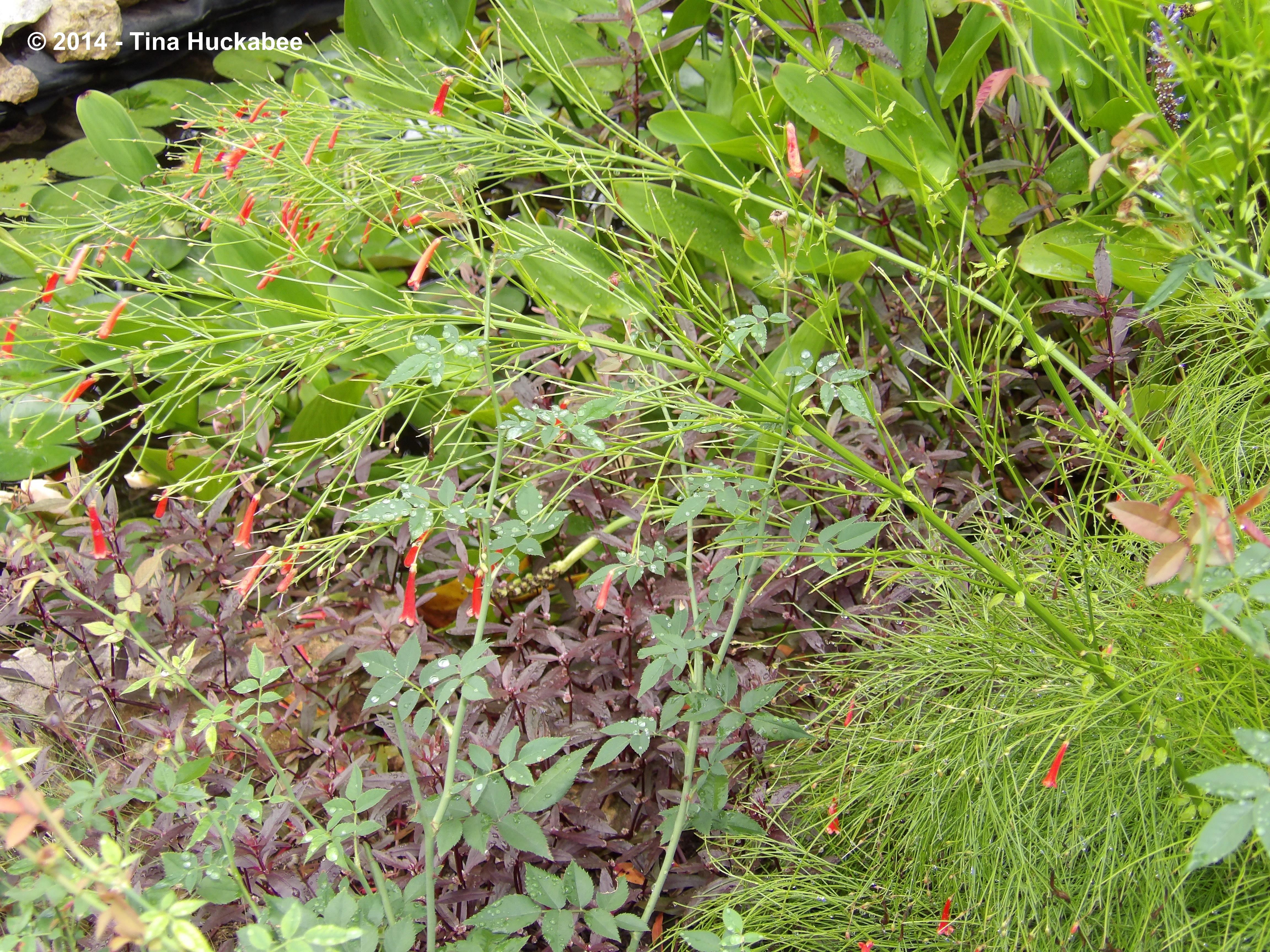
20140914_19.new

Not much blooming in those photos, but a variety of leaf beauty.

I particularly like these water shots with the creeping roots of the Ruby Red Runner, spreading its spidery fingers toward the lily pads,

P1070057.new

P1070056.new

…as if the roots are creeping outward to grab the pads.  Or maybe they’re just reaching out for a watery hug!

The soft, elegant foliage of Lindheimer’s Senna, Senna lindheimeriana,

20140914_11.new

lends structure to, but also softens the back of my garden.  Combined with the bright green leaves of the Yellow Bells and spiky, but matching-in-color American Century Plant, Agave americana,

P1070358.new

20140914_14.new

…the Senna fits well in this spot.

The morning after a recent rain,  the foliage of the Purple Heart, Setcreasea pallida, retained droplets along its edges.

20140914_54.new

With “traditional” autumn coloring, (which doesn’t happen for Central Texas on a large-scale until late November/December), the plumes of the Maiden Grass, Miscanthus sinensis ‘Adagio’, beautifully complement the flowers of Turk’s CapMalvaviscus arboreus, and the orange blossoms of Flame Acanthus, Anisacanthus quadrifidus var. wrightii.

P1070133.new

Here’s a closer look at the inflorescence of the Maiden Grass.IMGP0268.new

Along with the orange-y and autumn-y color theme, this new ceramic container is planted with the ‘Color Guard’ YuccaYucca filamentosa ‘Color Guard’, accompanied by Woolly Stemodia, Stemodia lanata.

P1070197.new

The container sits amidst a nest of blooming and berrying Pigeonberry, Rivina humilis.

What interesting foliage is gracing your garden space now?  Celebrate foliage in your gardens and learn about other foliage by visiting Digging for September Foliage Follow-up.


Foliage Follow-up, July Firecrackers!

There are several plants with the term “firecracker” in the name, but none lovelier than Firecracker Fern (Plant),  Russelia equisetiformis. 

P1050535 - Copy.new

This beautiful  tropical shrub sports small, red, tubular shaped flowers at the terminal end of the branches–and I’m a sucker for red blooms!  The flowers give rise to one common name of the plant (to some, they look like little firecrackers). But  Firecracker Fern hosts other common names: Firecracker Plant, Firecracker Fern, Coral Plant, and Coral Fountain.

P1050925.new

P1050926.new

P1050946.new

P1050949_cropped_2539x3239..new

But it’s the “Fern” part of the equation that attracts me.  Though I think the blooms are fetching, the “foliage” of this plant is what I find most appealing.

P1050959.new

This herbaceous (in Austin) perennial forms multiple bright green, arching branches.  Firecracker Fern is a rush-like plant, with wiry, slender foliage,

P1050539.new

though small ovate leaves form along the main branches of the plant.

P1050929_cropped_1979x2640..new

P1050935.new

Firecracker Fern is  a tropical native to Mexico, but grows officially in USDA zones 9-12.  Here in Austin, Texas, zone 8b, it will die to the ground after a hard, sustained freeze.  The Firecracker Fern doesn’t grow as large here as it does in its native zones because of winter freezes. Most specimens I’ve seen, including my own, only grow to about 3 feet tall and 2-3 feet wide.  In the milder winters of the past 15 years, my Firecrackers often didn’t die back completely. This past winter all of mine died and I wondered if they would return.  Happily, all did and my garden is the better for it!

The specimen beside my pond gets morning to early afternoon sun,

P1050948.new

P1050951.new

and the foliage is always striking–I think Firecracker Fern is a good companion plant for a pond garden.   It doesn’t require much water from me, so it also fits nicely with my xeric garden.  While not a strong attractor of wildlife, I’ve seen hummingbirds sipping at the little red flowers.    Firecracker Fern is reportedly deer resistant, though, like many plants, that can depend on drought and situation.

This group of three in my front garden,

P1050930.new

receive morning sun, then dappled shade for the remainder of the day.  They bloom,

P1050931_cropped_3495x2160..new

though not as profusely as the pond Firecracker Fern. I dug these three out from the mother plant beside the pond.  Firecracker Fern will form roots when the branches touch the ground around the immediate area where an original plant is located. Firecracker Fern transplants easily, though I’d recommend transplantation in spring because of its sensitivity to winter freezes. If transplanted in the fall, root development might not be significant enough for winter survival. When I gardened in the Green Garden at Zilker Botanical Garden, there were excess  Firecracker Ferns in the garden because several mother plants had rooted out.   I moved those extra plants to different spots throughout that garden, some in shade and some in sun. I think the Green Garden Firecrackers procreated well because that garden received regular irrigation.  It’s an easy plant to pop into a small space and  I always found a home for new specimens.

In my home garden, I like this combination of Firecracker Fern with Mexican Feather Grass, Nassella tenuisima, and Soft-leaf Yucca, Yucca recurvifolia. 

P1050961.new

And in another view, the slender foliage Firecracker Fern contrasts  beautifully with the wider leafed Pickerel Rush, Pontederia cordata.

P1050963.new

P1050928.new

Though I’ve never grown it as such, Firecracker Fern is a beautiful container plant because of its arching qualities–well, also because of its foliage and blooms!  In a container, it would require more regular (several times per week) watering than it does when planted in the ground.  There are also cultivars of this perennial that bloom creamy white or a pale pink flowers.

Beautiful foliage,

P1050965.new

and stunning red flowers,

P1050964_cropped_2967x4012..new

Firecracker Fern is a great plant for many situations in the garden.

Thanks to Pam at Digging for hosting foliage fun for July.