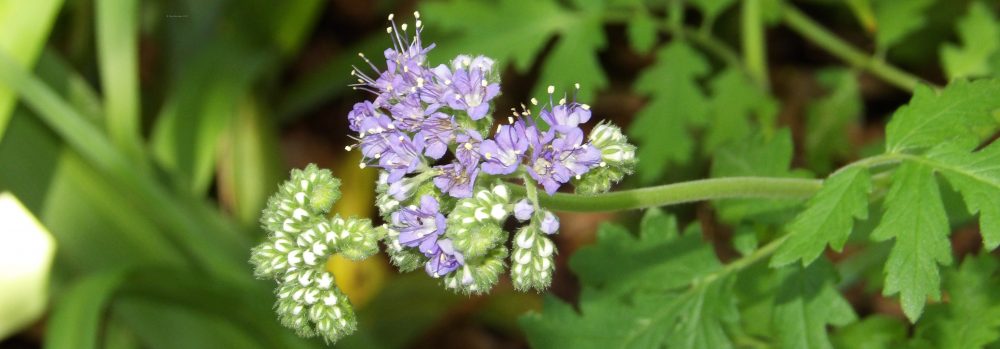
Here in Central Texas, resident birds slow down their feeder feeding during August, September, and October. The chicks have fledged and are mostly grown, the next breeding season is far enough away that adult birds are just taking care of themselves. Also, there are plenty of plants with seeds and fruits available during late summer and autumn, so feeders aren’t emptied with the enthusiasm as during other times of the year. Native plants are always the best feeders for birds! Birds are certainly around, but the garden is quieter in these months; I miss the birdie antics and chatter.
In the last few weeks, avian activity has ramped up. There are more birds and a greater variety of species. As well, the mated pairs are hanging out again and feeding together. There are two Northern Cardinals, this female,

…and her mate, that are regular visitors in the garden. For a while, I spotted a second male flitting about, but I’m guessing that this handsome guy chased him off and won her heart.

Red-bellied Woodpeckers are common in this neighborhood and several of her kind regularly stop by for suet (seen here) and peanuts.

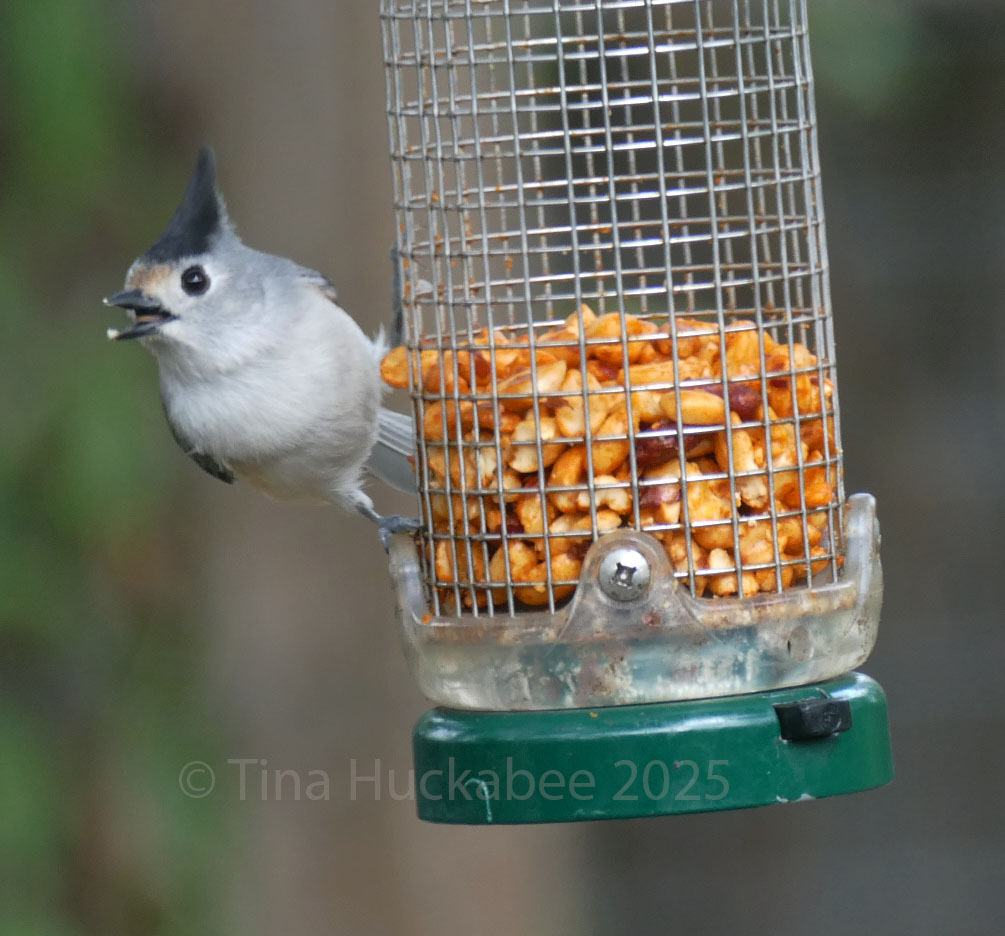
Some of the cutest birds are Black-crested Titmice. Native to Texas and northern Mexico, these adorable birds zip from tree-to-tree, branch-to-branch–and really love peanuts.
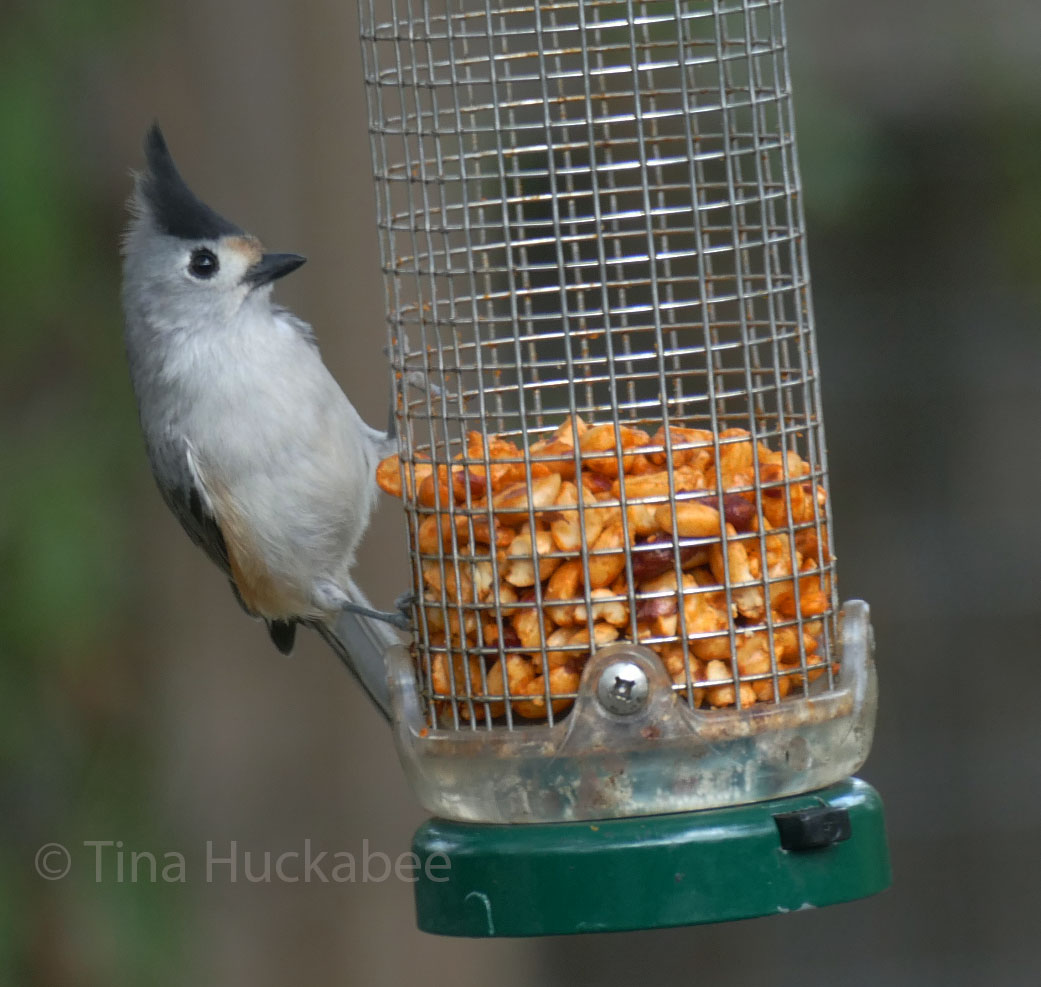
What a darling!
I’m always happy that over-wintering warblers hang out in the garden from November to April. Typically, there are one or more Orange-crowned Warblers, like this little one:
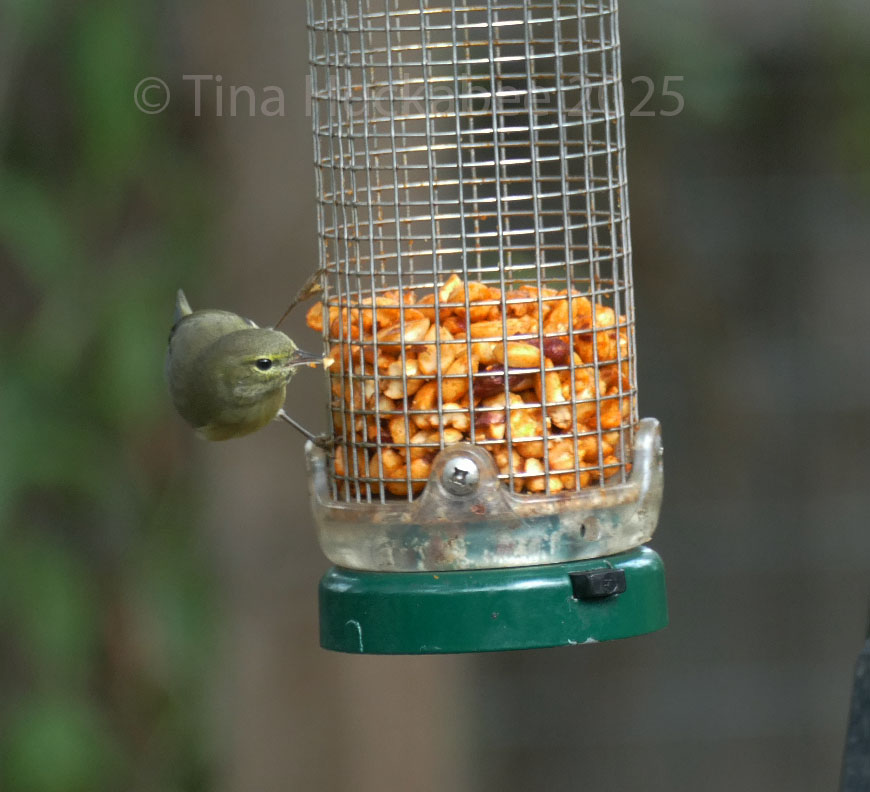

Also, Yellow-rumped Warblers and Ruby-crowned Kinglets are winter residents. So far this autumn I’ve sighted only one of the Butter Butts (Yellow-rumped Warblers) and no Kinglets in my garden. I have heard both kinds of birds nearby, so they may be snatching peanuts when I’m not looking.
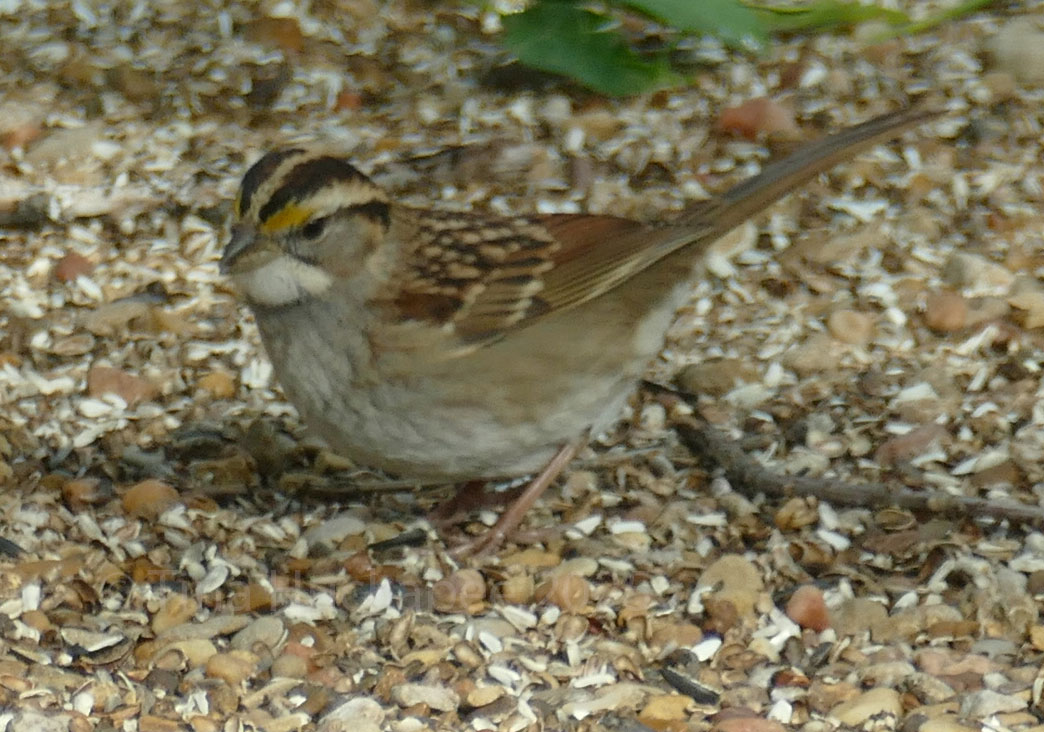
This attractive fella and a buddy spent a couple of days cleaning up sunflower and safflower seeds on the ground. A White-throated Sparrow, this part of Texas is included in its non-breeding territory. I’ve seen this species before, but they’re not common visitors to my garden.
A me-and-my-shadow capture of a local Blue Jay as it snacks on some peanuts. Blue Jays are always fun birds to have around: loud, raucous, and beautiful, they’re obnoxious charmers.

I’m keeping count of my backyard birds for Cornell Lab of Ornithology’s Project Feederwatch, though I don’t really need a reason to watch birds! It’s a great way to learn about resident and visiting birds, their habits, breeding, and food likes, and it’s easy. Birds are boss and always interesting to watch!
 My Gardener Says...
I remember that the birds disappeared in the fall, as there was a lot to eat in the woods. Quite a few birds are flying around here, some I recognize. I haven’t set up feeders or a garden yet, so I’ll see how it goes.
LikeLike
You may be in an area where you’ll enjoy the migratory birds all summer, whereas I’ll only see them in spring and fall. Looking forward to what you’ll write about!
LikeLiked by 1 person
Feeding birds is one of my greatest joys in winter. In our cold, bleak landscape, they bring life to a barren yard.
LikeLike
I’m sure they’re heart warming to have and I’m also sure they appreciate the buffet!!
LikeLiked by 1 person
It’s good that you know how to recognize birds by their calls alone, like the two you mentioned from next door.
You mentioned that the titmice really love peanuts. Are peanuts kin to something native in their diets that they particularly enjoy?
LikeLike
I don’t know the answer to that specific question. I can tell you that almost all of the resident birds and most of the migrants that come through my garden LOVE peanuts. My understanding is that peanuts provide fat and are similar enough in what birds like in nature (acorns, pecans, etc.) to make a good non-native snack.
Interestingly, your question caused me to think about all the birds I get in the garden and, except for the peanuts-in-the-shell (which jays, red-bellied woodpeckers…and squirrels love!), only the Titmice and Carolina Chickadees eat everything I offer in feeders, which is sunflowers, safflowers, shelled peanuts, and suet in winter. I’ve even seen the little Titmice taking a peanut-in-the-shell! It was almost as big as the bird! Cardinals and finches only eat the safflower and sunflower seeds.
The winter visitors really like the suet and the peanuts. I only use suet in the winter and I buy it. It’s made with lard, which I don’t use in my kitchen. I’ve made vegetarian suet (using Crisco–yuk) and the birds didn’t touch it. I guess they like the meaty kind!
LikeLike
It seems your winter visitors don’t keep kosher.
LikeLiked by 1 person
They don’t, but I think they are. 🙂
LikeLike
I was interested in your comment about your cardinals. I have a couple of pair that hang around, and they do eat shelled peanuts, although they’re also fond of shelled sunflower. Regulations here are “no shelled bird seed,” so shelled peanuts and sunflower make up the bulk of what I offer — although I have been known to hide white millet beneath shrubs for the doves. I’ve tried and tried to get something to eat safflower, but that just sits around untouched.
My bluejays are back again, and a whole assortment of sparrows. I think I saw a warbler, and the goldfinches are plentiful right now. The wrens and woodpeckers I had during the summer seem to have disappeared.
Are the peanuts in your feeder coated with something? They seem more reddish than the ones I use.
LikeLike
I recall that you’ve mentioned that your cardinals eat peanuts. I think that’s so interesting as I’ve never seen my cardinals eat them. I wonder if there’s something about our respective geography or climate that influences their choices. Plenty of times I’ve seen cardinals nibbling at ‘things’ in shrubs or on the ground, but never a peanut! The blue jays are ok with that, more for them. 🙂
I love that you’re hiding the millet. Resisting authority is a good thing. 🙂
You’re correct about the color of the peanuts. I use a liquid pepper sauce to discourage the squirrels from the peanuts. It’s not 100 %, but at least the little stinkers don’t eat it all! That’s another thing that weird about this year. Typically, squirrels are interested in the peanuts through about mid-summer, then they ignore. This year, they only became interested in the peanuts at about that time. As well, there 5 of them that wait for me in the mornings, one of which is right at my feet! Very assertive bunch. While they all look healthy and one or two seem a bit chunky to me, I wonder if they’re actually hungry? I’ve had no acorns on my trees this year, probably due to the drought and I assume this is the case throughout the neighborhood. I’ve wondered if they’ve having a harder than normal time foraging. I’ll keep feeding them, though it’s only a a couple of handfuls of the peanuts in the shell and whatever the jays drop from the feeders.
LikeLiked by 1 person