Always fascinating to observe, the insects of the Odonata order, Dragonflies and Damselflies, are regular–and welcomed–inhabitants in my garden. My pond, which sits in the back garden, is the main focus of the dragon and damsel action, but I observe these beautiful insects in all areas of my property. Interestingly, I haven’t observed as many dragons and damsels this year. I have no particular explanation as to why, but realized that the airspace around my garden wasn’t as busy as usual. That said, Odonata zoomies are increasing as we head in to late summer and I’m glad for that.
Odonates are found through out the world, excepting the polar regions. Texas hosts over 200 species, with well over 400 species living throughout the United States. All species live near water sources; the first and longest part of their lives as nymphs, called naiads, living exclusively in water. They morph through many stages, emerging as flying adults. Adult Odonates live in the air, their remarkable flying abilities key to their survival.
Dragonflies are generally larger and hold their wings at a right angle when perched.

Stunning creatures, their aerial acrobatics are endlessly entertaining. I like that they’re willing to sit still for photos, they’re patient subjects.
Males aggressively patrol their territories, chasing one another and performing for their potential mates. These two perched somewhat amiably on the foliage of a Soft-leaf Yucca, though they kept their big eyes on one another.
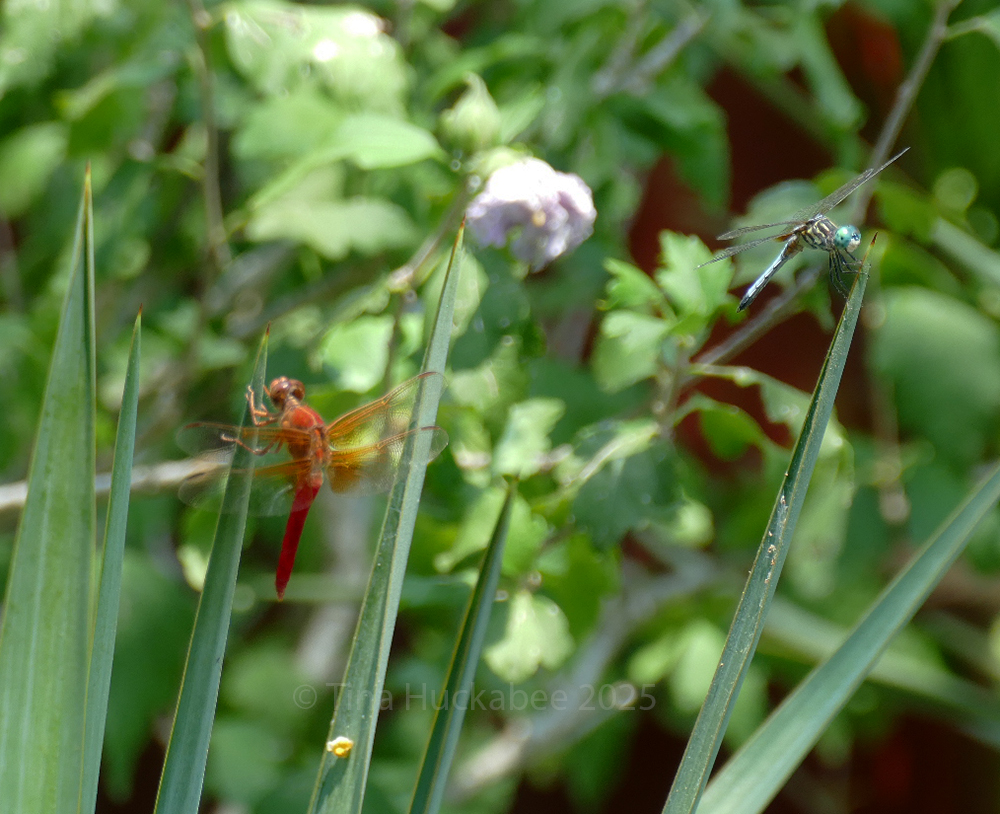
As well, they watched me as I ambled close-in for a shot. The Dasher zoomed upwards, took a spin around the garden, then landed in the same spot and waited for me to get his mug.
Sparkly, iridescent wings, lovely colors and patterns on heads, thoraxes and abdomens, these insects are predators, consuming a wide variety of insects, including mosquitoes (yay!), gnats, a variety of flies, and even butterflies and bees.

Dragonflies tend to mate in the air, females depositing eggs in a near-by water source. I regularly witness the neighborhood Neon Skimmer females’ rhythmic motions as they lay eggs in my pond. I’m sure many of those eggs and hatchlings are gobbled by the fish, but enough survive that I see larger naiads in late winter/early spring when we clean our pond. We always rescue these critters, putting them in buckets of saved pond water, dumping them back into the pond once it’s cleaned.
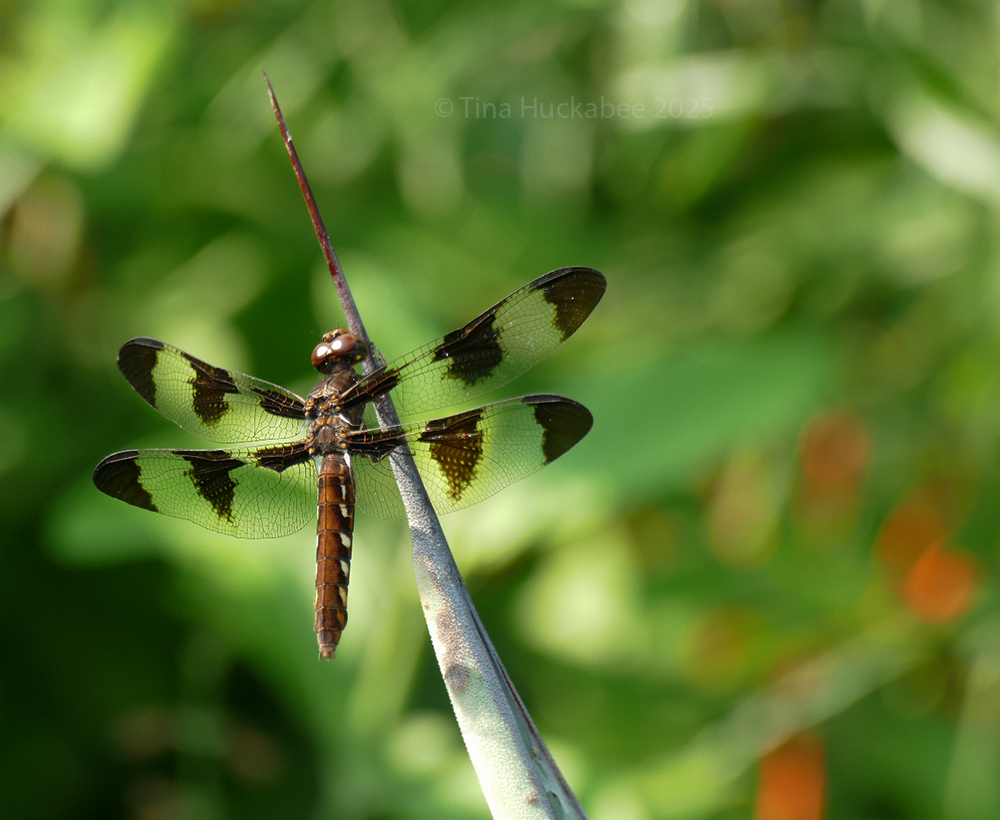
Neon Skimmers and Blue Dashers are currently the most common dragons in my garden. I find both kinds photogenic and a joy to watch.
The Dasher is particularly dashing!
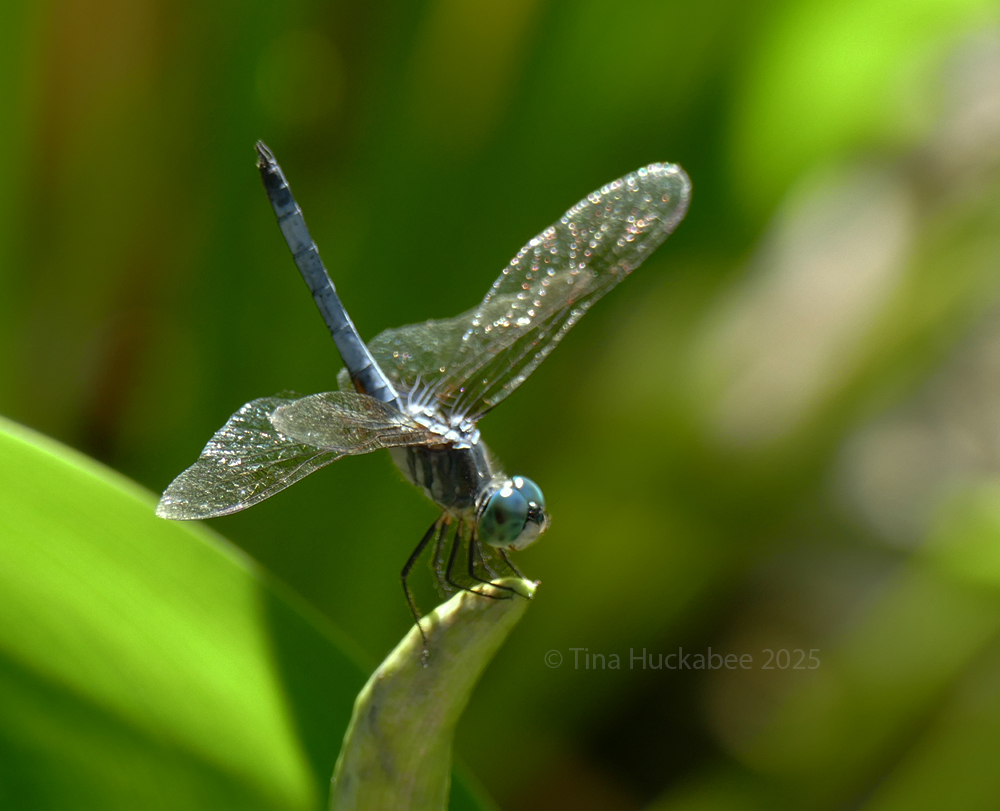
Odonates regulate their body temperature, responding to their environment. When the tail is pointed upward, like above, it’s hot. When temps are cooler (or “less hot”), the insects remain stretched, with opened wings.


Damselflies are equally gorgeous, but smaller and more elusive. Here in Texas, there are about 70 species, with about 128 throughout the U.S. I tend to see damsels in my gardens near, but not at, the pond. They like to perch on plants and because they’re slender, are tricky to observe. I’m certain that I have as many damsels as dragons in variety and number, but I don’t see them nearly as often.
Damsels perch with their wings folded over their tails.

Damselflies’ eyes are widely separated on their heads. Those big round orbs are hard to miss.
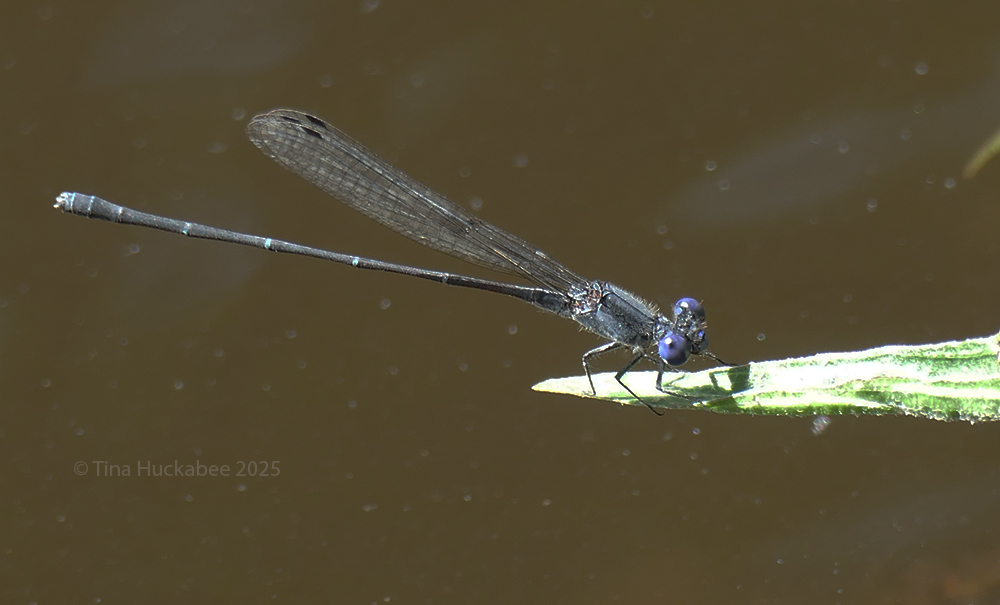
Like their Odonata relatives, damsels are accomplished flyers. They fly fast, change directions on a whim, and fly to hunt and patrol territory.
I like this photo, taken in spring. It looks like the Kiowa Dancer’s tail is touching water, sending off ripples. In fact, the insect is perched on a rock, well over the bog water–newly cleaned–and swirling of its own action, rather than having been touched by the tail.

Odonata are predators, but they’re also prey for birds and mammals. They are part of the intricate weave of a diverse biological community. They’re sensitive to environmental changes, requiring healthy, chemical free water sources and plenty of prey to eat. They’re also attractive insects, with charming physical features. They are a delight in the garden.
For more information about Texas Odonata, check out this link from Texas Parks and Wildlife.
 My Gardener Says...
You don’t have to look too far to find instances of biologists’ sense of humor. Referring to immature dragonflies as nymphs called naiads is an example. As Wikipedia notes, a nymph was “a minor female nature deity in ancient Greek folklore. Distinct from other Greek goddesses, nymphs are generally regarded as personifications of nature; they are typically tied to a specific place, landform, or tree, and are usually depicted as maidens.” More specifically, naiads were “a type of female spirit, or nymph, presiding over fountains, wells, springs, streams, brooks and other bodies of fresh water.”
No mythology is needed to account for the fact that as children in New York we called dragonflies darning needles.
Your pond makes all the difference in having dragonflies and damselflies in your yard. We have no pond and therefore none of those insects.
In my experience, fewer people have heard of damselflies than dragonflies. Have you observed that too?
LikeLike
I have, but then again, I’m always amazed at how few people I come across pay no attention to the natural world. I will say that before I began this wildlife watching, I would have assumed that a ‘damsel’ was just some sort of different ‘dragon’ and I would guess most would assume that too.
I never heard that NY kids called dragonflies darning needles–cute and creative!
LikeLike
I just checked the American Heritage Dictionary and found that darning needle in the sense ‘dragonfly’ is used in “Northeastern, Upper Northern, & Western US.” As kids I think we mistakenly believed that dragonflies could sting people.
LikeLike
I’ll bet most kids think most insects can sting!
LikeLike
Very fun insects to observe and have around for pest control. We esp. love the big green ones we see in late summer. I can watch them endlessly and cheer their mosquito catching prowess!
LikeLike
I wonder if those are Eastern Pond Hawks? There are green ones here too, though I don’t see them as regularly. Like you, I’m glad they munch skeeters, but there are still plenty of those blood suckers!
LikeLiked by 1 person
I think they are, though I’m not as well versed in insects as plants, but they are quite large. Yes, always more mosquitoes being hatched every day!
LikeLike
We have a good supply of skeeters too! Boo!
LikeLike
Last week, I noticed we’d had a hatch of a different species; hundreds of smaller, gold-ish dragons were everywhere. It’s interesting how each species seems to be on a slightly different schedule; I usually see damselflies galore around the boats, but this year they’ve been absent. My most memorable encounter with damselflies involved boats; one ate another on a boat railing, right down to the eyes, which it left. I didn’t have a macro lens at the time, but I still have a photo of those eyes, which I brought home and photographed on the dining room table!
LikeLike
Wow–what a story. I wonder what it was about the eyes it didn’t like? I mean, everything else… 🙂
Interesting that you’re short of damsels, too. I wonder if there’s some cyclic thing this year whereby breeding/hatching hasn’t been as robust? I am seeing more now, but it’s been a slow start.
LikeLiked by 1 person
When osprey sit atop a mast and devour a fish, they seem to reject the eyes as well. When I’m cleaning entrails off a deck, I often find fish eyes!
LikeLike
I guess the eyes taste yucky!!
LikeLike
We might say the predatory damselfly couldn’t metaboleyes those last bits of its prey.
LikeLike
If beauty is in the eye of the beholder, yuckiness is in the mouth of the eater. Many people in Asian countries consider fish eyes a delicacy.
LikeLike