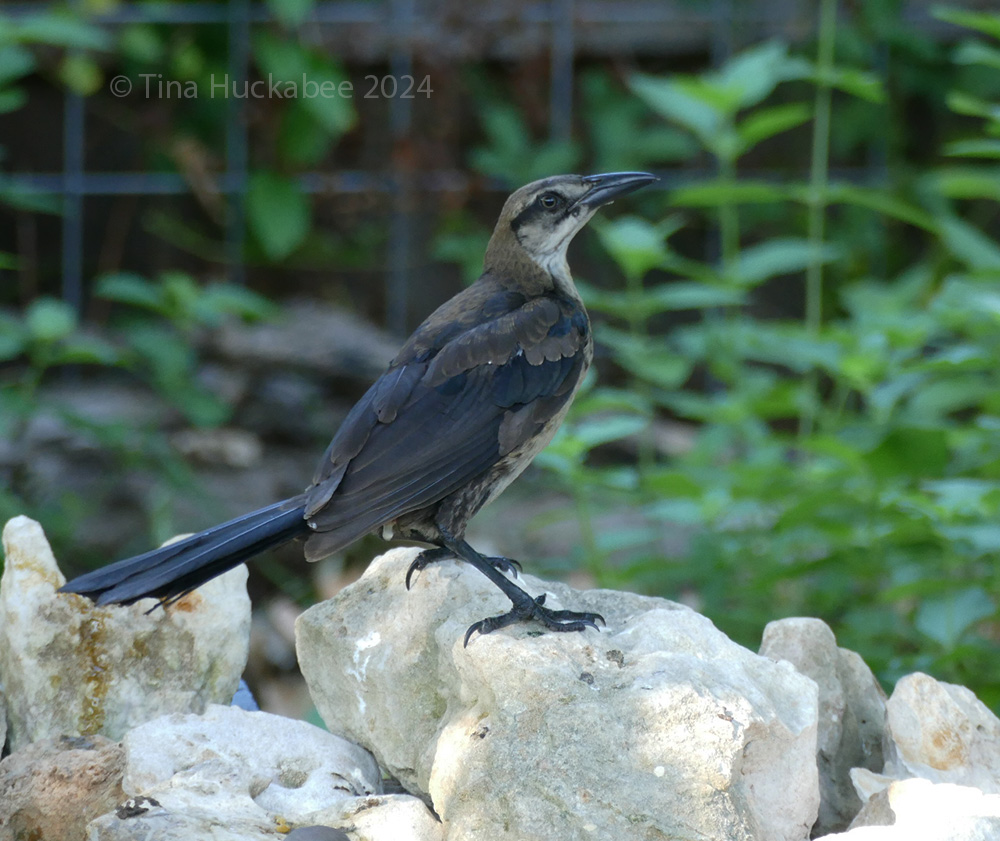
A new-to-me bird has visited the back garden this past week. I thought it kinda looked like a grackle, but it’s larger than either the Common Grackle or Great-tailed Grackle that are the usual grackle suspects here in Central Texas. Also, it has a mottled coloring, which I assume means either a juvenile or a female bird. It likes water. A lot. From the waterfall and bog of the pond, to the shallow bird baths nearby, this bird likes to bathe, spending most of its time splashing and dipping its impressive beak.
And look at those big feet!
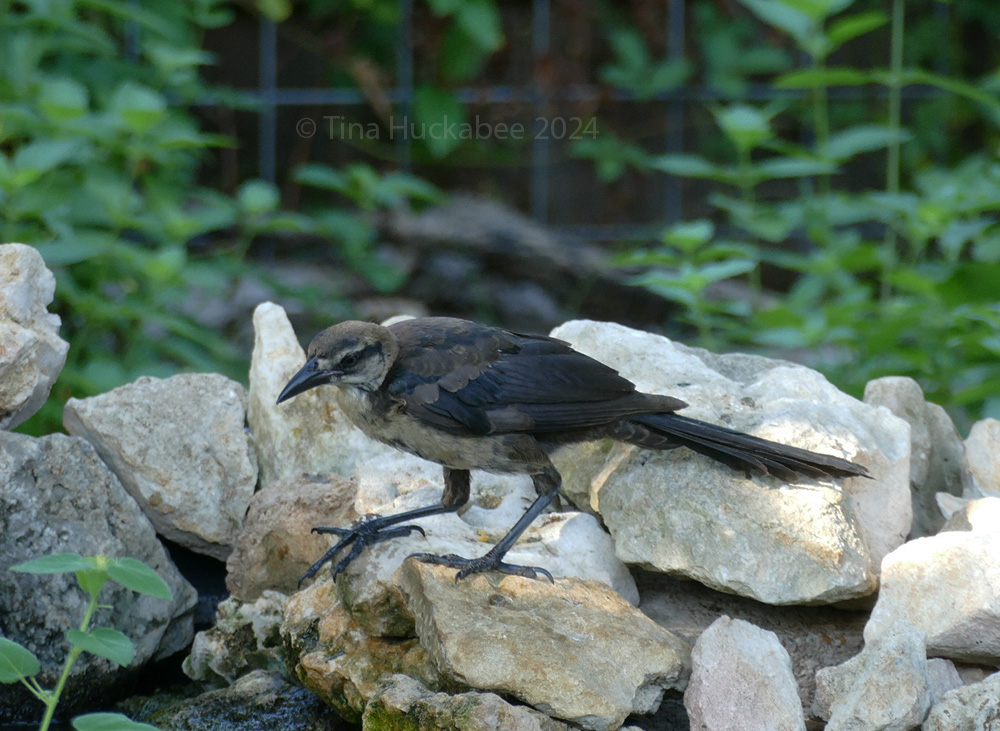
I checked my go-to resource for all about birds and Cornell Lab of Ornithology identifies this fella as a Boat-tailed Grackle, Quiscalus major; the Merlin app categorized this bird as rare for Central Texas.
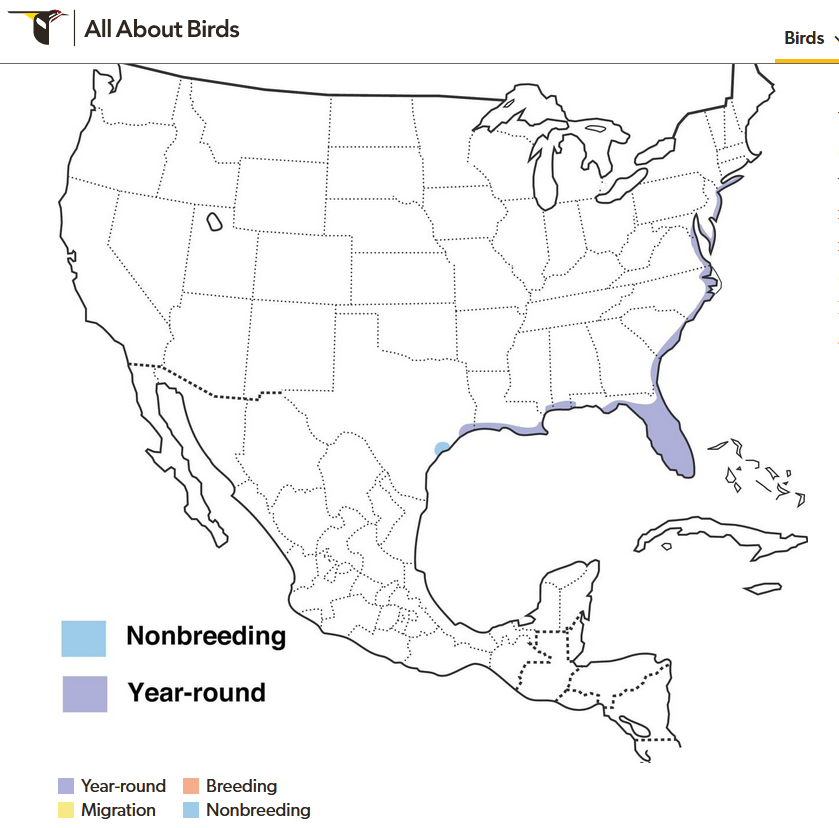
This is the Cornell map of Boat-tails’ range and it’s clear that this Boat is out of its normal stomping and bathing grounds. Along the east coast of Texas, some hundreds of miles east of my garden, one blob of blue indicates a non-breeding area for these birds, and nearby, a smidge of lavender, which is part of the Boats’ breeding range. Neither of these are anywhere near my pond!
I wonder how and why this juvenile male Boat-tailed Grackle wandered so far away from home?
He’s a bit aggressive with other birds, particularly the White-winged Doves (who are a bit aggressive themselves), though that might just be the teenager in him. I like how he looking at the dove, who who managed to plop itself in the cooling spillway of the pond’s waterfall ahead of Mr. Boat.
If looks could kill…
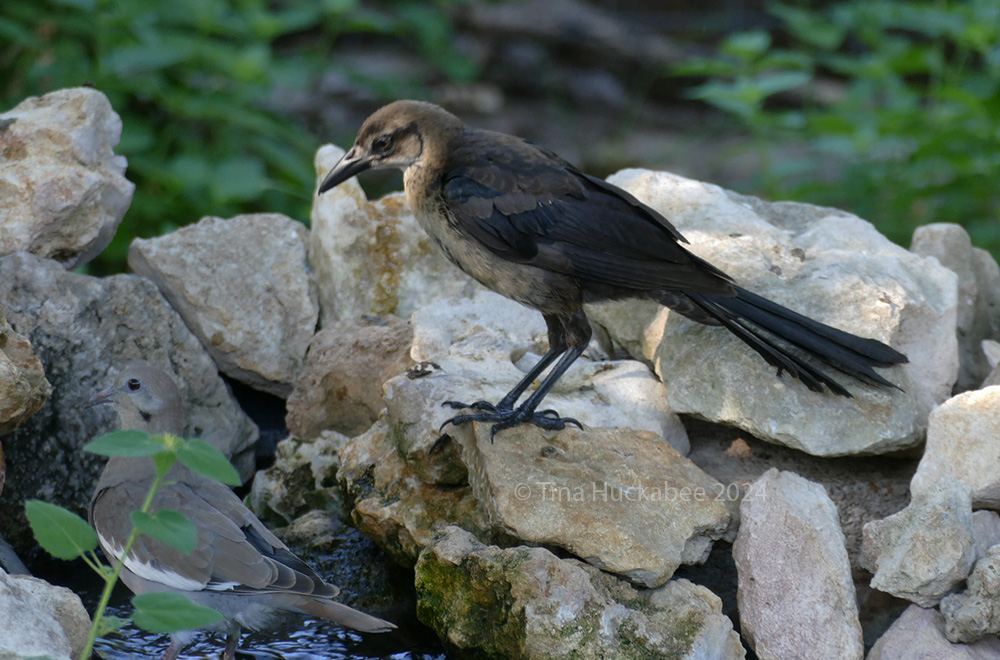
A nice rear view shows the tail feathers, which are beginning their turn to rich, luscious black that he will carry as an adult. Adult Boat-tailed Grackles are handsome birds, particularly the males with their long, dramatic tails, glossy in sunshine. Females are smaller and copper colored, though sweet-looking in their own way.

While perhaps not the prettiest bird in the back garden at the moment, this juvenile male does exhibit a kind of presence that foreshadows his adult self. Bright-eyed, strong of beak and profile, these birds are good-sized songbirds.
Along with bathing, he has eaten safflower and sunflower seeds on the ground. Grackles are also known for their preference for garbage, though currently, I’m not offering that delicacy for him.
It was interesting to see him hanging out, but I hope he finds his way back home to a mate and community. Fly to the coast Mr. Boat–where your birds are!
 My Gardener Says...
You really got some good pictures of him and I guess maybe he was tired if he was off course. I can’t identify the bird, but it seems more likely that I would see one being closer to the coast.
LikeLike
Thanks, Judy! He was quite a poser; he’d just perch there, ready for his photo-shoot. I tend to agree with you that he’s pretty far away from home and of course, I may have it all wrong–wouldn’t be the first time!
LikeLiked by 1 person
Might this be a vanguard of a species extending its range?
LikeLike
It’s possible, for sure. It’ll be interesting to keep tabs on him. I didn’t see him today, but I was busy with other things.
LikeLike
Great shots on this juvenile, Tina. Guess his parents decided to expand their range? 🙂
LikeLike
Maybe they’ve decided that they prefer the Texas Hill Country, rather than the Texas Coast. I know I do. 🙂
LikeLiked by 1 person
🙂
LikeLike
New yard birds are always exciting, especially when they stay a while and when they allow you get good photos, which is obviously the case with your Boat-tailed Grackle. Let’s hope he will find his way to where his family is hanging out.
LikeLike
He did spook once or twice, but he wasn’t nearly as flitty as many birds. He really did make himself at home, but I agree, I hope he finds his way back to his home(s).
LikeLiked by 1 person
Wow, it certainly is out of its range. How wonderful to see it, though. You did, indeed, get some great photos! Thanks for sharing the photos, the information, and your experience. 🙂
LikeLike
Thanks, Beth. He was a real surprise for me!
LikeLike
What fun! These birds are everywhere here, of course. They nest in palm trees at the marinas, and strut around the refuges like they own them. What you may not know is that they hang around water not only for drinking and bathing, but also for fishing. Every now and then I’ll see one fishing from dock lines at the marinas; they pluck up those tiny silver bait fish when they’re in season and gulp them right down.
I saw one fishing from a rock near a culvert at the Brazoria refuge on Sunday, and almost got a photo of it with a fish in its beak. Unfortunately, I was shooting from the car, and when I leaned over to get a better view from the passenger side, I spooked the bird and it flew — fish in beak. Now I really hate missing that shot. It would have been fun to share it with you. Anyway: that love of fishing just might have been one factor that tempted the bird to your pond!
LikeLiked by 1 person
Wow–so you agree that he’s a Boat-tailed Grackle? I’ve been doubting myself, but the photo on Cornell look just like my dude. Thanks for sharing your story about the grackle fishing. You might just be right, though I mostly saw him dipping his beak and fluttering his wings. I have goldfish and gobs of gambusia in the pond and those gambusia (not the brightest, I suspect…) always come up to the surface to see what happening. I wonder if Mr. Boat caught a couple?
I haven’t seen him today, or yesterday, so he might have moved on.
A lot of people don’t like grackles, I think because they’re noisy and so common (here it’s the Common and the Great-tailed), but I’ve always liked them. Full of personality and cheek, I fine them a fun bird to watch.
LikeLiked by 1 person
The more I looked at this one, the more I wondered. My own app says it’s Great-tailed, and it could well be a juvenile. I usually see adults, so I’m not accustomed to distinguishing juvenile Great-tailed and Boat-tailed. That said, it would be cool if it showed up again and did a little fishing at your pond!
LikeLiked by 1 person
Hmm, I was so sure it was a Great-tailed.
LikeLike