I was surprised to see this softball-sized swarm this chilly February 29th.

Bee Daddy and I checked our honeybees this past week for the first time since October and both were thriving. Bo-Peep and Woody (our hives) had brood frames that were packed with larvae and honey–which is exactly what we wanted to see. In fact, we took a brood frame from each (replacing with an empty brood frame) which will give them some space to re-comb and hoard more honey. I was particularly chuffed about the healthy state of both hives, as I’ve been concerned about our weaker hive, Woody.
I didn’t write much last year about the honeybees, but 2023 was a tricky bee keeping year for us. Both hives swarmed in late March–which is normal–but just afterward, Central Texas plunged back to “January” weather and it was wet and cold for a full week. For the next month or so, neither hive showed any larvae, which meant that there was no queen in either hive. We guessed that the virgin queens created by the hives perished during their respective mating flights during the inhospitable-to-honeybees weather of that first week in April.
We purchased two queens and re-queened in early May, hoping that would solve the issue. Bo-Peep responded well to her new queen and rallied. Woody continued to struggle; by late June, we realized that the “new” queen had probably died. We re-queened Woody again and the hive accepted the queen. She was a prolific egg producer; by October, Woody had mostly recovered and had honey and a decent, though small, population of bees. With the late start (mid-summer) of building a population of workers, Woody entered winter weakened and with minimal honey. During that last hive check, we added a couple of Bo-Peep’s honey frames to bolster Woody’s honey stores for the winter months.
This past week was quite warm and we popped in on the girls to say howdy and check their post-winter conditions. I was gobsmacked at how robust each hive was, both full of honey and larvae. Bo-Peep has so much honey that we added a second honey box and will take and process some frames in the near future.
Then, this weird little swarm shows up today. It’s located about 6 feet from the hives. In the photo, the swarm sits on a branch in the Texas Mountain Laurel, to the left and up from the taller hive (Bo-Peep).

Additionally, our very warm spell has ended and it’s back in the 40s and cloudy. This brush of winter won’t last; it’ll be mild again this weekend, but the swarm won’t move while it’s cold. This swarm is too small to survive on its own. Will it swoop back into the hive it most likely came from, or, will it set out for parts unknown and perish? I’ll keep an eye on this ball of bees, though it’s unlikely that I actually see the girls leave the limb.
Honeybees–they’re always doing something cheeky and unexpected, messing with our heads!
 My Gardener Says...
Good news that the hives overwintered well, and hope the mini-swarm sticks around. Is there a queen in the middle of the ball?
LikeLiked by 1 person
Yes, though I didn’t stick my finger in there to find her. :) The workers will surround the queen to keep her safe and, in this case, warm. My best guest is that they’ll trundle back to whichever hive they came from. That being said, it probably means there’s already swarming pheromones in the air and a real swarm in imminent.
LikeLiked by 1 person
How do you keep them around? Do you have to make another hive?
LikeLiked by 1 person
There are bee keepers who capture swarms and it’s not all that hard, depending on where the swarm is located. The bees will stay together in a clump and they’re at their most calm and docile when they swarm: they’ve engorged on honey, they’re hanging out with their beloved queen, and there are no larvae to protect. So swarms are easy to handle. They’ll all stay in a clump and can be placed in an appropriate box. Bee keepers will also often spritz them lightly with sugar water–bees love that!
As for this little group, I won’t do anything with them and I believe they’ll return to the hive once it’s warm again.
When a real swarm happens, it’s quite dramatic. They get really loud (buzzing) and swirl up in a cloud. They’ll usually settle in a nearby tree for a time, they move to where the scouts have found a place for them to settle.
I’d rather my bees not swarm, because I lose half of the colony, but it’s a natural process: birds do it, bees do it! Swarming is honeybee procreation and spring is the most common time for it to happen. Half the colony leaves for a new home with the old queen when the colony becomes too large. There are things beekeepers can do to lessen the probability of swarming, but truthfully once honeybees decide to swarm, there’s no real stopping them. Beekeeping is 2/3 science, 1/3 art–and it’s the art part that’s tricky!
LikeLiked by 1 person
It’s been interesting, listening to fishermen talk recently about the movements of fish in the bays and lakes in this up-and-down weather. It never had occurred to me that bees might get ‘caught’ by the same erratic temperature changes. I hope the swarm’s able to find shelter, whether in its original hive or elsewhere.
It’s great to hear that your hives are doing so well. Clearly, you’re good bee parents!
LikeLike
I have to assume they’re cold. But they’re good little bees; the queen is nice-n-cozy in the middle of the bee ball.
I mentioned to Eliza that I’m pretty sure this is a starter swarm; I’ll bet they’ll go back to where they’re from, but that there will be a real swarm with in a few days of that.
LikeLiked by 1 person
So — it’s like they send out scouts to look over the territory!
LikeLiked by 1 person
I’d noticed, as no doubt other readers had, the long absence in your posts of any talk about your bees. Now you’ve happily broken apiary silence, even to the point of using the Britishism chuffed.
The purchasing of queens that you mentioned might not be that different from what certain European royal families resorted to doing to keep their monarchies going.
LikeLike
My not writing about the bees is more about laziness, but still, I know readers enjoy learning about backyard beekeeping.
Also the Britishism gobsmacked!
LikeLike
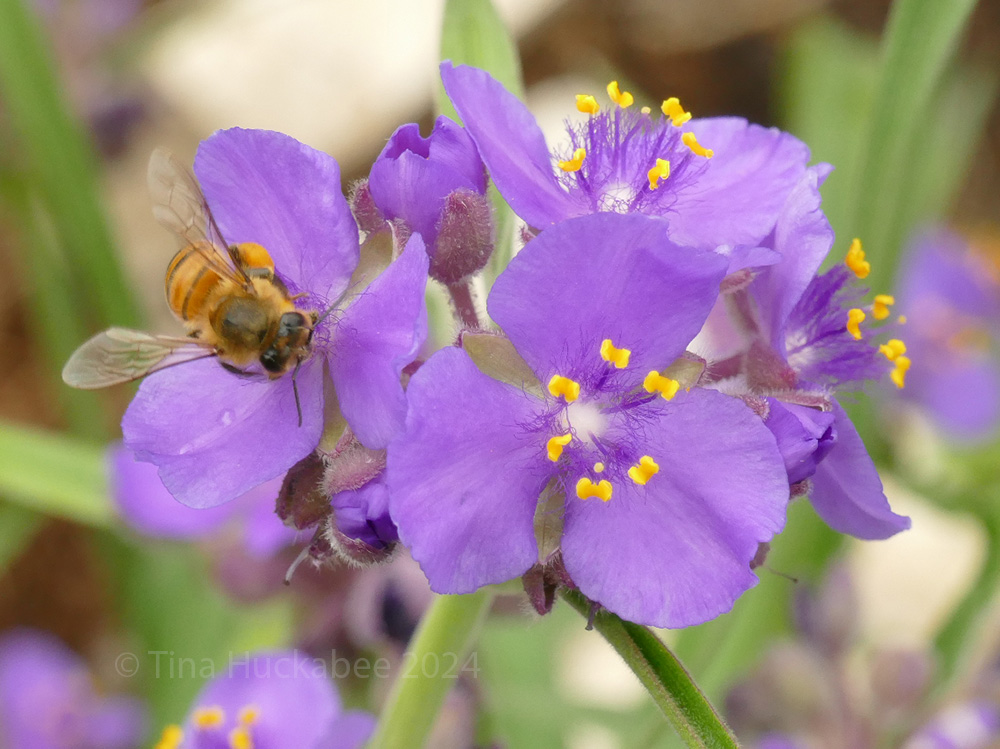
Very interesting post, thanks for sharing this info. And love the photo of that worker bee, baskets stuffed.
LikeLike
I just love to see the gals with stuffed pollen pantaloons. It’s also interesting to see the variety of colors of the pollen.
LikeLike
I also have been wondering how your bees your doing. I guess people are paying attention.
LikeLike
Thank you for sharing these interesting goings-on in your garden, Tina. Bees are such fascinating creatures. I’m glad your hives are doing well and I hope the swarm will survive the weather swings.
It’s nice to see that your spiderwort is in bloom.
LikeLike
You’re welcome, Tanja. Honeybees are certainly interesting critters to watch. We’ve learned a lot during our bee keeping adventure.
LikeLiked by 1 person
🐝🐝🐝
LikeLike