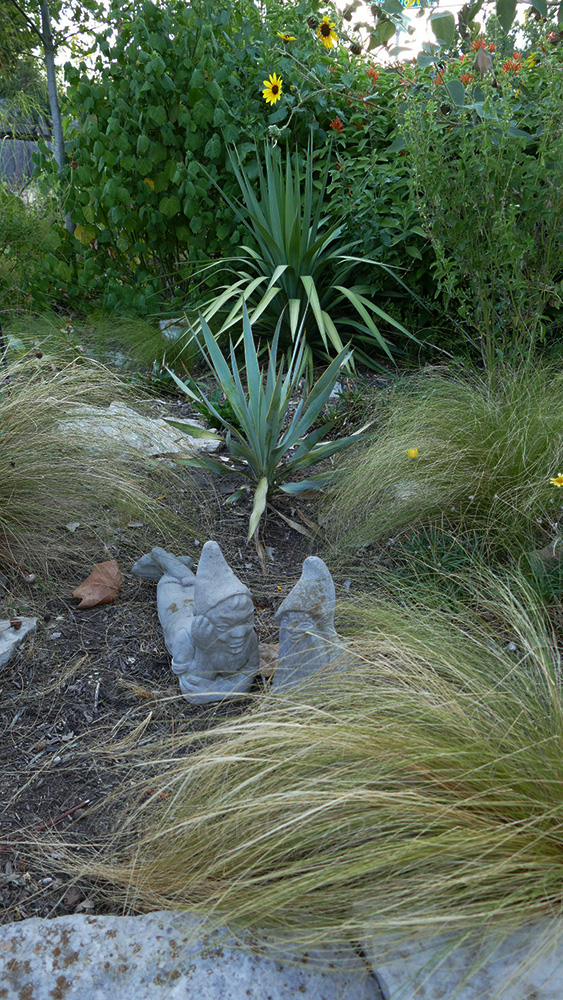
The garden gnomes aren’t happy. They’re weary of heat and bummed that so many plants are sunburned; they’re annoyed that crispy, baked leaves are drifting into the garden. They’re ready for some rain and cooler temperatures.

These gnomes were a Mother’s Day gift from my then three-year-old son, oh so many years ago. We picked a spot for the gnomes to occupy, to keep tabs on the goings-on of the garden. My son liked the two together, he said they were conversating. And so they have, through drought and flood, extreme heat and icy cold.
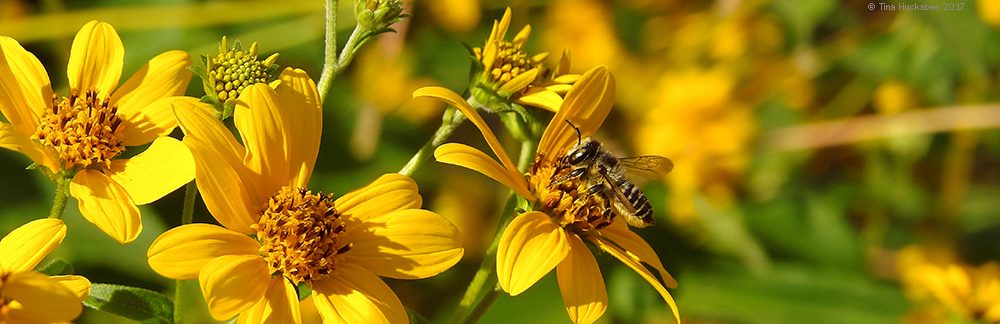
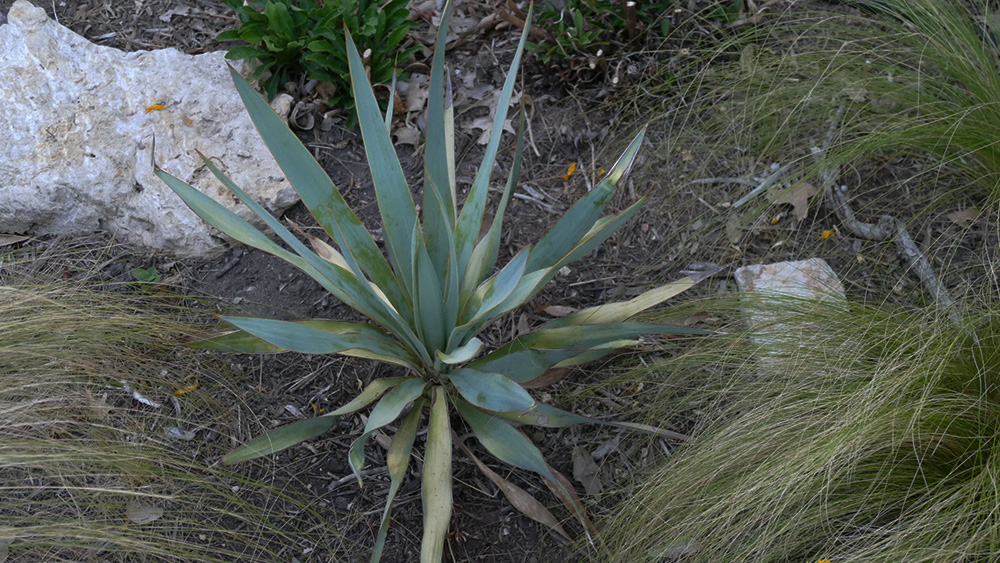
Some plants are sunburned. This currently discolored Pale-leaf Yucca, Yucca pallida, stalwart in its place, pointy leaves looking upward to the Texas sun, is stripped of some foliage color, burned to brown in other spots. But much of its foliage retains the lovely blue-green hue, and new foliage is emerging. The yucca survives.
Certainly, with this record shattering heat, there are plenty of crispy, crinkly leaves and droopy flowers. That being said, not all are fried by the heat and sun; many remain green, growing, and blooming.
Some, like these unknown variety of Crinum lilies, have not fared well in this hellish summer.

The gnomes and I have conversated about said plants, and believe, for the good of the garden and sanity of the gardener, that these need removing. Summer is always the time that the–ahem–gardener’s mistakes, become apparent. Even the gnomes, who don’t live anywhere near these sad lilies, agree that the lilies have to go. The gnomes and I will conversate, and decide on a more appropriate plant for the spot. You know, one that can take 35+ consecutive days over 100F and not a drop of water.


It has been a rough summer for you, sorry to see. Heat and drought are no fun. Preparing for more of the same in the future is wise. We’re all shifting with the climate. 😦
Love the your son’s word ‘conversating’ – so cute. 🙂
LikeLike
I’ve heard adults use the verb conversate.
LikeLike
Oh dear. Thanks for that link! Who knew! I’ll caution Aaron to not use it when he writes. Funny story: my son is a documentary film maker. He just finished his first film and it’s been out on the film festival circuit (it’s won some awards, btw, says proud mama). It’s a beautifully made production, but when he asked us to edit, I noticed that on the subtitles, he kept getting ‘it’s’ and ‘its’ mixed up. He knows better, but I had some fun harassing him. He did correct his mistakes. 🙂
LikeLike
It’s even made its way into some dictionaries. Check out this article:
https://www.merriam-webster.com/dictionary/conversate
LikeLiked by 1 person
Ugh, Eliza, it really has been a tough one. But you’re not wrong and it won’t be the last of the hot, hot, hot.
I’m pretty sure my 28 year-old doesn’t say conversating anymore–but I agree, it was a cute word from a cute little boy.
LikeLike
Hi,
I believe you are talking about removing the Crinum lilies near the Gnomes? This is such a beautiful plant from very early spring on. Yes, some of mine have leaves that are browning at the bottom. The leaves are so long always. I will take regular scissors and trim them several times in August. It is very hot these days in Mid South Carolina also. We had 102 yesterday{actual temp.).
I wanted to caution you about digging a crinum. You may or may not know how deep the roots of this plant grow. A friend of mine attempted to move a plant half the size of yours in late April. She had dug 6 inches out from existing green, and about 18 inches deep. It wasn’t deep enough! She actually cut through the root while removing the plant. She was so upset. At the end of the day, the plant was carefully bedded in its intended new home and the roots remaining in the original hole were covered and watered to make up for cutting them. She has seen some small hope that the remaining roots have survived and the plant in its new home produced flowers in late July.
My own oldest Crinum had 19 fully open blooms one day, and it kept approximately 15 bloom stalks on average ready to continue the beauty of it’s constant glorious blooms every day.
Regards,
Joan
LikeLike
I’ve moved crinums before and you’re correct: big, deeply held bulbs. I’ll probably wait until late fall/winter, presumably, it’ll be cooler by then. In fact, this clump (and an adjacent one, that I didn’t show) were moved from another part of my garden just a few years ago.
Mine have a gorgeous bloom, but it’s a stingy one and rarely happens. I have one group that blooms every summer and that’s about it. I’ve generally planted them for their foliage–I like the green straps–but we’re getting too hot and dry for them to grow well and they’re struggling.
LikeLike
So some leaves of your Yucca pallida are living up to the name of their species.
At the Arboretum this morning I noticed that some of their Turk’s cap plants were looking pretty beat, while others adjacent to them were holding up well. It may come down to the individual plants, whose genes may vary just enough to explain the difference in thriving. Or maybe one spot gets watered a little more than the other.
Tomorrow’s high is predicted to be 108°, but next Monday–Thursday there’s at least a 20% chance of rain. Let’s hope.
LikeLike
My Turk’s cap are about the same: those that get a little water are doing better and don’t look ragged. I am trying to water them some (even though they can survive without water) because I want them blooming for the hummingbirds, especially as they ramp up for migration.
Yes, I saw the 108 and said a bad word. Or two. I didn’t see the 20% chance of rain, something to look forward to. Maybe.
LikeLike
Texas can be brutal. I’ve been through a lot here in Texas and I’m thinking Yankee snow isn’t so bad.
LikeLike
That’s for sure! It wasn’t always this hot, but it’s the way of the future, I’m afraid. Plus, we’re having more difficult winters.
LikeLiked by 1 person
I think it must have been worse for you over these past weeks than it’s been down here at the coast. This summer hasn’t seemed nearly as bad as 2011, or a couple of summers before that. Even though our humidity can be gruesome, it does moderate the temperatures somewhat.
And last night, two big ol’ clouds formed over Clear Lake; there was some thunder, and one tiny portion of League City actually saw some rain for about a minute. It probably was only .001″, but it’s a start! Everyone’s hoping next week’s developing high stays far enough north to allow some tropical moisture to creep in. That would be something worth conversating over!
LikeLiked by 1 person
Here’s an example of what I was saying about the humidity. Right now, the humidity’s 21% at Houston Hobby, and 65% here. They said the front probably wouldn’t be able to push through to the coast, and they were right!
LikeLike
It’s been pretty bad here in central Texas and of course, here in Austin, the heat island effect. Pretty low humidity for Houston!
LikeLiked by 1 person
It’s interesting how things reverse in winter, too. When Judy is frosted up or frozen, we’re often well above freezing. The water can make quite a difference.
LikeLike
I just looked at your forecast for the coming days. Yikes! There’s hot, and then there’s that. My best to you and your garden!
LikeLiked by 1 person
Ouch! but do some types of Crinum do that anyway? Ours can get roasted without such harsh weather. I just figured that was their normal behavior.
LikeLike
Yeah, you’re right, they do tend to crinkle, especially at the tips. But these just look so sad and I have better choices for that spot. So, change is afoot–as soon as we cool off, whenever that is!
LikeLiked by 1 person
It’s hard to believe that any plant would survive 35+ days of 100+ degree weather without rain. Luckily, when there is a well-established plant community, such as your garden, that gets occasional help in the form of a life-sustaining drink from a thoughtful gardener, some plants can hang on. Sorry your lilies didn’t.
I would love conversating with your garden gnomes. As a child, I spent hours with their relatives in intimate conversation.😊
LikeLike
So far, I haven’t actually lost anything, but there are a few plants that are near the end, I’m afraid. Those are mostly new plants, so not really a surprise. The lilies are alive, they just look very bad and I think there are better choices (and native, pollinator plants!) for the spots where the lilies look like death.
The gnomes are good conversationalists. 🙂
LikeLiked by 1 person
That you haven’t actually lost any plants is astounding. I keep hoping for your heat to abate and the rains to arrive. 🌧🌧🌧
LikeLike
A few are on the edge, though. I’m hoping they’ll spring back once the heat abates and some rain happens. If not, some of the plants may be done.
LikeLike
Enjoyed your gnomes article. Made me laugh. I live in NW Austin we are melting. Farmers Almanac says we’re going to have another harsh winter. I had planned to add more shade trees this Oct to help with the heat, but now afraid they won’t have time before our winter to survive our winter. Your thoughts please?
LikeLike
Hi Cindy! Go ahead an plant trees, just make sure they’re native, appropriate for your spot and accept that you might have to do some major babying if we do get another weird and very cold spell. Over time, your trees will benefit…everything!
LikeLike
Your extended 100+ temps are hard to imagine. We’ve had a lot of 90+ temps this summer, but not all summer. Drought on top of it is rough! We’re finally making it out of drought…just in time for another extended hot, dry stretch. Hang in there! Your plants look amazing, considering the heat and drought!
LikeLike
I’m really tired of it. The garden has fared well, but it’s also really tired. We seem to have another hot week ahead, maybe after that some rain will come and the temps will drop. Glad you’ve gotten out of your summer drought and I hope your fall is lovely!
LikeLike
Yeah, it’s bad here in Texas.Since we have mostly natives, survival rate is not too bad. But, everything looks terrible. My main concern is having enough blooming plants for the fall monarch migration – goldenrod and Maxmillian sunflowers. There will be about 60% less than average.
LikeLike
Bad, bad, bad! Like you my natives are surviving–they don’t all look great, but they’ll live. And I’m also concerned about migratory season. I’m starting to water more so that the Turk’s cap and other fall bloomers are in a decent flowering cycle for the birds, butterflies, etc. I guess that’s all we can do.
LikeLike
That weather must even be tough on cacti…and garden gnomes. Hope relief is on the way.
LikeLike